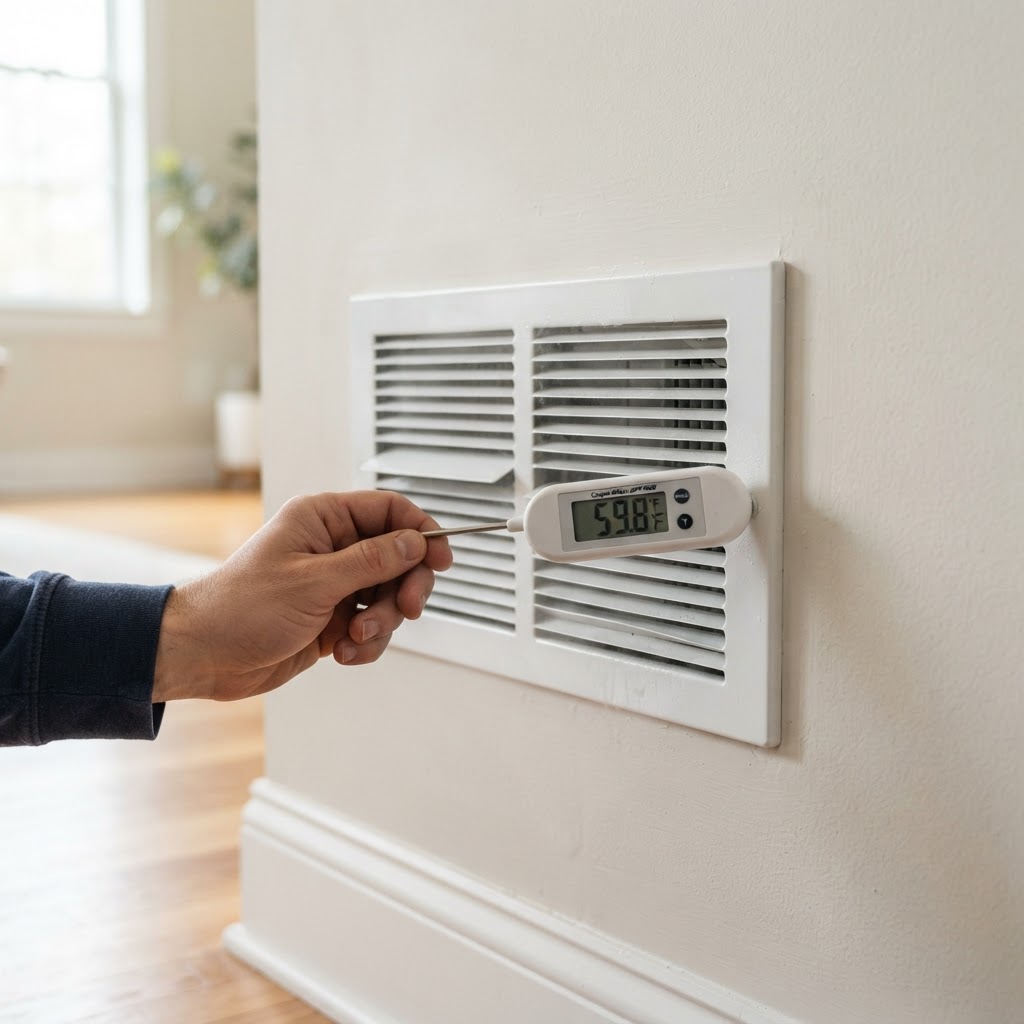
One of the most common questions we get from Arizona homeowners is how cold the air coming out of the supply register should actually feel. It is a smart question, because the temperature difference between the air entering and leaving your system is one of the fastest ways to tell whether your air conditioner is running properly. If you have ever wondered what temperature your AC should blow out of the vent, the short answer is that supply air typically runs 14 to 22 degrees cooler than your return air under normal conditions. In this guide we break down the numbers, how to measure them, and when a reading outside that range points to a problem.
What Is the Ideal AC Vent Temperature in Arizona Homes?
The accepted industry benchmark for a healthy residential air conditioning system is a 14 to 22 degree temperature drop across the indoor coil. If the air returning to your system measures 80 degrees, the air leaving the supply vents should fall somewhere between 58 and 66 degrees. That is the ideal AC vent temperature range for most Arizona homes during summer operation. Readings inside that band tell you the refrigerant circuit, airflow, and coil condition are all working together as intended.
It is normal for the measured drop to shift a few degrees depending on outdoor temperature, indoor humidity, and how long the system has been running. The key is that the number stays relatively stable after the first ten minutes of operation. If your supply air is only 5 to 8 degrees cooler than your return, something is restricting performance and deserves a closer look.
How to Measure Your AC Vent Temperature the Right Way
Testing the vent temperature is a simple DIY check any homeowner can perform with a basic digital probe thermometer. Let the system run continuously for at least ten minutes so the coil and ductwork reach steady state. Then follow these steps:
- Place a thermometer in a return grille and wait until the reading stabilizes. Write that number down as your return temperature.
- Move the thermometer to a supply register that is close to the indoor unit and let it sit until the reading holds steady. This is your supply temperature.
- Subtract the supply reading from the return reading. The difference is your temperature drop across the coil.
Avoid measuring at a register directly above the furnace or air handler, since that supply run is shortest and may read slightly warmer. For the most accurate AC vent temperature, choose a register in a frequently used room and keep the probe centered in the airflow. Repeat the check on a hot afternoon when the system is under real load.
What Does It Mean If My AC Is Only Blowing 60-Degree Air?
If your return air is 85 degrees and your supply air is only 60 degrees, that 25-degree drop is actually on the high end and may indicate a low airflow problem. A system that moves too little air across the coil will chill a smaller volume more aggressively, producing very cold supply air but cooling the house poorly overall. You might notice cold spots near vents while the rest of the room stays warm. Common causes include a dirty filter, a clogged indoor coil, undersized or restricted ductwork, or a blower motor running on the wrong speed tap.
On the other hand, if your supply air measures only 5 to 8 degrees below your return, the system is not removing enough heat. That points to low refrigerant charge from a leak, a failing compressor, a restricted outdoor coil, or an issue with the metering device. Either way, a reading outside the 14 to 22 degree range is worth investigating before a small problem becomes a no-cool emergency in the middle of an Arizona heat wave.
Factors That Change Your AC Vent Temperature Reading
Several variables can shift your measurement without meaning your system is broken. Understanding them helps you interpret the numbers correctly.
- Outdoor temperature: On a 115-degree day, your system works harder and the measured drop may sit closer to the lower end of the range because the outdoor unit struggles to reject heat.
- Indoor humidity: A system spends part of its capacity removing moisture. On a humid monsoon day, more energy goes to dehumidification and less to sensible cooling, which can lower the measured temperature drop.
- Duct length and insulation: Long, poorly insulated attic runs can warm supply air several degrees before it reaches the register, especially in a 160-degree attic.
- Run time: Take measurements after at least ten minutes of continuous operation. Short-cycling systems never reach steady state and will give misleading readings.
When to Call a Professional About Your AC Vent Temperature
If your temperature drop consistently falls outside the 14 to 22 degree range, or if the air from your vents simply feels lukewarm, it is time to call a licensed HVAC technician. A reading that is too low often means a refrigerant leak, a dirty condenser coil, or a compressor losing capacity. A reading that is too high usually points to an airflow restriction that can freeze the indoor coil and eventually damage the compressor. Both conditions waste energy and shorten equipment life if left unaddressed.
A professional will measure the actual refrigerant pressures, verify the metering device, inspect the coils, and check the blower performance against the equipment specifications. That level of diagnosis cannot be done with a household thermometer alone, but your vent temperature check gives you a reliable early warning sign.
Conclusion
Knowing what temperature your AC should blow out of the vent gives you a practical way to monitor system health all summer long. Aim for a 14 to 22 degree drop between your return and supply air, measure after ten minutes of run time, and treat readings well outside that range as a reason to call a pro. A simple thermometer check can catch a failing capacitor, a low refrigerant charge, or a restricted coil long before your home goes warm.
Brewer's Air Conditioning & Heating helps Arizona homeowners keep their systems running in the correct range with thorough diagnostics and clear communication. Our certified technicians measure airflow, refrigerant charge, electrical components, and coil condition, then share the readings so you know exactly where your system stands. We stock common parts to finish repairs on the first visit whenever possible. Call Brewer's Air Conditioning and Heating for service you can count on every season.
About the Author
Mark Ybarra
Mark Ybarra is the owner and leader of Brewer's Air Conditioning & Heating, a trusted HVAC company serving Tempe, Phoenix, Scottsdale, Mesa, and surrounding Arizona communities since 1982. After working in multiple roles within the company, Mark officially took ownership in 2018 and continues to uphold Brewer's long-standing commitment to integrity, exceptional service, and customer satisfaction.
Need HVAC Help?
Serving Phoenix, Tempe, Scottsdale, Mesa & surrounding areas since 1982.