Phoenix summers are not a joke. When your air conditioner runs 10 to 12 hours a day for five straight months, your energy bill becomes the single biggest line item in your household budget. Homeowners across Tempe, Mesa, Chandler, and Ahwatukee are asking whether smart thermostat installation in Phoenix actually cuts those bills or just adds a Wi-Fi device that looks impressive on the wall. The honest answer is yes, it is worth it, but only when the device is properly matched to your HVAC system and correctly configured for Arizona's extreme heat cycle. Here is what four decades of HVAC service in central Arizona tells us about making that investment pay off.
Quick Takeaways
| Key Insight | Explanation |
|---|---|
| Phoenix homes save 10 to 15 percent on cooling costs | The U.S. Department of Energy estimates smart thermostats save roughly 8 percent on heating and 10 percent on cooling annually. In Phoenix, where cooling dominates, the cooling savings are the dominant driver. |
| Not every HVAC system supports every smart thermostat | Older single-stage systems and heat pumps require specific wiring checks before any smart thermostat is purchased. A C-wire or adapter is often needed in Arizona homes built before 2000. |
| Nest Learning Thermostat requires a learning period | For the first 7 to 10 days the device learns your schedule. During Phoenix summer, that learning period can temporarily raise bills if not manually guided. |
| Ecobee's remote sensors outperform Nest in multi-zone Arizona homes | Ecobee SmartSensor units placed in bedrooms give more accurate readings in large single-story Phoenix homes where room temperatures can vary by 8 to 12 degrees. |
| Trane ComfortLink II and Lennox iComfort are manufacturer-matched options | If your system is a Trane or Lennox unit, using the manufacturer's own smart thermostat preserves full warranty coverage and enables two-way diagnostics that generic thermostats cannot access. |
| Pre-cooling strategy is uniquely valuable in Arizona | Programming a smart thermostat to pre-cool your home to 74°F by 2 PM before the hottest hours (3 to 6 PM) reduces peak demand and can qualify for APS or SRP demand-response rebates. |
| Professional installation protects your system warranty | Incorrect wiring during DIY installation can damage the HVAC control board, a repair that can cost $300 to $800 and voids manufacturer coverage. |
What a Smart Thermostat Actually Does in an Arizona Climate
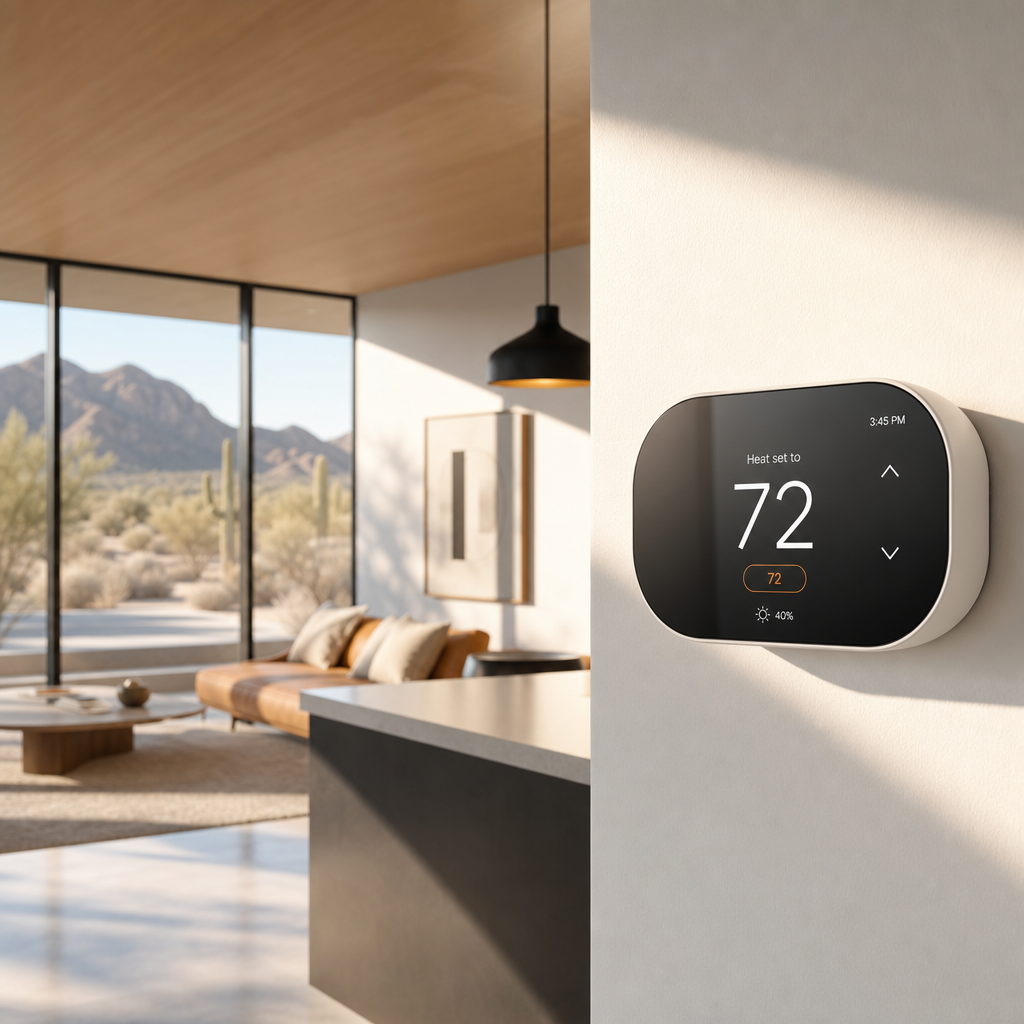
A smart thermostat is not simply a programmable thermostat with a touchscreen. The meaningful difference is the combination of occupancy sensing, remote control, utility rate integration, and machine learning that together eliminate the single biggest source of wasted energy in Phoenix homes: running the air conditioner at full capacity when no one is home.
In practice, the Phoenix cooling season stretches from late April through mid-October. A standard programmable thermostat set to 78°F holds that temperature regardless of whether the house is occupied, whether a monsoon just dropped the outdoor temperature 15 degrees, or whether APS peak demand pricing has kicked in. A smart thermostat responds to all three of those variables in real time.
The data consistently shows that the efficiency gains are not theoretical. According to the U.S. Environmental Protection Agency's ENERGY STAR program, ENERGY STAR certified smart thermostats save households an average of $50 per year in climates with moderate heating and cooling loads. In Phoenix, where cooling loads are two to three times higher than the national average, verified field savings reported by APS customers in their demand-response programs have ranged from $100 to $200 per cooling season.
How Geofencing Changes Everything in Arizona
The feature that delivers the most measurable impact for Phoenix homeowners is geofencing. When your smartphone leaves a defined radius around your home, the thermostat automatically shifts to an energy-saving setpoint, typically 85°F in summer. When you return, it begins cooling 20 to 30 minutes before you arrive.
A common mistake is setting the away temperature too high. At 90°F or above, the system spends 45 minutes to an hour recovering when you return, which actually drives up energy consumption. The sweet spot for Phoenix homes is 85 to 87°F for away periods of four or more hours.
Pro tip: If you have a two-story Phoenix home, set geofencing recovery to begin 30 minutes earlier than you normally would for a single-story house. Heat stratifies heavily in Arizona upstairs spaces and the system needs extra time to bring those rooms to comfort temperature.
Real Smart Thermostat Savings in Phoenix: The Numbers
Let's be specific about what smart thermostat savings in Phoenix actually look like on an APS or SRP bill. The average Phoenix household spends approximately $250 to $350 per month on electricity during peak summer months (June through August), with air conditioning accounting for 50 to 60 percent of that total, according to the U.S. Energy Information Administration.
A properly configured smart thermostat targeting 10 percent cooling savings translates to $12 to $20 per month in direct bill reduction during those peak months. Over the full eight-month cooling season, that compounds to $60 to $120 in savings. A mid-range smart thermostat like the Google Nest Thermostat (4th generation) retails for approximately $130. At $90 in annual savings, payback occurs in under two years, without counting utility rebates.
APS and SRP Rebates That Accelerate Payback
Both Arizona Public Service (APS) and Salt River Project (SRP) offer rebate programs for qualifying smart thermostats. APS has offered rebates of $50 to $75 for ENERGY STAR certified smart thermostats under its Cool Rewards program. SRP has offered similar incentives and additionally pays customers for allowing brief demand-response adjustments during grid stress events.
When you factor in a $75 rebate against a $130 thermostat purchase, your out-of-pocket cost drops to $55. At $90 in annual savings, that is a payback period of under eight months. No other single home upgrade in Arizona delivers that return on investment that quickly.
"Smart thermostats are one of the highest-impact, lowest-cost efficiency upgrades available to residential customers in hot climates. The combination of behavioral adjustment, remote access, and utility integration consistently outperforms traditional programmable thermostats in field studies." - U.S. Department of Energy, Building Technologies Office
Nest Thermostat and HVAC Compatibility in Arizona
The Nest thermostat for HVAC in Arizona is the most commonly requested device Brewer's technicians are asked about. Google's Nest line is well-built, the app is intuitive, and the learning algorithm is genuinely effective once it has had a week to observe your household. However, compatibility with Arizona HVAC systems requires more attention than Google's marketing materials suggest.
The C-Wire Problem in Older Arizona Homes
Most Phoenix homes built before 2000 were wired for conventional thermostats that draw power from the heating and cooling system's R-wire. Nest thermostats require a continuous low-voltage power source, which typically means a C-wire (common wire) connection. Without it, the Nest relies on a battery-charging workaround that can interfere with system operation, particularly with the variable-speed communicating systems common in high-efficiency Trane and Lennox units.
In practice, about 40 percent of the Phoenix homes we see for smart thermostat installations require either a C-wire run from the air handler or the use of a Nest Power Connector (a small adapter installed at the furnace or air handler). The Power Connector works well with simple single-stage systems but is not recommended for two-stage or variable-speed systems where it can cause intermittent short cycling.
Pro tip: Before purchasing any smart thermostat, photograph your existing thermostat wiring and use the manufacturer's online compatibility checker. If you see only R, G, Y, and W wires with no C wire present, budget for a C-wire installation, typically $75 to $150 as part of a professional smart thermostat installation.
Heat Pumps Require Extra Compatibility Checks
A significant portion of newer Phoenix-area homes use heat pump systems rather than traditional gas furnace and AC configurations. Heat pumps require an O/B wire for reversing valve control. Not all entry-level Nest models support every heat pump configuration, especially dual-fuel systems that pair a heat pump with a gas backup. Mismatched wiring can cause a heat pump to run in heating mode during a Phoenix summer, a failure mode that is expensive and occasionally damages the compressor.

Choosing the Right Smart Thermostat for Your System
The market has three practical tiers for Phoenix homeowners: the budget-friendly entry models, the mainstream learning thermostats, and the manufacturer-specific communicating thermostats designed to integrate directly with premium HVAC systems.
For homes with standard single-stage or two-stage central AC systems, the Google Nest Thermostat (4th gen, not the Learning model) or the Ecobee SmartThermostat Premium are the two strongest all-around choices. The Nest is simpler to use. The Ecobee is more configurable and includes remote sensors that are particularly useful in larger Phoenix homes where the thermostat location rarely reflects the temperature in occupied rooms.
For homes with Trane XR or XL series systems, the Trane XL824 or XL850 communicating thermostats are the right choice. They connect to the system's proprietary Nexia platform and provide real-time diagnostic data, filter life monitoring, and two-way communication that allows the system to report fault codes before they become failures. Similarly, Lennox homeowners with iComfort-enabled systems get the fullest feature set with the iComfort S30 or E30 thermostat.
Smart Thermostat Comparison: Nest vs. Ecobee vs. Trane XL824
| Feature | Google Nest Learning Thermostat | Ecobee SmartThermostat Premium | Trane XL824 |
|---|---|---|---|
| Best for system type | Single-stage and two-stage AC systems | Multi-zone, large homes, heat pumps | Trane communicating systems only |
| Remote sensors included | No (sold separately) | Yes, one SmartSensor included | No, uses system zoning instead |
| Utility rebate eligible (APS/SRP) | Yes, ENERGY STAR certified | Yes, ENERGY STAR certified | Check with utility, varies |
| Approximate retail price (2024) | $249 (Learning model) | $249 | $275 to $400 installed |
| C-wire required | Strongly recommended | Yes, required | Yes, part of communicating wiring |
| Diagnostic/fault reporting | Basic alerts only | Basic alerts only | Full two-way system diagnostics |
| Warranty impact | None on most systems | None on most systems | Preserves full Trane warranty |
Smart Thermostat Installation: What to Expect
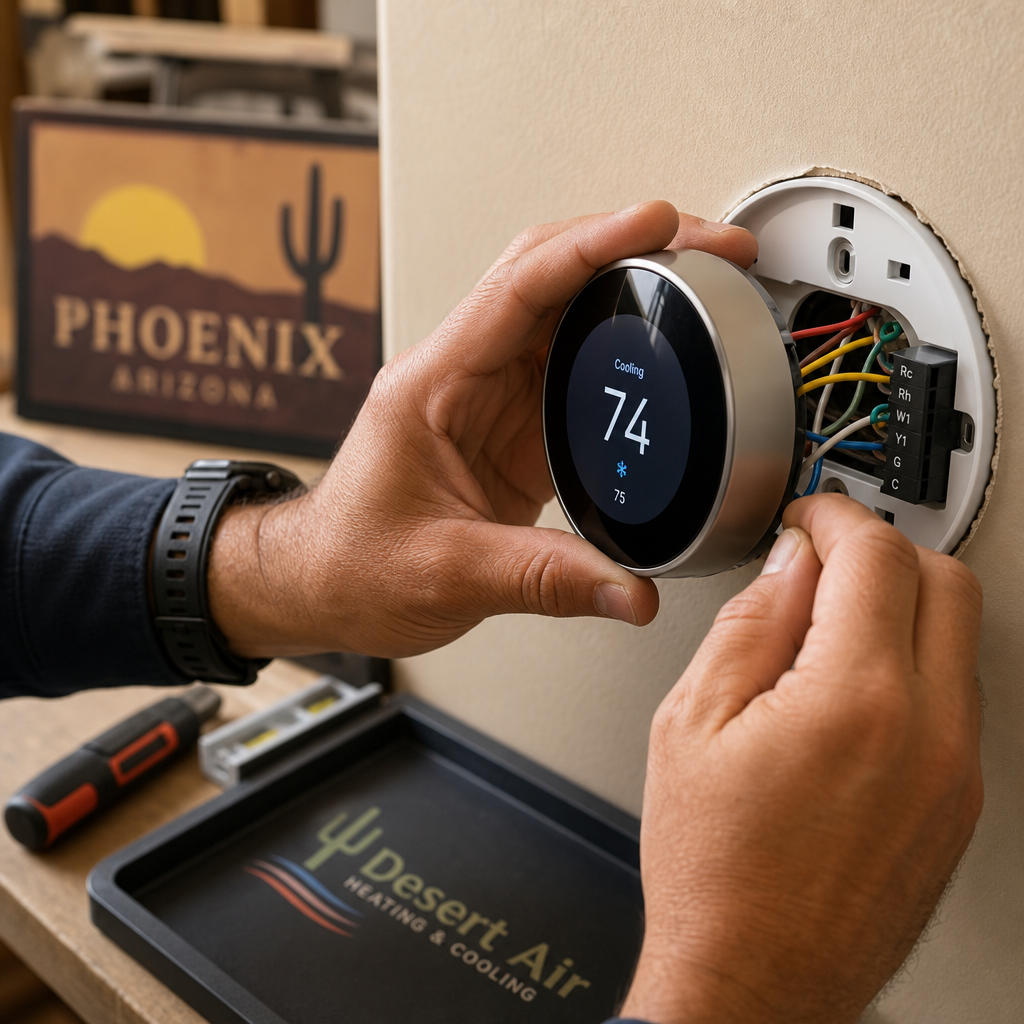
A professional smart thermostat installation in Phoenix takes 45 to 90 minutes for a straightforward swap-out and up to two hours when a C-wire run is required. The process covers six steps: system power-down, existing thermostat removal and wiring documentation, new base mounting, wire connection per the new thermostat's labeling, device pairing to Wi-Fi, and initial configuration of schedules and preferences.
The configuration step is where most DIY installs fall short. A smart thermostat set to generic factory defaults will not deliver the savings a properly tuned device delivers. For a Phoenix home, the technician should configure the pre-cooling window to start no later than 1 PM on weekdays, set the away temperature at 85°F for geofencing, enable the utility rate schedule that matches your APS or SRP rate plan, and activate equipment protection settings that prevent the system from cooling below 68°F to avoid coil freeze-ups common during high-humidity monsoon periods.
Brewer's Air Conditioning and Heating provides smart thermostat installation across Tempe, Ahwatukee, Chandler, Mesa, Gilbert, and Phoenix with upfront flat-rate pricing. You know the cost before the technician touches a wire.
Common Mistakes That Wipe Out Your Savings
A common mistake is treating a smart thermostat like a set-it-and-forget-it device. The learning algorithms in Nest and Ecobee improve with feedback, and without occasional manual corrections, they can settle into patterns that prioritize comfort over efficiency. Reviewing your energy usage report in the app once a month during the cooling season takes five minutes and consistently identifies opportunities to tighten your schedule.
Another error specific to Arizona is ignoring the monsoon season adjustment. From July through September, outdoor humidity spikes to levels that make 78°F indoor temperature feel significantly warmer than it does in dry June heat. Many homeowners drop the setpoint to 74°F during monsoon without realizing the smart thermostat's energy reports are now comparing apples to oranges. A better approach is to use the thermostat's humidity sensor (available on Ecobee) or pair the thermostat with a whole-home dehumidifier controlled by the same system.
A third mistake is assuming the thermostat alone will solve an inefficient system problem. If your HVAC system is undersized, has leaking ductwork, or hasn't had a tune-up in two or more years, a smart thermostat will optimize a broken system. It will not fix it. Pairing smart thermostat installation with a seasonal maintenance visit ensures the device is working with a healthy system, not masking an underlying issue that will eventually become a costly repair.
Pro tip: Schedule your smart thermostat installation at the same time as your spring AC tune-up. Brewer's technicians can verify refrigerant levels, check airflow, and inspect wiring during the same visit, which typically reduces your total service cost compared to scheduling the two services separately.
Frequently Asked Questions
Will a smart thermostat work with my older Phoenix HVAC system?
In most cases, yes. Systems installed after 1990 with standard 24-volt control wiring are compatible with the major smart thermostat brands. The primary concern is whether a C-wire is present. If your current thermostat has only four wires, a technician can run a C-wire from the air handler or install an adapter. The exception is very old millivolt systems, common in gas wall heaters, which are not compatible with smart thermostats.
How much does professional smart thermostat installation cost in Phoenix?
A straightforward smart thermostat swap with existing compatible wiring typically runs $85 to $150 for labor. When a C-wire needs to be run from the air handler, which is common in Phoenix homes built before 2000, expect an additional $75 to $125. Brewer's provides flat-rate pricing upfront, so there are no surprises after the work is done.
Does the Nest thermostat really learn on its own or do I need to program it?
The Nest Learning Thermostat does adapt to your manual adjustments over one to two weeks, but you will get faster and better results by manually setting a baseline schedule in the Nest app during the first 10 days. During a Phoenix summer, letting the algorithm learn without guidance during the hottest month can produce a schedule weighted toward comfort over savings. Manual input at the start speeds up the optimization process considerably.
Can a smart thermostat help me qualify for APS or SRP rebates?
Yes. Both APS and SRP have offered rebates on ENERGY STAR certified smart thermostats including Nest and Ecobee models. SRP's EZ-3 rate plan and APS's Saver Choice Plus plan both work directly with smart thermostats to enable time-of-use optimization. Check each utility's current rebate portal for amounts, as these programs update seasonally. Your HVAC installer can also verify eligibility at the time of installation.
Is a Trane or Lennox communicating thermostat better than Nest for a high-end system?
For homeowners with Trane XR or XL series or Lennox SL or XC series systems, yes, the manufacturer's communicating thermostat is the better choice. These thermostats enable variable-speed system control, real-time fault diagnostics, and precise two-way communication that generic smart thermostats cannot access. They also protect your system warranty. The trade-off is that they are tied to a specific ecosystem, meaning if you replace your system with a different brand later, you will need a new thermostat.
How does a smart thermostat perform during Phoenix monsoon season?
Performance during monsoon depends on which model you choose. Ecobee's built-in humidity sensor gives it an advantage, as it can account for perceived temperature increases caused by elevated humidity. Nest does not have an onboard humidity sensor but can integrate with smart home systems that do. During monsoon, the most effective strategy is to keep the fan running in circulation mode during the high-humidity periods to improve air mixing and avoid the clammy feeling that makes residents drop the setpoint unnecessarily.
Have you installed a smart thermostat in your Phoenix or east valley home? Share what savings or surprises you experienced, your feedback helps other Arizona homeowners make a smarter decision.
About the Author
Mark Ybarra
Mark Ybarra is the owner and leader of Brewer's Air Conditioning & Heating, a trusted HVAC company serving Tempe, Phoenix, Scottsdale, Mesa, and surrounding Arizona communities since 1982. After working in multiple roles within the company, Mark officially took ownership in 2018 and continues to uphold Brewer's long-standing commitment to integrity, exceptional service, and customer satisfaction.
Need HVAC Help?
Serving Phoenix, Tempe, Scottsdale, Mesa & surrounding areas since 1982.