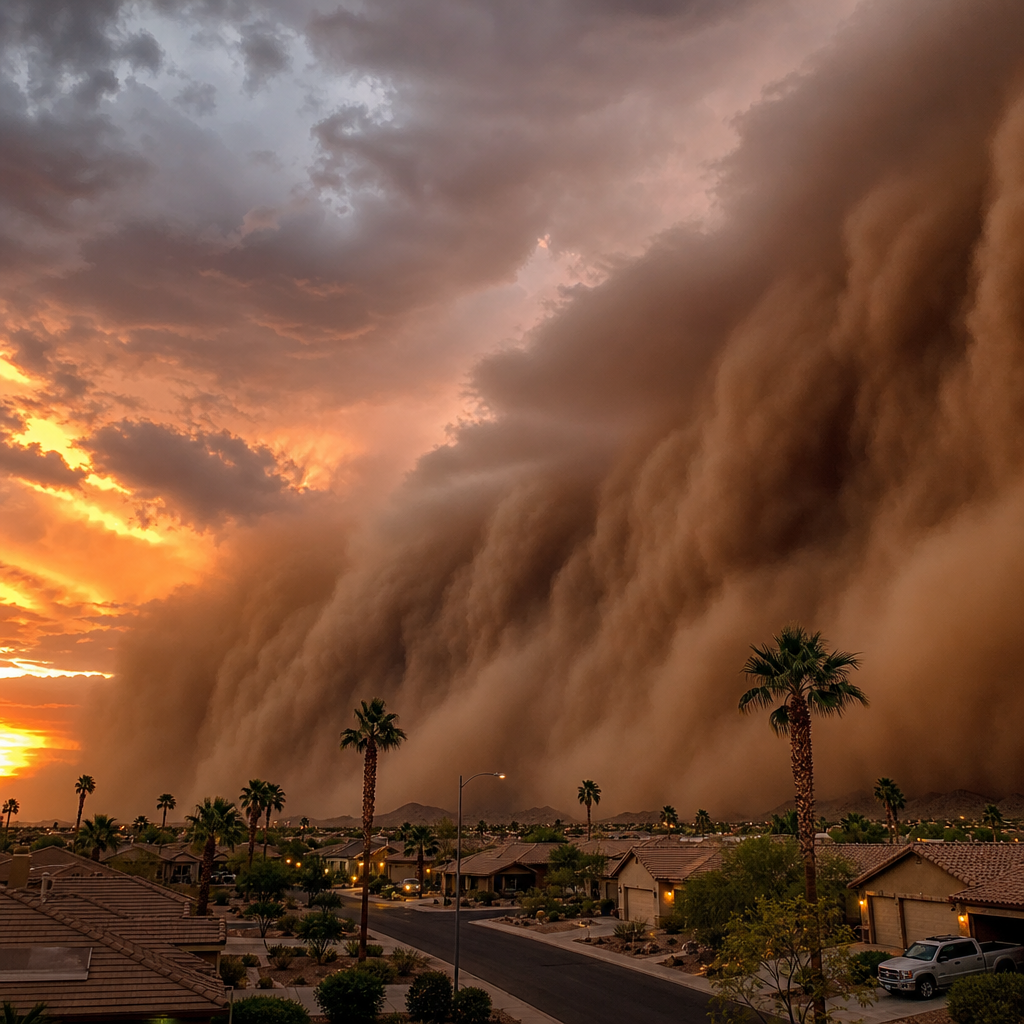
Phoenix monsoon season runs from June 15 through September 30, and it does more damage to residential AC systems than most homeowners realize. Dust storms carrying particles as fine as 10 microns clog condenser coils, lightning surges fry compressor capacitors, and flooding around outdoor units accelerates corrosion on refrigerant lines. Monsoon AC protection in Arizona is not optional maintenance you schedule when convenient. It is a hard deadline with real consequences. Miss it, and you risk a compressor failure during the exact stretch of summer when Brewer's AC and every other HVAC company in the valley is fully booked with emergency calls.
Quick Takeaways
| Key Insight | Explanation |
|---|---|
| Schedule pre-monsoon service before June 15 | Technician availability drops sharply once monsoon storms start. Booking in May or early June guarantees you get on the calendar before emergency call volume spikes. |
| Condenser coil cleaning is non-negotiable | Dust-clogged coils force the compressor to run longer and hotter, cutting efficiency by up to 30% and shortening compressor life by years. |
| Whole-home surge protectors outperform outlet strips | A quality whole-home surge protector rated for HVAC equipment absorbs lightning-induced voltage spikes before they reach the capacitor and control board. |
| Clear debris from the 2-foot clearance zone around the condenser | Haboob winds turn gravel, palm fronds, and patio furniture into projectiles. Keeping the perimeter clear prevents fin damage and airflow restriction. |
| Change air filters immediately after major dust storms | A single haboob can load a 30-day filter to near-full capacity. Running on a choked filter stresses the blower motor and reduces cooling performance immediately. |
| Check the condensate drain line before monsoon humidity arrives | Arizona AC systems rarely deal with high humidity, so drain lines often go ignored. Monsoon moisture can overwhelm a partially blocked line and cause water damage inside the home. |
| Document your system before storm season | Photograph refrigerant line connections, serial numbers, and electrical connections now. Insurance claims and warranty service go faster when you have pre-damage documentation. |
Why Monsoons Are Uniquely Hard on Arizona AC Systems
Arizona monsoons combine three threats that do not typically occur together anywhere else in the country: extreme particulate dust, sudden electrical storms, and rapid humidity spikes layered on top of already punishing 110-degree heat. Your AC system is working at or near maximum capacity before the first storm even develops on radar. That means any additional stress, whether from clogged coils or a damaged capacitor, pushes the system past its design limits.
The Arizona Department of Environmental Quality has recorded PM10 particle concentrations exceeding 2,000 micrograms per cubic meter during major haboob events, compared to the federal standard of 150 micrograms. That level of airborne particulate is not just an air quality problem. It is a direct mechanical threat to any equipment with exposed coils and moving parts sitting outdoors.
In practice, the calls Brewer's receives in the first 48 hours after a major dust storm fall into three categories: refrigerant leaks caused by debris impact on copper lines, capacitor failures triggered by voltage spikes during lightning, and blower motor failures caused by dust-choked filters running the motor at elevated current. All three are largely preventable with proper preparation done before June 15.
Pre-Monsoon Inspection Checklist
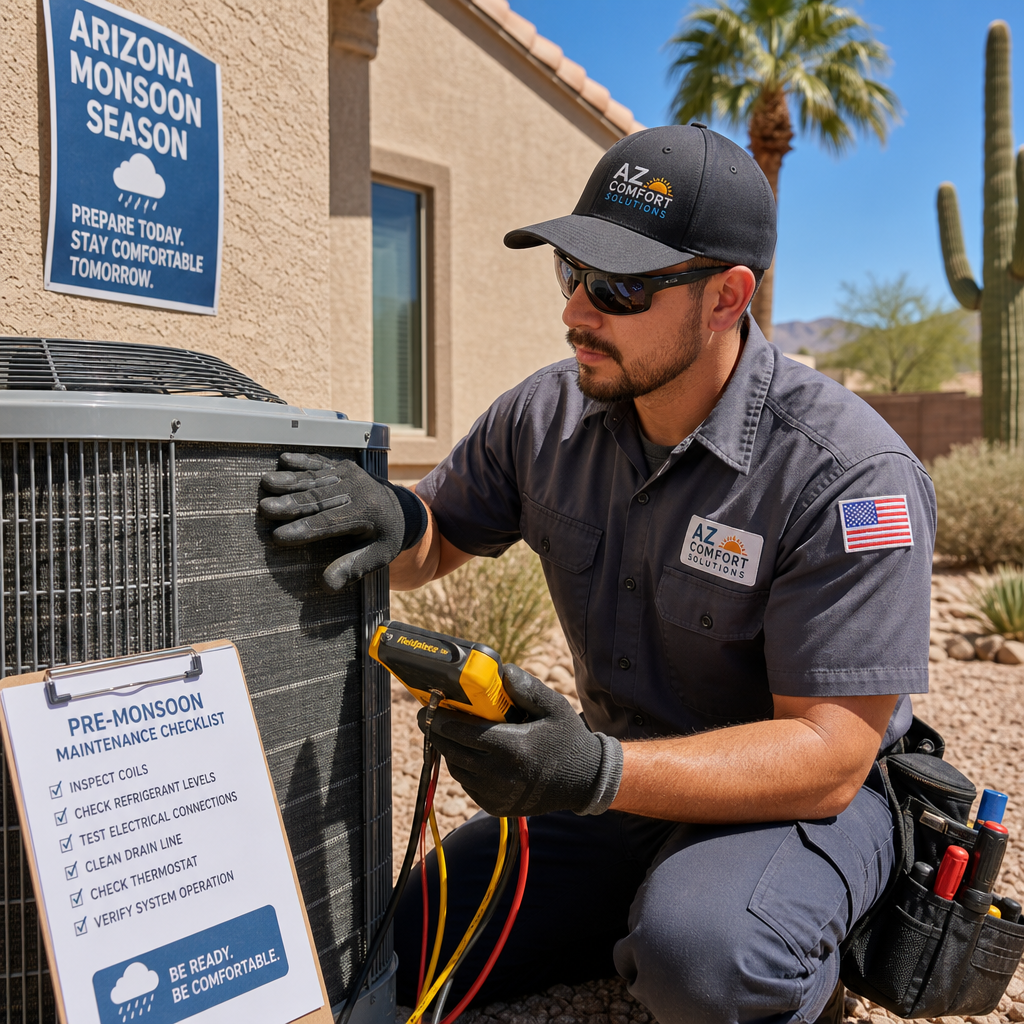
A professional pre-monsoon inspection covers more than a homeowner tune-up checklist. A certified technician will check refrigerant charge with gauges, test capacitor microfarad ratings against spec, measure supply and return static pressure, inspect contactor contacts for pitting, and verify that the condensate drain flows freely. These are not tasks that can be eyeballed from the ground.
What homeowners can do before the technician arrives
Trim back any vegetation within two feet of the condenser unit. Remove patio furniture, decorative rock borders, and potted plants from the immediate perimeter. Check that the pad your outdoor unit sits on is level, because monsoon soil saturation can cause settling that tilts the compressor.
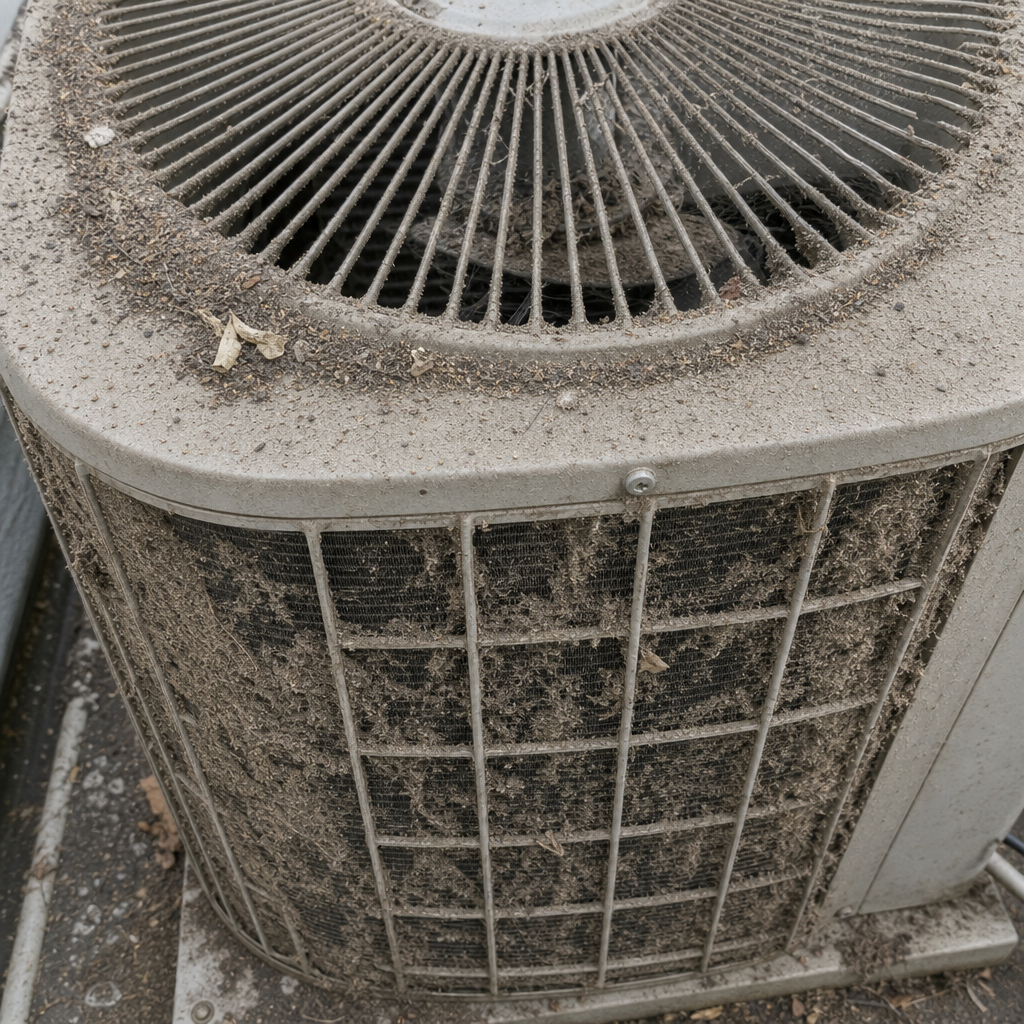
Look at the fins on the condenser. If you can see visible dust buildup or bent fins from the outside, document it with photos. A fin comb and gentle coil cleaner can address light surface dust, but heavy debris compaction between the coil rows requires professional cleaning equipment to avoid pushing contaminants deeper into the coil.
Pro tip: Ask your technician to inspect the electrical disconnect box outside next to the condenser. Monsoon rain and blowing dust infiltrate these boxes and cause corrosion on fuse clips and contactors, which then fail during the next heat cycle.
Filter replacement schedule during monsoon season
During non-monsoon months, a MERV 8 filter in a typical Phoenix home lasts 30 to 60 days. During active monsoon season, that same filter can saturate in 7 to 10 days after a significant dust event. Check your filter within 24 hours after every major haboob, not on a calendar schedule.
Use MERV 11 filters during monsoon season if your system can handle the increased static pressure. Many older systems with single-speed blower motors cannot, so confirm with your technician before switching filter grades. A MERV 11 filter that your blower cannot pull air through properly is worse than a MERV 8 filter that stays clean.
Protecting Your Outdoor Condenser Unit
The outdoor condenser unit is the most exposed component of your system and the most expensive to replace. A residential condenser in Phoenix can cost between $1,800 and $4,500 installed, depending on system size and brand. Protecting that investment during monsoon season comes down to three things: physical clearance, coil cleanliness, and drainage.
Grounding and pad elevation
Flat gravel yards drain poorly during monsoon downpours, and standing water around the condenser base accelerates rust on the cabinet and degrades the electrical connections at the base of the unit. If your unit sits in a low spot that pools water, raised concrete pads or composite risers are worth the cost. They are far cheaper than a rusted-out cabinet or waterlogged control board.
Check that your unit's ground rod connection is intact. Lightning ground faults become common during monsoon season, and a missing or corroded ground can allow fault current to travel into the system rather than safely to earth.
Coil cleaning methods compared
There are three realistic approaches to cleaning condenser coils before monsoon season. Homeowner-applied coil cleaner foam is the least invasive but only addresses surface-level dust on the outer fins. Technician-applied low-pressure water rinse from the inside out is the standard professional method and removes embedded debris without bending fins. Chemical no-rinse coil cleaner applied by a certified technician handles heavy grease and organic buildup that water alone cannot remove.
For most residential condensers in the Phoenix and Tempe area, a low-pressure inside-out rinse performed annually before monsoon season is sufficient. If your unit is near a pool, a restaurant kitchen exhaust, or a heavily landscaped yard with cottonwood or palm trees, chemical cleaning every other year may be warranted.
Pro tip: Never use a pressure washer on condenser coils. The aluminum fins are designed to bend at roughly 1 PSI of direct pressure. A standard residential pressure washer delivers 1,500 to 3,000 PSI, which will flatten entire rows of fins and permanently reduce your system's heat rejection capacity.
Electrical Surge Protection for HVAC Systems
According to the Insurance Information Institute, lightning causes over $900 million in residential property damage annually in the United States, and Arizona ranks among the top states for lightning strike density during summer months. Your HVAC system is one of the highest-value electrical loads in your home and one of the most vulnerable to surge damage because the compressor motor draws high current on startup, which creates a voltage environment that amplifies the effect of incoming surges.
A quality whole-home surge protector installed at the main panel typically costs $300 to $500 installed and is rated to handle surges up to 40,000 amps. A dedicated HVAC surge protector mounted in the disconnect box adds a second layer of protection specifically for the compressor and control board. Both layers together cost less than one compressor replacement.
"The capacitor and control board are the two most surge-vulnerable components in any residential split system. A whole-home surge protector plus a dedicated HVAC surge device is the minimum reasonable protection for any home in Arizona's monsoon corridor." - Brewer's AC and Heating, Tempe
A common mistake is assuming that a whole-home surge protector eliminates the need for an HVAC-specific device. The whole-home unit protects at the panel, but voltage transients can still develop within the run of wire between the panel and the disconnect box. The HVAC-specific protector catches what the panel-level device misses.
Indoor Air Quality During Monsoon Season
Monsoon season in Arizona creates a rare indoor air quality challenge: your home shifts from extremely dry conditions to temporarily humid conditions within hours, and the dust infiltration from haboob events carries biological material including mold spores, bacteria, and particulate matter from agricultural fields and construction sites. HVAC monsoon season Phoenix preparation must account for indoor air quality, not just mechanical protection.
Managing humidity spikes inside the home
Arizona homes are built and insulated for dry heat, not humidity. When relative humidity jumps from 15% to 50% or higher during a monsoon event, condensation can form on cold surfaces inside the air handler and ductwork. If your evaporator coil has any dust buildup on it, that moisture creates an ideal environment for mold growth.
An annual evaporator coil cleaning, scheduled as part of your pre-monsoon service, removes the organic material that mold needs to establish itself. Homes with known moisture issues can benefit from UV air purification systems installed in the air handler, which inhibit mold and bacterial growth on the coil surface year-round.
Air purification options worth considering
HEPA bypass filtration systems, UV-C germicidal lights, and bipolar ionization units are the three most practical options for central Arizona homeowners concerned about dust and biological contaminants during monsoon season. HEPA bypass systems add genuine hospital-grade filtration without restricting airflow on the main filter. UV-C lights address microbial growth on coil surfaces. Bipolar ionization units reduce airborne particulates throughout the living space.
Brewer's installs and services all three of these system types across Tempe, Chandler, Mesa, and Gilbert homes. If you are unsure which option fits your situation, an indoor air quality assessment is a good starting point rather than guessing based on marketing claims.
Comparison of Monsoon Prep Approaches
| Approach | What It Covers | What It Misses |
|---|---|---|
| DIY Homeowner Prep Only | Filter changes, debris clearance around condenser, visual inspection of fins and electrical connections, documentation photos | Refrigerant charge verification, capacitor testing, internal coil cleaning, condensate drain flush, surge protection installation, static pressure testing |
| Annual Professional Tune-Up (Basic) | Filter, capacitor check, coil rinse, refrigerant pressure reading, thermostat calibration, contactor inspection | Indoor air quality components, surge protection upgrades, duct inspection, detailed electrical load testing, evaporator coil deep clean |
| Full Pre-Monsoon HVAC Service (Comprehensive) | All basic tune-up items plus surge protection assessment, evaporator coil cleaning, condensate drain treatment, indoor air quality evaluation, duct inspection, and priority emergency scheduling through monsoon season | Real-time storm response. Post-storm inspections are always a separate service call regardless of prep level. |
What to Do Immediately After a Haboob
The 30 minutes after a major dust storm passes are the most important window for protecting your AC system from secondary damage. The instinct to immediately turn the system back on after the storm clears is understandable, but it is the wrong call in most cases.
First, walk the perimeter of the outdoor unit before starting the system. Look for debris caught in the condenser fins, dislodged refrigerant line insulation, and standing water around the base of the unit. If you see any of these, do not run the system until they are addressed.
Second, check the indoor air filter before restarting. If the filter is visibly coated with dust, replace it before turning the system on. Running the system with a loaded filter after a haboob puts immediate strain on the blower motor at a moment when the system will be working hard to recover the indoor temperature that climbed while the system was off.
Third, set the thermostat to fan-only mode for 10 to 15 minutes before switching to cooling. This circulates air through the filter and gives you a chance to detect any unusual sounds from the blower before the compressor engages. A grinding or rattling sound from the blower at this point means debris made it into the air handler and needs professional attention before normal operation resumes.
Pro tip: If your outdoor unit's disconnect was pulled during the storm (some homeowners do this as precaution), wait at least 10 minutes after restoring power before starting the system. Compressors need time to equalize pressure before startup. Restarting immediately after a power interruption without a time-delay relay can cause compressor slugging and valve damage.
Frequently Asked Questions
When is the best time to schedule a pre-monsoon AC service in Phoenix?
The ideal window is May 1 through June 10. Scheduling in this range gets you ahead of the June 15 monsoon season start date and before the surge in emergency calls that typically starts in late June. Brewer's books up quickly in late May and early June, so calling in April if you have an older system or have not had service in over a year is a smart move.
Should I cover my outdoor AC unit during a dust storm?
No. Covering a running condenser unit during a storm can cause the compressor to overheat within minutes. The safer approach is to turn the system off at the thermostat when a major haboob is visible on the horizon, leave the condenser uncovered, and restart the system after the storm passes and you have completed a perimeter check. Condenser cabinets are designed to handle dust exposure. The problem is compacted debris inside the fins, not surface dust on the cabinet.
How much does a monsoon-related AC repair typically cost in Arizona?
Capacitor replacements, the most common monsoon-related failure, typically run $150 to $350 including labor. Control board replacements range from $400 to $900. Compressor replacement or condenser unit replacement due to surge or debris damage can run $1,800 to $5,000 or more depending on system size. Brewer's uses flat-rate pricing, so you know the exact cost before any work begins. Preventive service costing $100 to $200 before monsoon season is the most reliable way to avoid the higher end of that repair range.
Does homeowner's insurance cover monsoon AC damage in Arizona?
It depends on the cause and your specific policy. Lightning damage is typically covered under standard homeowner's policies as a named peril. Wind and hail damage is usually covered as well. Flooding damage to a ground-level condenser unit may be excluded under standard policies but covered under separate flood insurance. Mechanical failure attributed to dust buildup or deferred maintenance is almost never covered. Document your system's condition before monsoon season with dated photographs and keep maintenance records to support any claim.
Is it worth installing a whole-home surge protector just for AC protection in Arizona?
Yes, without reservation. Arizona's summer lightning activity is among the most intense in the country, and a single capacitor or control board failure from a voltage spike costs more than the surge protector itself. A whole-home unit plus a dedicated HVAC surge protector together typically costs $400 to $700 installed and can prevent thousands in repair costs over the life of the system. Brewer's recommends this combination for every home in the Phoenix metro area, not just homes on elevated or exposed lots.
Can I run my AC during a monsoon storm?
Running the system during light rain is generally fine. During an active haboob, it is better to shut the system off at the thermostat until the storm passes. The combination of reduced visibility outside, lightning risk, and rapid dust infiltration through any unsealed duct penetrations or return air leaks makes temporary shutdown the conservative and correct choice. Your home will hold temperature for 30 to 60 minutes with doors and windows closed, and the system can recover the setpoint quickly once the storm clears.
If you have had your pre-monsoon service done and your AC is performing well coming into storm season, we would like to hear what made the biggest difference for you this year.
About the Author
Mark Ybarra
Mark Ybarra is the owner and leader of Brewer's Air Conditioning & Heating, a trusted HVAC company serving Tempe, Phoenix, Scottsdale, Mesa, and surrounding Arizona communities since 1982. After working in multiple roles within the company, Mark officially took ownership in 2018 and continues to uphold Brewer's long-standing commitment to integrity, exceptional service, and customer satisfaction.
Need HVAC Help?
Serving Phoenix, Tempe, Scottsdale, Mesa & surrounding areas since 1982.