Scottsdale homeowners who invest seven figures in a property expect the home to feel effortless, yet the HVAC system is often the most neglected part of the build. Big floor plans, glass walls, and tall ceilings make comfort harder to deliver, and a system sized from a square footage chart will usually miss the mark. In a Valley summer, where afternoons regularly climb past 100 degrees and monsoon humidity arrives in late summer, the gap shows up fast as hot rooms, noisy registers, and bills that climb faster than the thermostat suggests. This guide explains where a high-end AC system earns its cost, where it doesn't, and what to ask before you sign.
Table of Contents
- Quick Takeaways
- What Makes HVAC Luxury in a Scottsdale Home
- Zoning and Load Calculations for Large Homes
- Variable-Speed Equipment for Long Run Times
- Indoor Air Quality and Humidity Control in the Valley
- Smart Controls and Remote Monitoring
- Choosing a High-End System Configuration
- Installation Quality and Flat-Rate Pricing
- Frequently Asked Questions
- References
Quick Takeaways
| Key Insight | Explanation |
|---|---|
| Size from a room-by-room load calculation | Square footage alone misses sun exposure, ceiling height, and glass area, which are the factors that drive comfort in large Scottsdale homes. |
| Choose variable-speed equipment for long run times | Desert afternoons keep big homes cooling for hours, and modulating compressors and blowers control humidity better than single-stage units. |
| Zone the house by sun exposure and use | Separate thermostats and dampers keep sunlit rooms from overheating the rest of the house and stop guest wings from running needlessly. |
| Verify a closed return air path | Wall cavities used as return air can pull dust and debris into the supply air. Confirm the return design before the walls are closed. |
| Match the compressor, air handler, and controls | A premium compressor paired with a mismatched blower or control board loses much of its advantage. |
| Require a written flat-rate proposal with model numbers | Bids are only comparable when every proposal lists the same equipment, zones, and warranty terms. |
| Plan for monsoon humidity, not just heat | Comfort complaints during monsoon weeks are usually about clamminess, which calls for a dehumidification strategy as well as cooling capacity. |
What Makes HVAC Luxury in a Scottsdale Home
A luxury home in Scottsdale usually means a larger footprint, more glass, higher ceilings, and rooms designed for guests rather than daily traffic. Each of those choices makes the air conditioning harder to deliver evenly. A system that handles a modest tract home can struggle in a custom residence twice that size, even when the tonnage looks similar on paper.
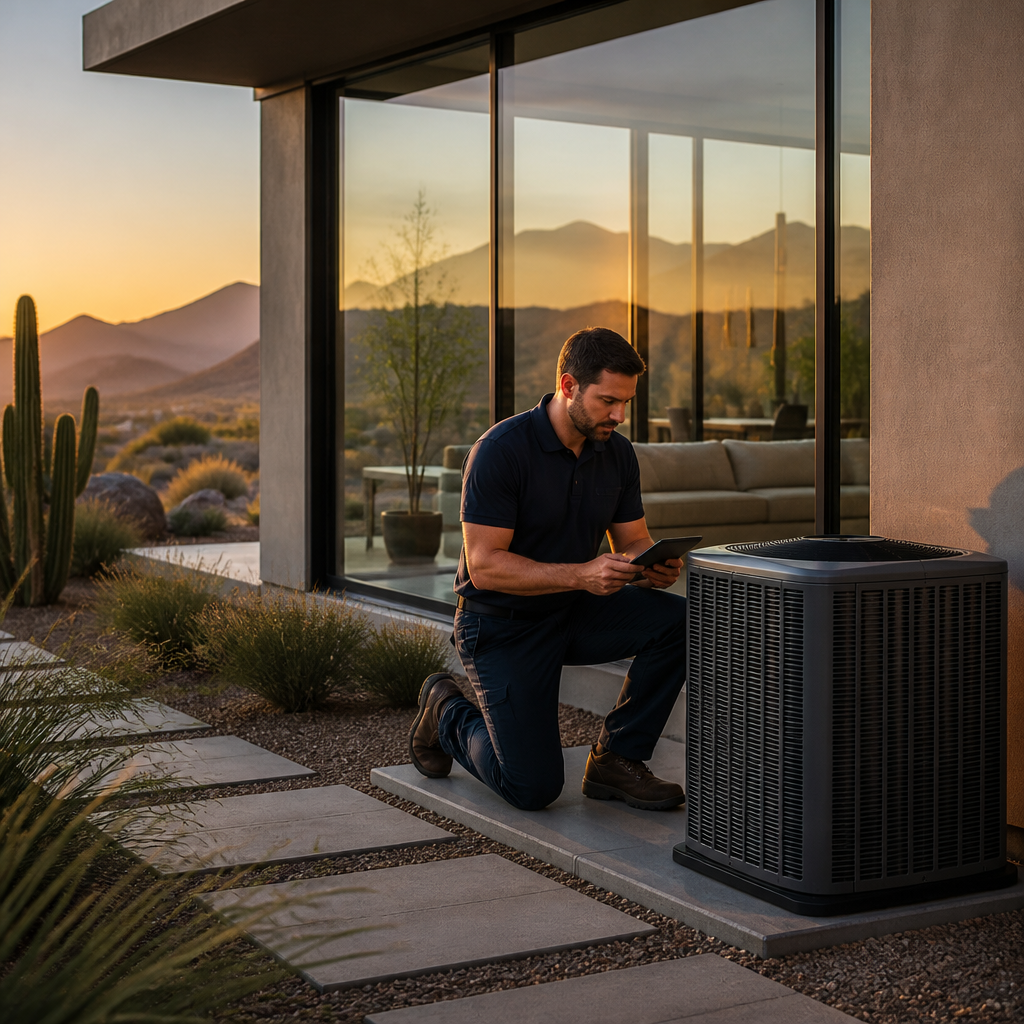
Luxury comfort is not a single product. It is the combination of correctly sized equipment, distribution that reaches every room, controls that respond to how the house is actually used, and an installation that does not cut corners behind the drywall. When one of those pieces is weak, the whole system feels expensive and unreliable, even when the brand name is impressive.
In practice, we see the same pattern across Scottsdale and the east valley. The owner buys premium equipment, then the home has a cold upstairs office, a hot great room, and a thermostat that is always fighting the afternoon sun. The equipment was fine. The design and the duct layout were not.
In a large home, the equipment is the easy part. Load calculations, duct layout, and return air design decide whether the system ever feels right.
Evergreen's custom HVAC guidance makes a similar point from its own Central Texas work: sizing equipment from square footage or heating load alone will not deliver the highest level of comfort and efficiency. Their approach weighs several home-specific factors before a unit is chosen. That is the standard we hold ourselves to as well.
When we assess a luxury home for replacement, the first question is not which model to buy. It is how the house is built, where the sun hits, how many people use each floor, and where the air currently goes. Those answers shape every recommendation that follows. A premium HVAC installation in Scottsdale starts with that inventory, not with a catalog.
Zoning and Load Calculations for Large Homes
Why Square Footage Charts Fail
Most residential sizing starts with square footage and a rule of thumb. That shortcut assumes every room gains and loses heat at the same rate, which is rarely true in a large Scottsdale home. A great room with a wall of glass facing the afternoon sun can carry far more heat load than a shaded bedroom of the same size.
A proper load calculation models the building envelope room by room. It accounts for window area and orientation, insulation, ceiling height, and internal heat from kitchens and media rooms. The output tells the installer how much conditioned air each space needs, which is the number that matters when the house is designed around open sightlines.
Oversizing is the other trap. A system with too much capacity cools the air quickly, shuts off before it has run long enough to remove humidity, and leaves the house clammy during monsoon weeks. Bigger is not better, and a qualified installer should be able to explain the calculation line by line.
Zoning Rooms by Sun Exposure
Zoning divides the house into areas with separate thermostats and motorized dampers, so the system delivers air where it is needed. In a home with a quiet primary suite on one side and a sunlit entertaining wing on the other, zoning is often the difference between a comfortable evening and a constant thermostat argument. It also lets a rarely used guest wing stay near setpoint without the rest of the house paying for it.
The downside is complexity. Every zone needs a sensor, a damper, and proper airflow balancing, and a poorly designed zoned system can starve equipment of return air. Zoning works when it is designed before the ducts are set, not patched in afterward.
Pro tip: Ask for the room-by-room load report before you approve any equipment. If a contractor cannot show you the numbers, you are paying for a guess.
Variable-Speed Equipment for Long Run Times
Large homes in the desert run the air conditioner for long stretches, often through the whole afternoon and into the evening. A single-stage compressor that switches fully on and fully off struggles with that pattern. It overshoots the setpoint, coasts, and lets humidity linger because the coil is not running long enough at low speed to pull moisture out of the air.
Variable-speed equipment changes that behavior. The compressor and indoor blower modulate to match the load, which keeps temperatures steadier and removes more moisture at part load. For a home with high ceilings and a lot of glass, the result is fewer hot spots and less of the cold-then-hot cycle that frustrates owners.
Variable-Speed Compressors and Blowers
The blower matters as much as the compressor. A variable-speed air handler can ramp airflow up or down, which keeps supply air velocity comfortable in large rooms and reduces the noise of high-speed fans. Trane and Lennox both offer variable-speed lines that we work with regularly, but the specific model matters less than matching the compressor, air handler, and controls as one set.
A mismatched set is a common failure. A premium compressor paired with an older blower or an incompatible control board can lose most of its advantage. Ask whether the proposed components are designed to work together, and whether the manufacturer warranty depends on a matched system.
When Two-Stage Equipment Makes More Sense
Two-stage equipment is a sensible middle option for some homes. It runs on a low stage most of the time and a high stage on the hottest days, which gives better comfort than single-stage gear at a lower price than full variable-speed. It is not the right answer for a sprawling house with many zones and a demanding owner, but it can be a solid choice for a smaller luxury residence with a simple layout.
Indoor Air Quality and Humidity Control in the Valley
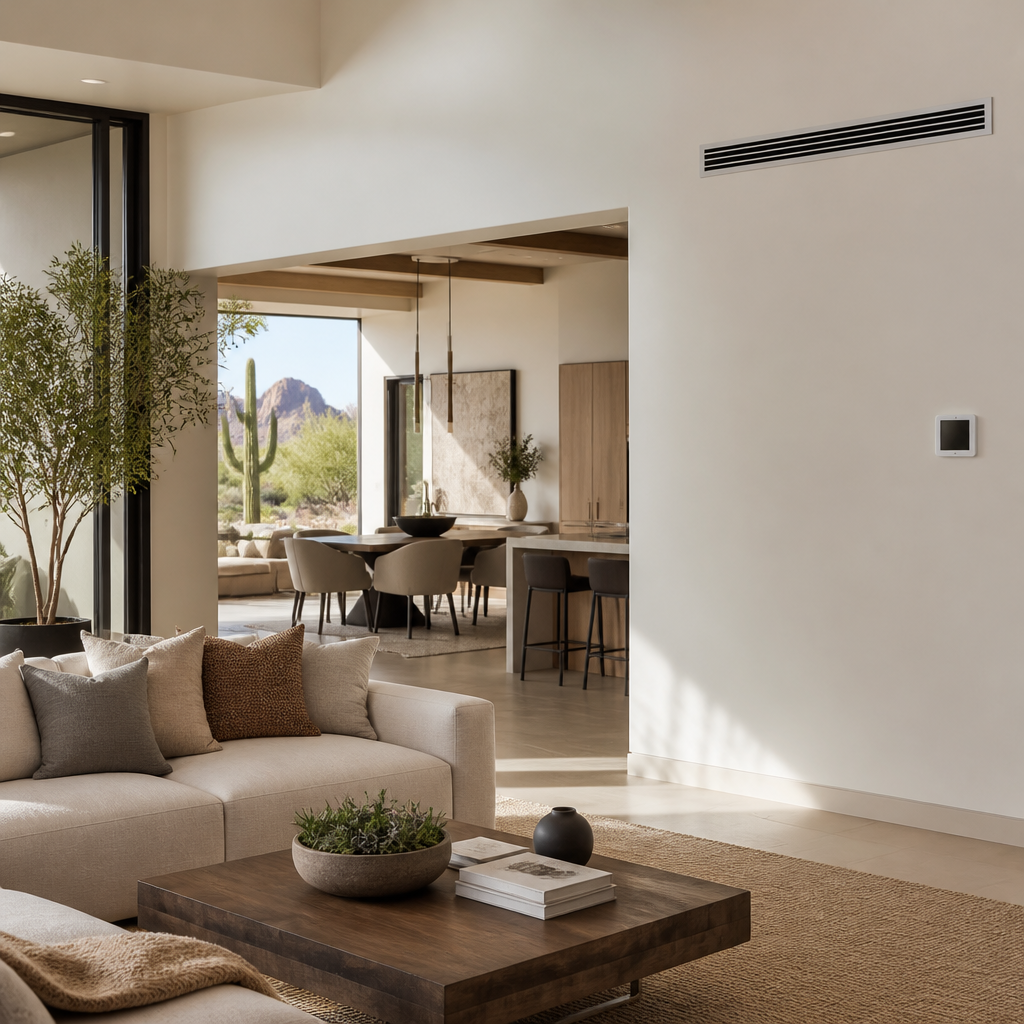
Luxury finishes do not help if the air feels stale, dusty, or damp. In the Valley, the main challenges are dust from dry seasons, pollen, and the humidity that arrives during monsoon season. A well-designed system handles all three through the return path, filtration, and dehumidification, not through a single gadget at the grille.
Closed Return Ducts and Wall Cavity Contamination
Return air design is where many high-end homes quietly go wrong. Some builders use the space between drywall as part of the return path rather than running sealed ductwork. A St. Louis custom home builder's published guidance describes the problem plainly: that cavity often holds dust and construction debris, and when the system runs, air passes over those materials and pushes particles back into the home through the supply ducts.
A fully ducted, closed return keeps the air path sealed from room to equipment. It costs more during construction, which is why it is often skipped in spec builds. Once the walls are closed, though, fixing a leaky return is expensive, so this is a decision to make during design or early installation.
Filtration and Humidity During Monsoon Season
Filter ratings are easy to overspecify. A high-efficiency filter that the air handler cannot push air through will reduce airflow, strain the blower, and cut into comfort. The right answer is a filter the equipment is designed for, plus a real plan for humidity control. Whole-home dehumidification or a properly configured variable-speed system handles monsoon humidity far better than a standard unit running on a thermostat set to 75.
In practice, the most common comfort complaint during monsoon weeks is not temperature. It is a home that feels cool but clammy. That usually points to a system running too fast, cycling too briefly, or lacking a dehumidification strategy altogether.
Smart Controls and Remote Monitoring
A thermostat is the interface between you and the system, and in a large home it does more work than most owners realize. Smart controls can learn schedules, coordinate zones, and flag when equipment is struggling. Used well, they reduce guesswork. Used poorly, they become one more app to delete.
The useful features are unglamorous. Look for zone control compatible with your damper system, humidity readings you can see, and alerts for filter age or airflow problems. Remote access helps when you travel, but the main benefit is early warning before a small problem becomes an emergency in July.
Thermostats That Learn Your Schedule
Learning thermostats work best in homes with predictable routines. A household that is out most weekdays and home on weekends will see real savings from setbacks and occupancy detection. A household that hosts often or runs a home office may need manual overrides and clear schedules instead of a device guessing what it should do.
Setpoint discipline matters too. Dropping the house several degrees while you are away forces the system to work hard on return, and it can overshoot in a way that costs more than a modest setback would. We set expectations with owners before anyone programs a schedule.
Monitoring Airflow and Filter Status
Airflow problems are the hidden cost in large homes. A closed register, a blocked return, or a damper stuck in the wrong position can make a system look like it is failing when the real issue is distribution. Monitoring that tracks run times and temperature differences between zones can catch those problems weeks before the owner notices.
Pro tip: Ask your technician to record supply and return temperatures at installation and at every maintenance visit. A documented baseline makes it much easier to spot a problem early.
Choosing a High-End System Configuration
No single configuration suits every luxury home. The right choice depends on the floor plan, how the house is used, and whether the owner plans to add rooms later. The three most common high-end setups serve different homes across Scottsdale and the east valley.
Start with the layout. A compact single-level home with simple zones may be best served by one variable-speed system. A sprawling house with separate wings and a guest casita usually needs zoning. Additions and detached spaces often make ductless mini-splits the cleanest fix.
| Configuration | Best Fit | Main Trade-off |
|---|---|---|
| Single ducted variable-speed system | Compact or single-level homes with simple layouts | Limited control when rooms have very different sun exposure |
| Zoned ducted system with motorized dampers | Large homes with separate wings, guest suites, or mixed use | Higher design and installation complexity, and careful airflow balancing is required |
| Ductless mini-split systems | Casitas, home offices, and additions without existing ductwork | Several indoor units to maintain and less whole-home airflow |
A ductless system in a detached office keeps the main system from carrying a load it was never designed for. It also avoids running new ducts through finished ceilings, which is often the most disruptive part of a retrofit. Each option can be premium if it is designed and installed properly.
The common mistake is buying the most advanced option for a home that does not need it, or choosing the simplest option for a house with rooms that never reach setpoint. That is why a written comparison from the contractor matters more than a sales brochure.
Installation Quality and Flat-Rate Pricing
A premium system is only as good as its installation. Refrigerant charge, duct sealing, static pressure, airflow measurements, and electrical work determine whether the equipment reaches its rated performance. Two identical systems can deliver very different comfort depending on who installs them.
What a Premium Installation Includes
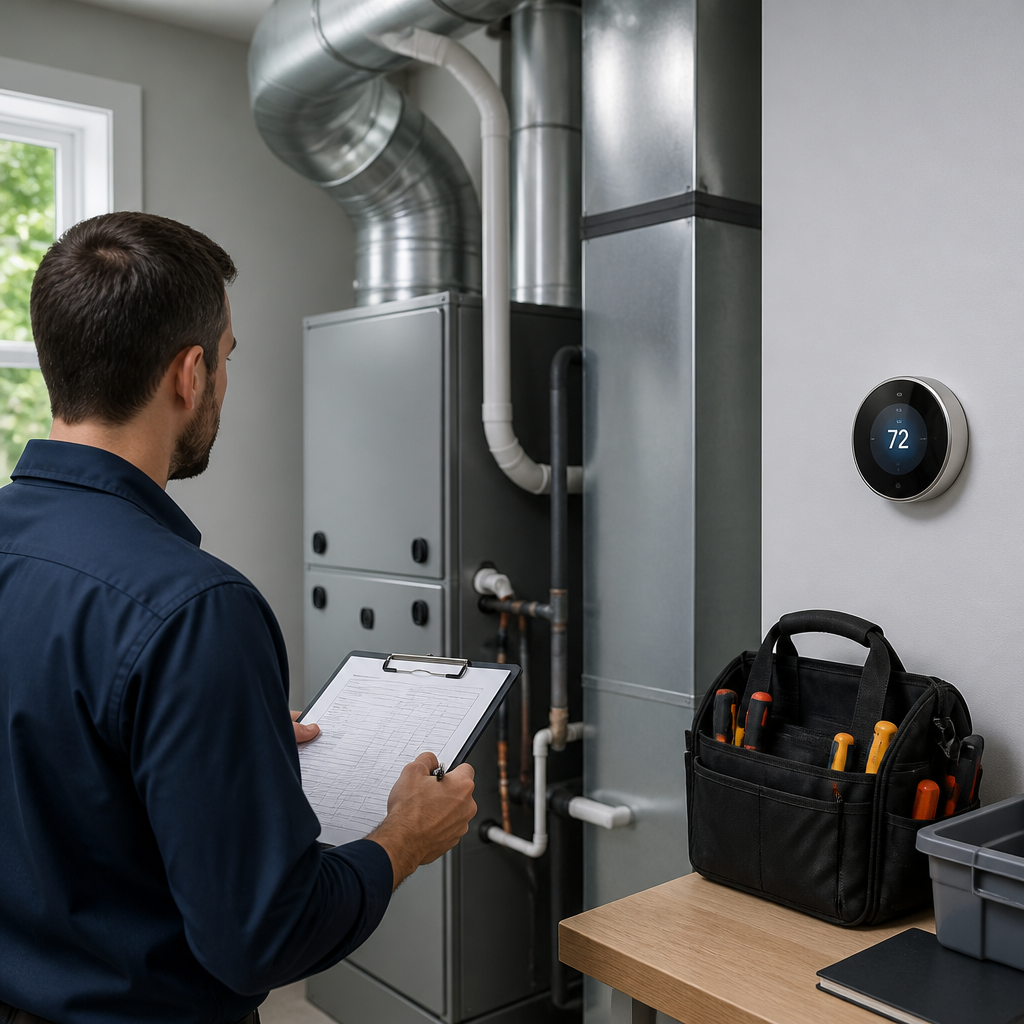
A proper installation starts with measurements, not assumptions. Expect a technician to check duct static pressure, verify airflow at the supply registers, measure the temperature split, and document refrigerant charge. Ducts in attics and other unconditioned spaces should be inspected, not assumed sound, because leaks there can waste cooled air before it reaches a room.
Ask how the installer will protect finished floors, control drywall dust, and clean up after the work. In a home with custom finishes, the quality of the crew is part of the investment. The system will run for many years, and the way it was installed will shape every one of them.
Reading a High-End Quote
Our flat-rate pricing is designed so the homeowner knows the cost before work begins, with no surprise charges for the agreed scope. A written quote for a premium project should list equipment model numbers, zone count, duct work, controls, permits, and warranty terms. If a quote gives you one lump number and no model numbers, you cannot compare it fairly with another bid.
Pro tip: Request the load calculation and the equipment model numbers in writing before you sign. Comparing bids on those two items quickly shows which proposal was built around your home.
Frequently Asked Questions
How much does a luxury home HVAC system cost in Scottsdale?
Costs depend on tonnage, zone count, equipment tier, and the duct work that has to be built or modified. Rather than quoting a range without seeing the home, we recommend a load calculation followed by a written flat-rate proposal. Those two documents show exactly what you are paying for.
Is variable-speed equipment worth it for a large home?
For most large homes with long cooling cycles and high humidity loads, yes. The steadier operation improves comfort and dehumidification, and the blower can run at lower speeds for quieter operation. A very small or simple home may not see the same benefit.
Do I need zoning if my house has only one floor?
Not always. A single-level home can still have rooms that heat up at different times because of sun exposure, so zoning may help even without a second floor. The decision should follow a load calculation and a review of how the rooms are actually used.
How often should a high-end system be serviced?
Plan on a professional tune-up in both spring and fall. Arizona's cooling season is long, so the air conditioning side needs attention before summer arrives. Filters should be checked more often during dusty months or in homes with pets.
Can a ductless system work for a Scottsdale guest house?
Yes, ductless mini-splits are often a good fit for detached guest houses, casitas, and home offices. They avoid running new ductwork through finished ceilings and keep the main system from carrying a load it was not designed for. The space still needs a proper sizing calculation.
Does the brand matter as much as the installer?
Brand matters, but installation quality often matters more. A well-chosen Trane or Lennox system installed with poor duct work will underperform a comparable setup installed correctly. Look for both a strong equipment choice and a crew that measures and documents the work.
What comfort problem in your home has never been solved, and which of these fixes do you think would make the biggest difference?
References
About the Author
Mark Ybarra
Mark Ybarra is the owner and leader of Brewer's Air Conditioning & Heating, a trusted HVAC company serving Tempe, Phoenix, Scottsdale, Mesa, and surrounding Arizona communities since 1982. After working in multiple roles within the company, Mark officially took ownership in 2018 and continues to uphold Brewer's long-standing commitment to integrity, exceptional service, and customer satisfaction.
Need HVAC Help?
Serving Phoenix, Tempe, Scottsdale, Mesa & surrounding areas since 1982.