If you live in the Phoenix metro area, you already know that August is brutal outside. What most homeowners do not realize is that August is also the single worst month for the air inside their homes. Between haboob dust storms pushing fine particulate matter through every gap in your building envelope, monsoon humidity spiking mold risk inside ductwork, ground-level ozone peaking during triple-digit afternoons, and an HVAC system running around the clock without a break, the conditions attacking your indoor air quality in Phoenix are stacking up all at once. This is not a generic air quality article. It is a direct, practical guide for central Arizona homeowners who want to understand exactly what is happening in August and what to do about it before it affects their family's health.
Table of Contents
- Why August Is Different From Every Other Month
- The Four Simultaneous Threats to Your Home's Air in August
- What Your HVAC Is Doing Wrong Right Now
- HVAC Air Quality Solutions That Actually Work in Arizona
- Comparing Air Quality Upgrade Options for Arizona Homes
- What to Do After a Haboob Hits Your Neighborhood
- Frequently Asked Questions
Why August Is Different From Every Other Month
Arizona's monsoon season runs from June through September, but August is when every threat converges at once. By August, the monsoon is in full swing, dust storm frequency is at its annual peak, ground-level ozone has been building since May, and your AC system has been running hard for four straight months without the deep cleaning it needs.
Maricopa County does not meet federal air quality standards for ozone or coarse particulate matter (PM10), placing the Phoenix region among the areas with the most significant air quality challenges in the country. When a major dust event hits, PM10 concentrations around the greater Phoenix area can spike to levels many times above the federal health standard in a matter of hours. The Arizona Department of Environmental Quality issues PM10 High Pollution Advisories multiple times each August for exactly this reason.
The monsoon complicates things further. While rain does temporarily clear the sky of dust, the humidity that comes with monsoon storms creates a completely different indoor problem: moisture intrusion that feeds mold growth in ductwork, attic spaces, and air handlers. So you are not choosing between a dust problem and a mold problem in August. You often have both at the same time.
The Four Simultaneous Threats to Your Home's Air in August
Haboob Dust and PM10 Infiltration
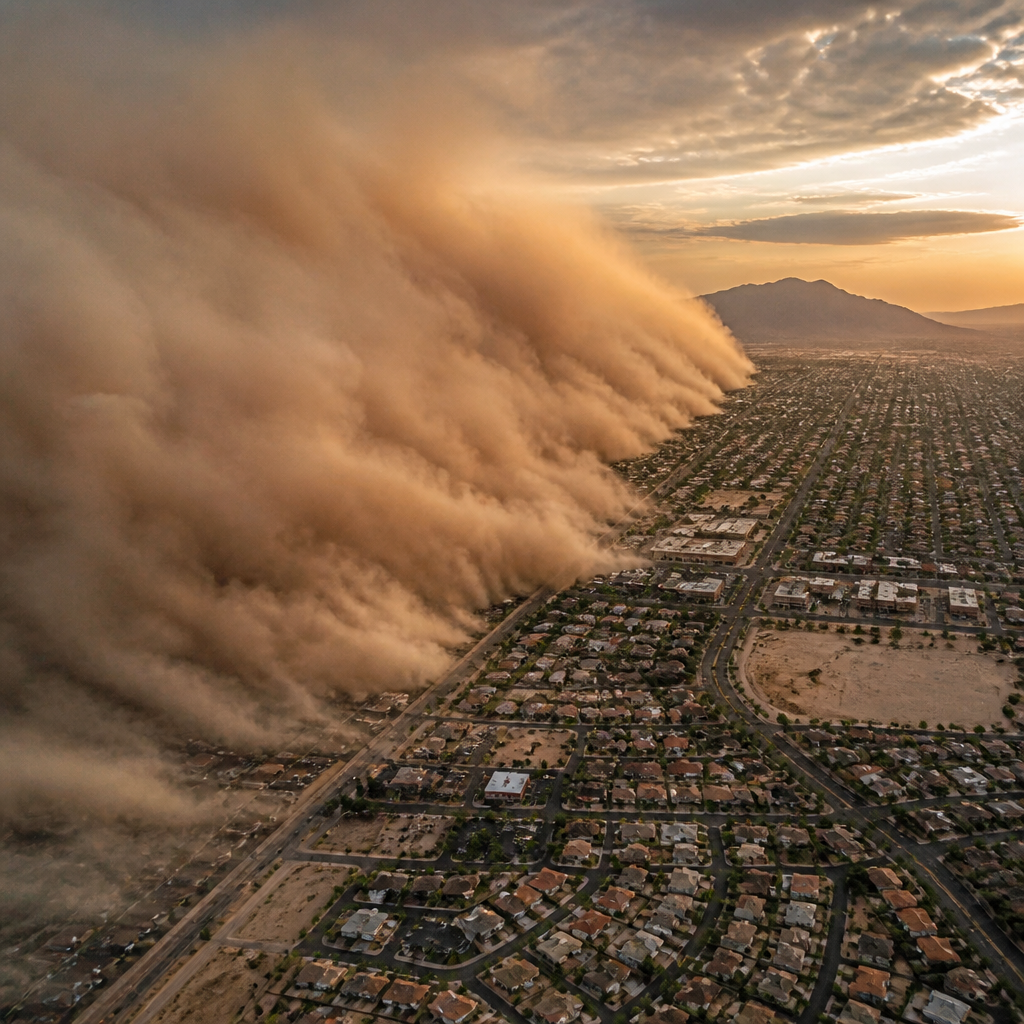
A haboob is a large wall of dust and debris pushed out by the downdrafts of a collapsing thunderstorm. These storms carry thousands of microscopic particles, including allergens, pollutants, spores, and bacteria. The problem is not just what you see coating your patio furniture. It is the particles you cannot see that push through gaps around windows, doors, electrical outlets, and poorly sealed ductwork and settle inside your home and HVAC system for weeks.
Arizona State University developed the Phoenix Dust Storm Scale (PHX-DUST) to measure storm severity. The scale runs from Category 1 through Category 5, with PM10 concentrations starting at 1,000 micrograms per cubic meter at the low end and reaching the most extreme conditions at Category 5. Major haboob events in the Phoenix area have hit Category 5 ratings, sending PM10 pollution to levels that far exceed the federal health standard. Once those particles are inside your ductwork, your HVAC system re-circulates them every time the fan runs.
Pro tip: After any significant dust storm in the Phoenix area, change your HVAC filter within 24 to 48 hours, not at your next scheduled interval. A clogged post-storm filter recirculates captured particulate back into your living space once the filter media is saturated.
Ground-Level Ozone Peaking in Summer Heat
Ozone peaks during hot summer afternoons in the Phoenix area. The extreme heat drives intense ozone formation, and the valley geography can trap pollutants during certain weather conditions. During summer, Phoenix experiences increased indoor ozone levels because outdoor air infiltrates the home, and running the AC with windows closed limits the natural ventilation that would otherwise dilute it. If your home has any fresh-air intake that draws from outside during peak afternoon hours, you may be pulling ozone-heavy air directly into your living space.
Monsoon Humidity and Mold Risk in Ductwork
Phoenix's average summer humidity outside of monsoon events sits around 19 percent, which is extremely dry. But during monsoon events, that number climbs sharply. Moisture from AC condensation or leaks can lead to mold growth in ducts and attics. An air handler that has been running nonstop through a humid August without a professional cleaning is a real mold risk, not a theoretical one. Mold spores circulated through your home's duct system are one of the most stubborn indoor air quality problems to fix after the fact.
VOCs and Combustion Byproducts Trapped Indoors
Because Phoenix homeowners keep windows sealed tight in August to preserve their AC's efficiency, there is almost no natural dilution of volatile organic compounds (VOCs) from furniture, cleaning products, flooring, and building materials. In practice, homes in Arizona's summer heat accumulate VOCs faster than cooler-climate homes because high temperatures accelerate off-gassing from synthetic materials. Combined with the near-zero outdoor air exchange that sealed homes create, August is when VOC concentrations inside reach their highest point of the year.
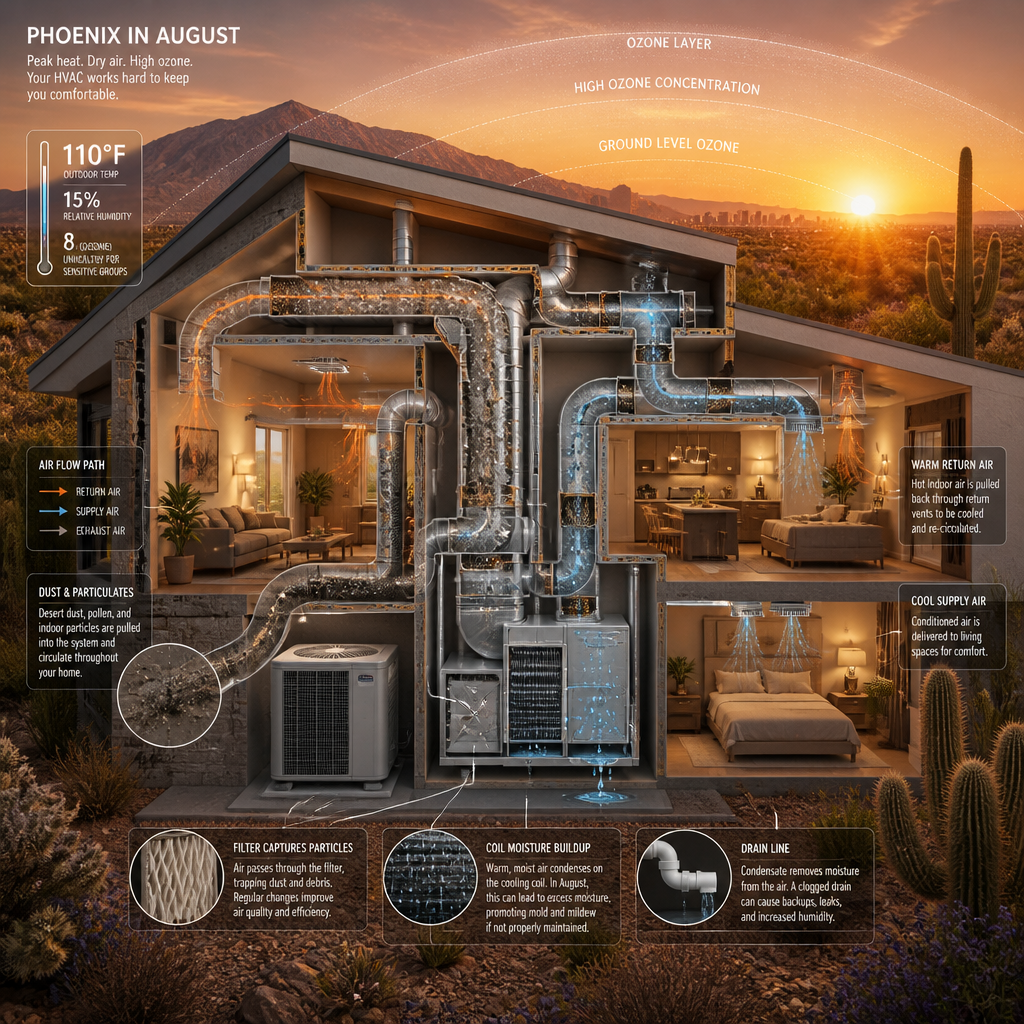
What Your HVAC Is Doing Wrong Right Now
Your HVAC system is the single most important tool you have for managing indoor air quality in Phoenix, but it can also be the biggest source of your problems if it is not properly maintained during summer's most demanding months.
Running a Clogged or Wrong-Rated Filter
Standard fiberglass filters only catch large particles and do almost nothing against the fine PM2.5 particles that cause the most health damage. MERV ratings measure filter effectiveness on a scale from 1 to 16, and filters rated MERV 8 to 11 work well for most Phoenix-area homes, trapping common allergens, dust, and some mold spores. MERV 11 to 13 filters are commonly specified for desert climates to capture both PM10 and fine PM2.5 particles. The catch is that before upgrading to a MERV 13, you need a professional to confirm your system's blower motor can handle the increased restriction. An incompatible high-MERV filter can strain your blower and reduce airflow enough to cause coil freeze-ups, which is the last thing you want in August.
Leaky Ductwork Pulling Attic Air Into Your Home
In Arizona homes, ductwork typically runs through attics that reach temperatures well above 150 degrees Fahrenheit in August. If your ducts have gaps or poorly sealed joints, negative pressure from the air handler pulls hot, dusty, potentially mold-contaminated attic air directly into your conditioned living space. Dust intrusion and filter failure from Arizona's haboob events are among the most frequent indoor air quality complaints in the Phoenix metro area. Leaky ducts are often the mechanism that makes a haboob's outdoor impact an indoor problem that lasts for weeks.
Pro tip: A simple way to test for major duct leakage is to run your system and feel the ceiling around supply registers in rooms directly below the attic. If the air coming out feels noticeably hotter than it should, or if you detect a musty smell after a monsoon storm, leaky ductwork pulling attic air is a likely culprit and warrants a professional duct inspection.
Skipping the Pre-Season and Mid-Season Maintenance Visit
Most Phoenix homeowners schedule one HVAC tune-up per year, usually in spring. By August, that system has been running almost continuously for three to four months. Technicians who inspect systems mid-season can clean components that have accumulated dust from summer haboob events, check for mold growth in the air handler, seal duct leaks discovered during heavy use, and verify that airflow rates are still correct. Skipping mid-season attention in August is the HVAC equivalent of changing your car's oil once a year while driving 30,000 miles.
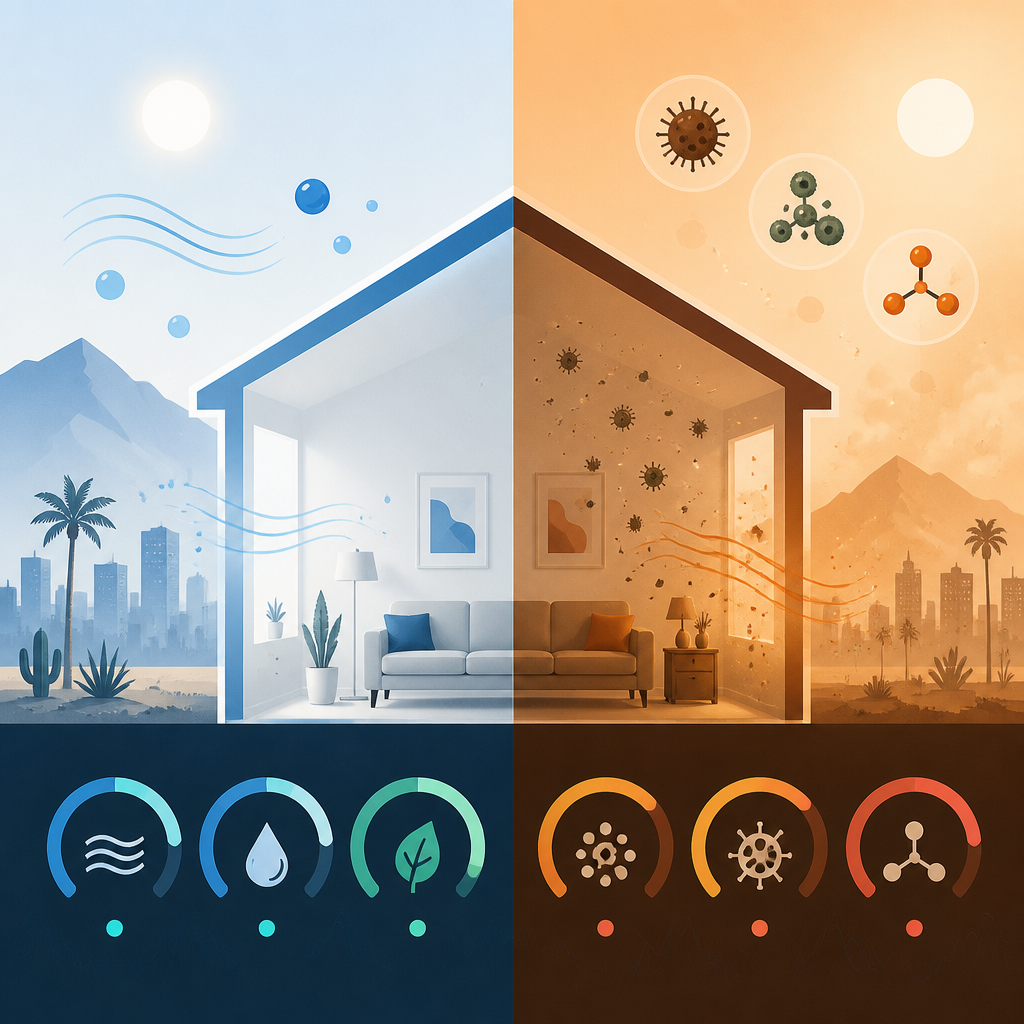
HVAC Air Quality Solutions That Actually Work in Arizona
The good news is that the HVAC air quality solutions available to Arizona homeowners are well-matched to the specific problems August creates. The key is layering them correctly rather than relying on any single upgrade.
High-Efficiency Filtration Upgrades
Upgrading to a high-efficiency filter is the highest-value starting point for most homes. For homes in the Phoenix, Tempe, Scottsdale, Mesa, Chandler, and Ahwatukee areas, a MERV 11 filter is a reasonable minimum during monsoon season, with MERV 13 appropriate for homes with asthma sufferers or anyone with respiratory sensitivities, provided the system has been confirmed compatible. Replace filters more frequently in August than at any other time of year. A single major haboob can load a filter that would otherwise last 60 to 90 days in two or three weeks.
Whole-Home UV Air Purifiers
UV light purifiers installed inside the ductwork kill bacteria, viruses, and mold spores as air passes through. This is particularly relevant in August, when monsoon humidity raises the risk of mold growth in air handlers and duct systems. Unlike portable room purifiers, a whole-home system treats every cubic foot of air your HVAC moves, which in a sealed Arizona home in August is essentially all of the air you breathe indoors.
Electronic Air Cleaners and HEPA Systems
Electronic air cleaners use an electric charge to trap particles as small as 0.1 microns, which is far smaller than what even a MERV 13 filter captures. HEPA filtration systems capture 99.97 percent of airborne particles including dust, pollen, and pet dander. For homes where the primary occupants have asthma or serious allergy conditions, a whole-home HEPA system integrated with existing heating and cooling equipment is the most effective single upgrade available. Proper sizing and installation by a trained technician is not optional here. An oversized or undersized system will not perform as advertised.
Duct Sealing and Air Barrier Improvements
No purification system can overcome a duct system that is actively pulling in contaminated attic air. Duct sealing should be treated as a prerequisite for any other air quality upgrade in Arizona homes with older ductwork. Beyond the ducts themselves, sealing gaps around electrical outlets, plumbing penetrations, and window frames reduces the rate at which outdoor particulate matter enters the home during and after haboob events. This is low-glamour work that consistently delivers among the highest returns of any air quality improvement in the Phoenix climate.
Comparing Air Quality Upgrade Options for Arizona Homes
| Solution | Best For | Key Limitation in Arizona's August Conditions |
|---|---|---|
| MERV 11-13 Filter Upgrade | Capturing PM10 and PM2.5 from haboobs; trapping pollen and mold spores during monsoon season | Requires system compatibility check; needs more frequent replacement in August due to heavy dust loads |
| Whole-Home UV Purifier | Killing mold spores and bacteria that grow in ductwork after monsoon humidity events | Does not address particulate matter directly; works best as a complement to high-efficiency filtration |
| Electronic Air Cleaner or Whole-Home HEPA System | Maximum particle removal for households with asthma, allergies, or respiratory conditions | Higher upfront cost; requires professional sizing and integration with existing HVAC to avoid airflow restriction |
What to Do After a Haboob Hits Your Neighborhood
When a dust storm warning is issued in the Phoenix area, keeping windows and doors closed and staying indoors is the right call. But most of the damage to indoor air quality happens in the hours and days after the storm, not during it. Here is the practical sequence that actually limits post-storm indoor contamination.
First, check your HVAC filter immediately after the storm clears. A filter that has captured a heavy dust load will restrict airflow and, if left in place, will allow particles to bypass the filter media as it becomes saturated. Replace it. Second, inspect visible duct connections in accessible areas like the attic access or utility closet. If you see dust accumulation around joints that was not there before, you have a sealing problem worth addressing. Third, if anyone in the household develops new respiratory symptoms, runny nose, eye irritation, or worsening asthma after a major dust event, do not assume it will resolve on its own. It often means your filtration system failed to contain the influx and the air inside still carries elevated particulate levels.
The Arizona Department of Environmental Quality recommends that people with heart or lung diseases, older adults, and children take elevated precautions during PM10 High Pollution Advisory days. If a High Pollution Advisory is in effect in Maricopa County, avoid burning wood, limit outdoor activity, and ensure your indoor filtration is working at full capacity.
"During active monsoon periods, we could have daily chances for dust. Thunderstorms developing over the mountains to the southeast or east can send winds toward the Phoenix area every evening." A key takeaway: in August, it is not a matter of if another dust event will follow the last one. It is a matter of how many days in between.
The Brewer's Air Conditioning and Heating team has served central Arizona since 1982. If your home in Tempe, Ahwatukee, Chandler, Mesa, Gilbert, Scottsdale, or Phoenix needs a mid-season air quality inspection, duct sealing, filtration upgrade, or UV purification system, these are not optional luxuries in August. They are the difference between breathing clean air and breathing what the last haboob left behind.
Frequently Asked Questions
Why is August specifically the worst month for indoor air quality in Phoenix?
August combines the peak of Arizona's monsoon dust storm season with the highest ground-level ozone levels of the year, the greatest risk of mold growth inside HVAC systems due to humidity spikes, and the cumulative effect of an AC system that has been running without deep maintenance since spring. No other month stacks all four threats simultaneously the way August does in the Phoenix metro area.
Can I just open windows to improve indoor air quality in an Arizona summer?
Opening windows during August in Phoenix is almost never a good idea from an air quality standpoint. Outdoor ozone peaks in the afternoon hours, dust storm conditions can develop rapidly with little warning, and the outdoor heat makes any ventilation strategy that is not filtered and conditioned a health and energy efficiency problem. Smart ventilation in August means using a properly filtered and maintained HVAC system, not open windows.
What MERV rating filter should I use in my Phoenix home during monsoon season?
For most Phoenix-area homes, a MERV 11 filter is a strong starting point during monsoon season. Homes where occupants have asthma, allergies, or respiratory sensitivities benefit from MERV 13, provided a technician has confirmed the system's blower can handle the additional resistance. Going above MERV 13 in a residential setting requires very specific equipment and is rarely necessary. What matters more than hitting the highest possible MERV rating is replacing whatever filter you use more frequently in August than at any other time of year.
How do haboobs affect the inside of my home's HVAC system?
During a haboob, fine dust particles push through gaps in your home's building envelope and enter your HVAC system. The air handler pulls this particle-laden air through the return, loads up the filter rapidly, and, if the filter saturates or is poorly rated, distributes those particles throughout your ductwork and back into your living space. Dust that accumulates inside ductwork creates a reservoir of particulate matter that continues to affect indoor air quality long after the storm has cleared. This is why filter inspection and replacement right after a major dust event is not optional.
Does running my AC more help or hurt indoor air quality during monsoon season?
It depends on the condition of your system. A well-maintained AC with a properly rated filter, sealed ductwork, and clean components actively improves indoor air quality by continuously cycling and filtering the air. A system with a clogged filter, leaky ducts, or mold growth in the air handler does the opposite: it recirculates contaminants. The answer in practice is not to run the AC less but to ensure the system is in proper condition to do its job, which in August means a mid-season professional inspection, not just hoping the spring tune-up still has you covered.
Is Valley Fever a risk from indoor air during Arizona dust storms?
Valley Fever (coccidioidomycosis) is caused by a fungus found in the soil of Arizona and other southwestern states. When dust storms kick up soil particles, fungal spores can become airborne. Staying indoors with windows and doors closed during a dust storm and using high-efficiency HVAC filtration reduces, but does not eliminate, exposure risk. Anyone experiencing a persistent cough, fever, or fatigue following a dust storm should consult a physician, as Valley Fever can cause a pneumonia-like illness in some people.
How often should I replace my HVAC filter in August compared to other months?
During most months in a Phoenix-area home, a MERV 8 to 11 filter may last 30 to 60 days. In August, during an active monsoon season with multiple haboob events, plan to inspect your filter weekly and replace it every two to three weeks, or immediately after any major dust storm. Waiting for your standard replacement schedule in August is the single most common mistake Phoenix homeowners make with indoor air quality maintenance.
Have you noticed a difference in your home's air quality after a monsoon dust storm this season? Share what you experienced and what helped, so other Arizona homeowners can learn from your situation.
References
- Phoenix air quality guide covering dust, ozone, and seasonal patterns in the desert valley
- Arizona HVAC authority breakdown of indoor air quality standards, filter ratings, and duct requirements for desert climates
- KJZZ news report on how Phoenix-area dust storms during monsoon season create hazardous air quality conditions
- Peer-reviewed research on PM10 concentration spikes during dust events in the greater Phoenix area
- Arizona HVAC industry analysis of why Phoenix air quality challenges include low humidity, ozone, and desert dust
About the Author
Mark Ybarra
Mark Ybarra is the owner and leader of Brewer's Air Conditioning & Heating, a trusted HVAC company serving Tempe, Phoenix, Scottsdale, Mesa, and surrounding Arizona communities since 1982. After working in multiple roles within the company, Mark officially took ownership in 2018 and continues to uphold Brewer's long-standing commitment to integrity, exceptional service, and customer satisfaction.
Need HVAC Help?
Serving Phoenix, Tempe, Scottsdale, Mesa & surrounding areas since 1982.