Phoenix homeowners rarely think about their furnace until October rolls around and the first cold night hits. By then, a system that has been sitting idle through eight months of triple-digit heat may already have a problem waiting to announce itself at the worst possible moment. Heating repair in Phoenix is not just a winter emergency, it is something you can get ahead of by knowing what your furnace or heat strips are trying to tell you right now, before the temperature drops. This guide covers the real warning signs, the differences between gas furnace and electric heat strip failures, and exactly when you should stop waiting and call a professional.
Table of Contents
- Why Fall Is the Right Time to Check Your Heating System in Arizona
- Quick Takeaways
- Signs Your Furnace Needs Repair This Fall
- Heat Strip Warning Signs Phoenix Homeowners Often Miss
- Gas Furnace vs. Electric Heat Strips: Failure Patterns Compared
- Warning Signs You Should Never Ignore
- Repair or Replace: How to Decide
- Frequently Asked Questions
- References
Why Fall Is the Right Time to Check Your Heating System in Arizona
The Phoenix metro sits in an unusual climate position. Average winter daily highs hover in the low-to-mid 70s, but overnight lows can dip into the low 40s or colder from November through February. That temperature swing is enough to expose a heating system that has been sitting idle for most of the year.
Here is what makes fall checks so important locally: your furnace or heat strips have been untouched since roughly March. During the eight or nine months in between, components can corrode, capacitors can weaken, and dust accumulates across heat exchangers and electrical contacts. The first time you flip the thermostat to heat is not a good time to discover a problem. A furnace repair in Arizona scheduled proactively in October costs far less, in both money and stress, than an emergency call on a cold January night in Tempe or Chandler.
Pro tip: Before the first cold night of the season, run your heating system for a full cycle during the day. Listen for unusual noises, check whether warm air actually comes out of every register, and note whether your thermostat reaches its set point. This five-minute test can reveal a problem while you have time to schedule a non-emergency repair.
Quick Takeaways
| Key Insight | Explanation |
|---|---|
| Short cycling is a major red flag | If your furnace or heat pump turns on for a few minutes and shuts off before reaching the set temperature, something is wrong with airflow, controls, or the heat exchanger. |
| Yellow or orange burner flames mean danger | A healthy gas furnace burns a steady blue flame. Yellow or flickering orange flames signal incomplete combustion and a possible carbon monoxide risk that requires immediate service. |
| Heat strips fail silently | Unlike a gas furnace, failed heat strips often produce no obvious noise or smell. Your system runs, air moves, but the air never gets warm. Check actual supply register temperatures if you suspect this. |
| Sudden energy bill spikes point to efficiency loss | When components like blower motors or heating elements wear down, the system runs longer to reach set temperature, using more electricity or gas in the process. |
| Uneven heat across rooms signals a duct or equipment issue | If bedrooms are cold while living areas are fine, the cause is usually ductwork, a failing blower motor, or a partially failed heat strip set. |
| Arizona systems sit idle for months before heating season | Eight to nine months of non-use allows dust, corrosion, and electrical degradation to develop. A fall tune-up catches these before they cause a cold-night breakdown. |
| Strange smells at first startup are not always harmless | A brief dusty smell is normal. Persistent burning, plastic, or electrical odors mean components are overheating and need professional inspection. |
Understanding the difference between a system that is starting up normally after a long summer and one that is genuinely failing is the most useful skill a Phoenix homeowner can develop heading into fall. The signs below are specific, not vague, and they apply directly to the gas furnaces and electric heat pump systems common in homes across Mesa, Gilbert, Ahwatukee, and Scottsdale.
Signs Your Furnace Needs Repair This Fall
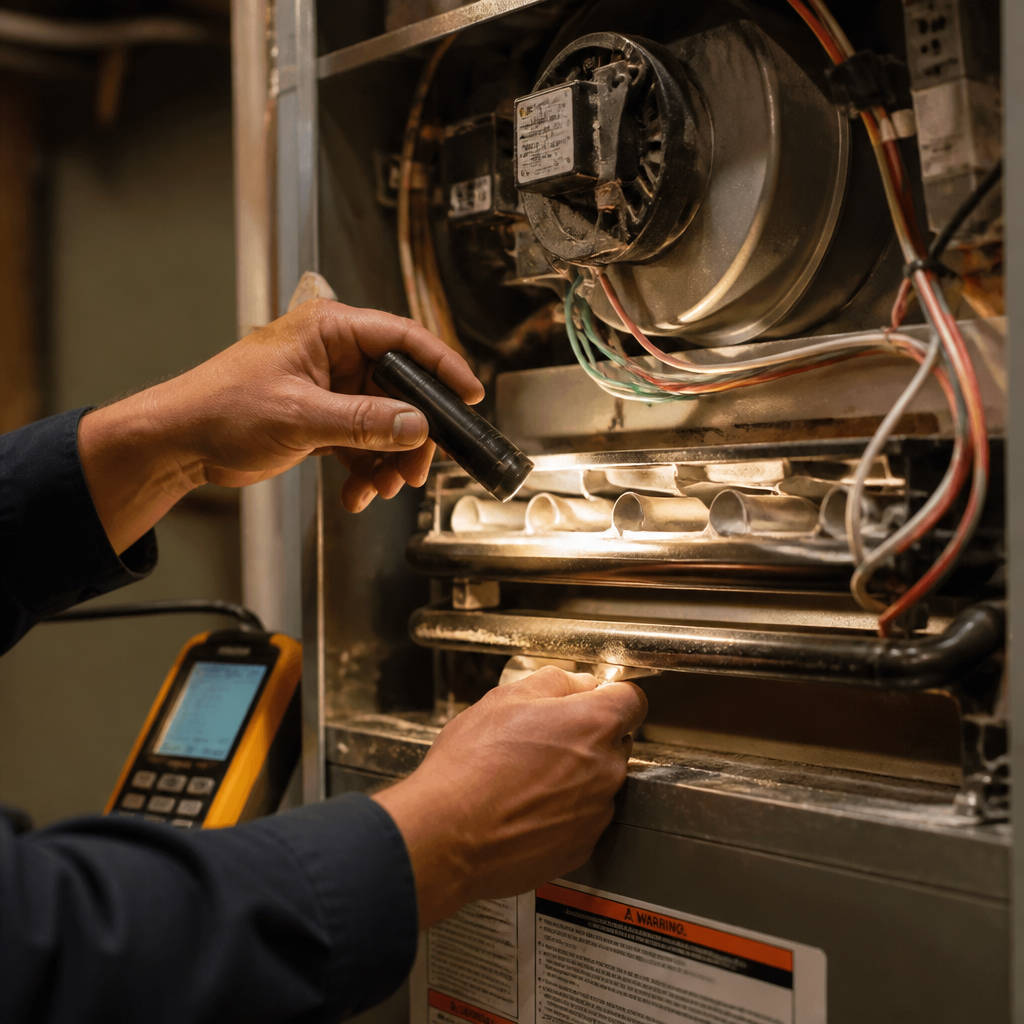
Gas furnaces are common in older Phoenix-area homes and in properties where natural gas service is available. They are robust but not immune to the effects of prolonged inactivity and Arizona's heat-to-cold cycling. Here are the warning signs that matter most.
The Furnace Struggles or Fails to Start
A properly working furnace should respond quickly when your thermostat calls for heat. If it hesitates, needs several restart attempts, or shuts off before completing a full heating cycle, the ignition system, safety switches, or wiring are likely involved. Older systems with standing pilot lights are particularly vulnerable to this, but modern electronic ignition systems are not immune, especially after a long idle period.
In practice, the first thing to check is the thermostat itself. Confirm it is set to HEAT and set above the current room temperature. Also check that the furnace's power switch (the wall-mounted switch that looks like a light switch, usually near the unit) is in the ON position. If those basics are fine and the unit still will not start consistently, the problem is inside the system and needs a technician.
Short Cycling: Starting and Stopping Too Frequently
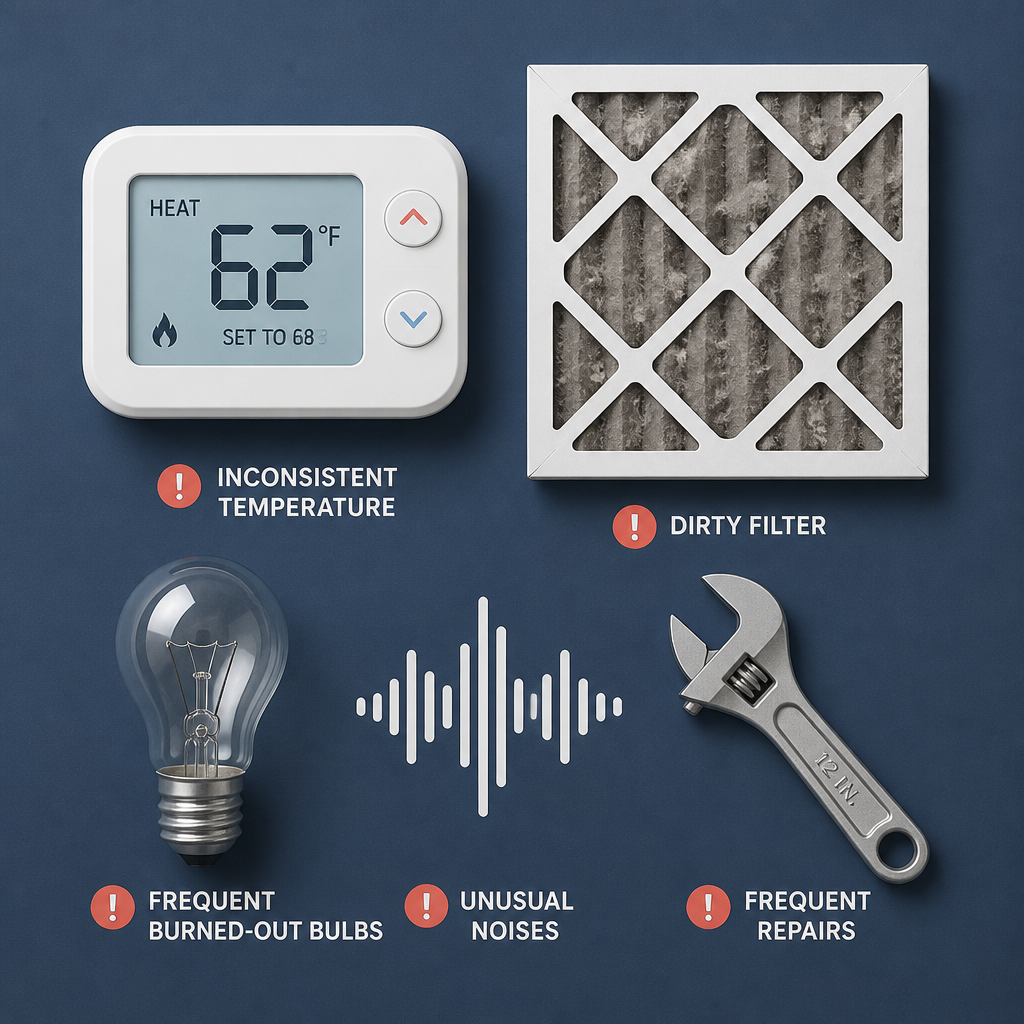
Short cycling is one of the most telling signs that something is wrong. The furnace kicks on, runs for a few minutes, shuts off, and then starts the cycle over without actually warming the home to the set temperature. This rapid cycling puts stress on electrical components and almost always signals one of three problems: restricted airflow from a clogged filter, an overheating heat exchanger triggering a safety shutoff, or a miscalibrated thermostat.
A dirty air filter is the most common and most easily fixed cause. Replace it first. If the short cycling continues after a new filter is in place, call for a professional diagnostic. Running a short-cycling furnace repeatedly will accelerate wear on components and can lead to a full breakdown quickly.
Unusual Noises During Operation
Furnaces are not silent, but they should not be alarming. A low hum, the click of ignition, and the sound of air moving through ducts are all normal. What is not normal: banging or booming sounds when the unit starts, which often indicate delayed ignition where gas accumulates before lighting. High-pitched squealing points to a worn blower motor belt or failing bearings. Grinding sounds suggest the motor bearings are close to failure. Rattling can mean loose panels or components vibrating during operation.
Do not ignore new noises and assume they will resolve on their own. A bang at startup can crack a heat exchanger over time. A grinding motor will eventually seize entirely. These are systems telling you they need attention now, not after the next cold front.
Yellow or Orange Burner Flame
If your gas furnace has a viewing window and you can see the burner flames, the color matters. A healthy gas burner produces a steady, crisp blue flame. Yellow, orange, or unevenly flickering flames indicate incomplete combustion. This is not just an efficiency problem. Incomplete combustion produces carbon monoxide, a colorless, odorless gas that poses a serious health risk to everyone in the home.
A yellow flame is a call-for-service situation, not a wait-and-see one. Turn the system off and contact an HVAC professional promptly.
Persistent Burning or Electrical Odors
When a furnace fires up for the first time after a long Arizona summer, a brief dusty or slightly burning smell is normal. Dust settles on the heat exchanger and burns off during the first cycle. This smell should clear within 15 to 30 minutes of first use. What is not normal is a persistent burning smell, or any odor that smells like melting plastic, hot metal, or electrical insulation. Those smells point to overheating components and can be a precursor to a fire or electrical failure. Have a technician inspect the system before running it again.
Pro tip: If you ever smell natural gas near your furnace, do not attempt to investigate or reset anything. Leave the house immediately, avoid using any electrical switches, and call your gas utility from outside. Gas leaks require emergency response, not a maintenance appointment.
Heat Strip Warning Signs Phoenix Homeowners Often Miss
Many Phoenix-area homes, particularly those built in the 1990s through the 2010s with heat pump systems, use electric heat strips rather than gas furnaces for supplemental or primary heating. Heat strips are resistance heating elements installed in the air handler. When the heat pump cannot extract enough heat from cold outside air, or during certain thermostat demand modes, the heat strips activate to warm the supply air.
Heat strip failures are distinctly different from furnace failures in one important way: they are often silent. The system runs, the blower moves air, but the air coming out of your registers is simply not warm enough. Many homeowners assume the thermostat is off or the system just takes time to warm up, and they live with inadequate heat for days before realizing something is actually wrong.
Air Is Blowing But Not Warming
This is the most common heat strip symptom. Hold your hand near a supply register while the system is running in heat mode. The air should feel genuinely warm, not just slightly above room temperature. If the air feels only mildly warm or cool, one or more heat strips have failed or a thermal cutout has tripped.
Individual heat strip elements can fail independently. A system with two or three strip sets may still produce some heat with one failed element, making the problem easy to miss until outdoor temperatures drop further and the remaining strips cannot compensate.
Tripped Circuit Breakers for the Air Handler
Heat strips draw a significant amount of electrical current. A failing strip element or a failing contactor can draw excess current and trip the dedicated circuit breaker in your electrical panel. If you find a tripped breaker for the air handler and the system is not heating, reset it once and observe. A breaker that trips again immediately or repeatedly is telling you there is an electrical fault in the heating system that needs professional diagnosis. Do not keep resetting it.
The System Runs Longer Than It Used To
A heating system that used to bring a Phoenix home to temperature within 20 to 30 minutes but now runs for an hour without reaching the set point is working harder to compensate for reduced output. This can come from a partially failed heat strip set, a failing heat pump compressor during cold weather operation, or a combination of both. The energy impact is real: you are paying for a system that is not delivering what it should.
Gas Furnace vs. Electric Heat Strips: Failure Patterns Compared
Because both system types are common across Phoenix, Tempe, Mesa, and the surrounding East Valley, it is worth understanding how they fail differently. This comparison helps you describe the problem accurately when you call for service and helps you assess urgency.
| Failure Category | Gas Furnace | Electric Heat Strips |
|---|---|---|
| Most common warning signs | Difficulty starting, short cycling, unusual noises, yellow flame, smell of gas or burning | Inadequate warmth despite system running, tripped breakers, longer run times, no warm air at registers |
| Safety risk level | Higher: gas leaks and carbon monoxide are serious hazards requiring immediate response | Moderate: electrical faults and overheating are risks but generally do not produce toxic gases |
| How failure announces itself | Usually obvious: noises, odors, or visible flame issues give clear signals | Often silent: the system appears to run normally but heat output is insufficient |
| Common repair components | Igniter, heat exchanger, gas valve, blower motor, limit switch, thermocouple | Heating elements, contactors, thermal cutouts, sequencers, control boards |
| DIY-accessible checks | Thermostat setting, filter replacement, power switch position | Thermostat setting, filter replacement, circuit breaker check |
| When to call immediately | Gas smell, yellow flame, CO detector alarm, no ignition after basic checks | Repeated tripped breakers, burning electrical smell, zero heat output |
The practical takeaway from this comparison: gas furnace problems tend to be louder and more obvious, which means they get addressed faster. Heat strip failures are quiet, which means they often go ignored longer. If you have a heat pump system with electric heat strips in your Ahwatukee or Chandler home, build the habit of physically feeling your supply air temperature at the start of each heating season rather than simply assuming the system is working because the fan is running.
Warning Signs You Should Never Ignore
Some heating system symptoms warrant the same-day response, not a "schedule when convenient" approach. Knowing the difference matters.
Carbon Monoxide Detector Alarms
If your CO detector goes off while your heating system is running, take it seriously every time. Do not assume it is a false alarm. Get everyone out of the house, leave the door open, and call emergency services. After the immediate situation is resolved, do not use your heating system again until a licensed HVAC technician has inspected the heat exchanger for cracks. A cracked heat exchanger on a gas furnace allows combustion gases to mix with supply air, and no amount of DIY fixes that problem safely.
The System Heats One Part of the Home But Not Others
Consistent temperature throughout the home is what a properly functioning heating system delivers. If your living room reaches the set point while bedrooms, hallways, or a specific zone remains cold, the problem is either the duct system or the heating equipment itself. In Arizona homes, this symptom is often tied to duct leakage that developed over the summer or a failing blower motor that cannot push enough air to distant rooms. Both conditions waste energy and compromise comfort.
Your Energy Bills Spike Without a Corresponding Change in Weather
A heating system that has lost efficiency runs longer to maintain temperature. When blower motors get dirty, heat exchangers crack, or heating elements degrade, the system consumes more energy for the same output. If your November or December utility bill is noticeably higher than the same period last year and you have not made any changes to your thermostat settings, your heating equipment is the first place to look.
Catching a heating problem in October or early November is almost always cheaper than addressing it as an emergency repair in January. A system that gives you warning signs is a system that still has time on its side, and so do you.
Repair or Replace: How to Decide
Not every heating repair in Phoenix makes financial sense. At some point, the cost of continuing to repair an aging system exceeds the cost of replacing it, and that crossover point is worth knowing before you approve a large repair bill.
Age of the System
Gas furnaces typically have a functional lifespan in the range of 15 to 20 years. Heat pump systems, which also handle air conditioning, tend to see more operating hours in Arizona and may reach the end of their efficient life closer to the 12 to 15 year mark. If your system is approaching or past these ranges and is presenting major failure symptoms, the honest calculation is often replacement rather than repair.
The 50 Percent Rule
A widely used guideline in the HVAC trade is this: if the repair cost exceeds 50 percent of the cost of a new system, and the existing system is more than halfway through its expected lifespan, replacement is almost always the better investment. This is not a hard rule, but it is a useful starting point when evaluating a repair estimate for a major component like a heat exchanger or compressor.
When Repair Clearly Makes Sense
If the system is under ten years old, the repair cost is modest relative to replacement, and the failure is a single component (an igniter, a contactor, a bad thermostat), repair is the right call. A well-maintained system in the five-to-ten year range has plenty of useful life remaining, and most single-component failures are straightforward service jobs.
Pro tip: When a technician at Brewer's Air Conditioning and Heating diagnoses your system, ask for the repair cost alongside a ballpark replacement cost so you can make an informed comparison. Flat-rate pricing means no surprises on the repair side, and an honest technician will tell you when repair is not the right answer for your situation.
Frequently Asked Questions
How often should I have my heating system serviced in Phoenix?
Once a year, ideally in September or October before the heating season begins. Arizona's extended cooling season means heating equipment sits idle for months, and a pre-season tune-up identifies problems while you still have time to schedule repairs without urgency. A standard heating maintenance visit typically includes inspecting the heat exchanger or heat strips, testing ignition, checking electrical connections, measuring airflow, and replacing the filter if needed.
What does it mean when my furnace keeps turning on and off quickly?
This is called short cycling and it almost always means something is preventing the system from completing a normal heating cycle. The most common causes are a clogged air filter restricting airflow, an overheating heat exchanger triggering a high-limit safety shutoff, or a faulty thermostat. Start by replacing the air filter. If short cycling continues, stop running the system and call for service, because continuing to operate a short-cycling furnace accelerates component wear.
Are heat strips common in Phoenix homes, and how do I know if my home has them?
Heat strips are very common in Phoenix-area homes with heat pump systems, which are widely installed in residential construction across the East Valley. If you have a heat pump rather than a gas furnace, your air handler almost certainly has electric heat strips as backup or supplemental heat. You can confirm this by looking at your air handler unit (usually in the attic or a closet) for a label indicating "electric heat" or "aux heat," or by checking with your HVAC service provider.
Is it safe to run my furnace if I smell something burning?
A brief, mild dusty smell during the first run of the season is generally harmless, the result of dust burning off heat exchangers after months of inactivity. It should clear in 15 to 30 minutes. A persistent burning smell, a smell like melting plastic or rubber, or any electrical odor means you should turn the system off and call an HVAC professional before running it again. These odors indicate overheating components that can cause more serious damage or a fire if left unaddressed.
How much does furnace or heating repair typically cost in the Phoenix area?
Repair costs vary considerably depending on the component involved and the system type. A simple igniter replacement or thermostat fix is generally far less expensive than a heat exchanger repair or a failed control board. Brewer's Air Conditioning and Heating uses upfront flat-rate pricing, which means the price is confirmed before work begins rather than after. The most useful thing to know is that a diagnostic visit gives you a real number to evaluate, and getting that number in October rather than in the middle of a cold snap gives you options a December emergency call does not.
What is the difference between emergency heat and normal heat on my thermostat?
On a heat pump thermostat, "emergency heat" bypasses the heat pump and runs only the electric heat strips inside the air handler. It is intended for situations where the heat pump has failed and you need to maintain some level of warmth. Running on emergency heat continuously is significantly more expensive than normal operation and should only be used as a temporary measure while waiting for repairs. If you find yourself switching to emergency heat to stay warm, that is a clear sign your heat pump needs professional service.
Does Brewer's Air Conditioning and Heating service both residential and commercial heating systems in the Phoenix area?
Yes. Brewer's serves both residential homeowners and commercial building owners and facility managers across Phoenix, Tempe, Scottsdale, Mesa, Ahwatukee, Chandler, Gilbert, and surrounding communities. Commercial HVAC systems, including rooftop units with gas heat sections and large air handlers with electric heating elements, require the same fall inspection discipline as residential systems, often more so given the consequences of a heating failure in an occupied commercial building.
Have you noticed any of these warning signs with your heating system this fall? Share your experience or question in the comments, and the team at Brewer's is happy to help you think through what you are seeing.
References
- Top signs your furnace may need repair, from a major HVAC equipment manufacturer
- Detailed guide to furnace repair warning signs including flame color and unusual noises
- Signs your furnace needs repair, covering short cycling, energy spikes, and blower issues
- Ten clear signs your furnace needs repair, with specific guidance for Arizona heating seasons
- Warning signs that a gas furnace or heat pump needs repair before it fails completely
About the Author
Mark Ybarra
Mark Ybarra is the owner and leader of Brewer's Air Conditioning & Heating, a trusted HVAC company serving Tempe, Phoenix, Scottsdale, Mesa, and surrounding Arizona communities since 1982. After working in multiple roles within the company, Mark officially took ownership in 2018 and continues to uphold Brewer's long-standing commitment to integrity, exceptional service, and customer satisfaction.
Need HVAC Help?
Serving Phoenix, Tempe, Scottsdale, Mesa & surrounding areas since 1982.