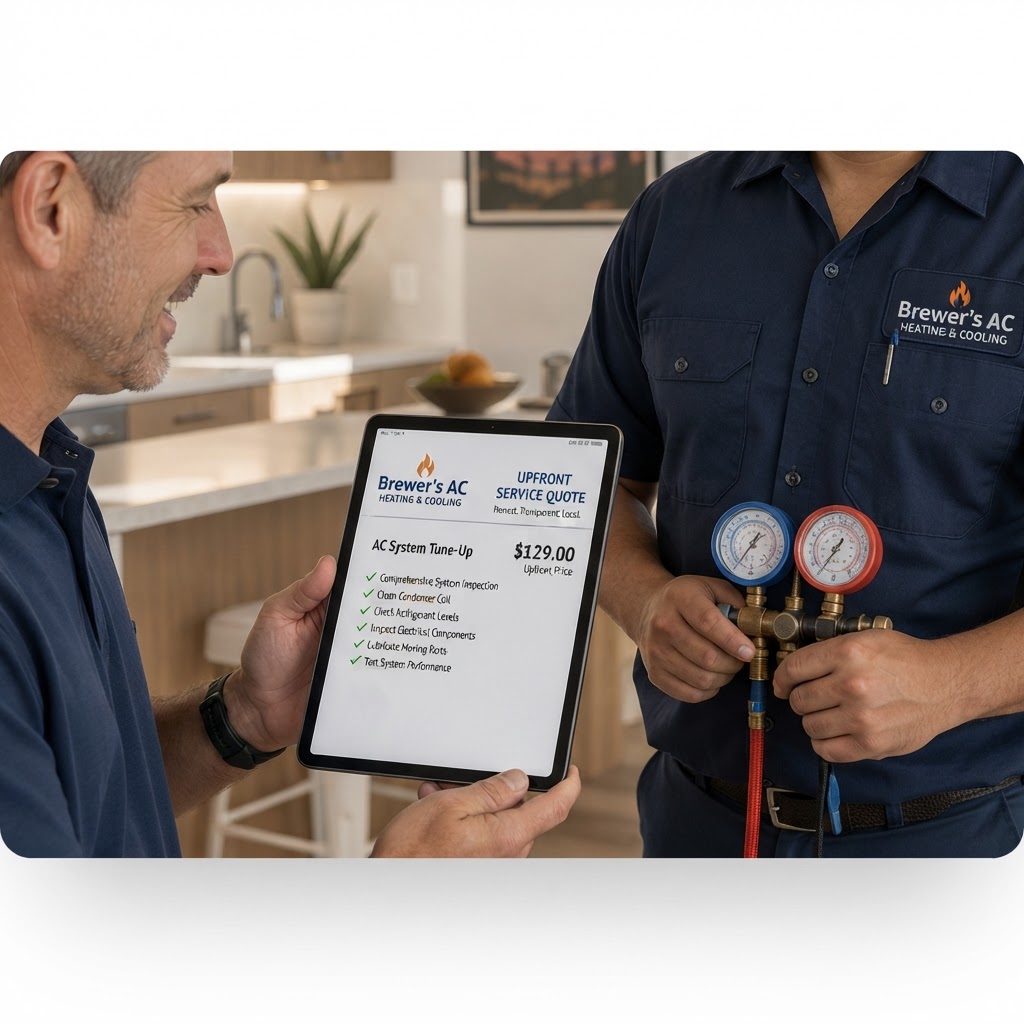
Most Phoenix homeowners dread the HVAC service call not because of the repair itself, but because of the invoice. Hourly billing models leave you guessing while a technician works, and the final number can land anywhere from reasonable to shocking. Flat-rate AC repair pricing in Phoenix eliminates that uncertainty entirely. At Brewer's Air Conditioning and Heating, every job is quoted before a single bolt turns, so you approve the price before work begins. This guide explains exactly how that model works, why it benefits you, and what to watch for when comparing HVAC companies across Phoenix, Tempe, Scottsdale, and the east valley.
What Is Flat-Rate HVAC Pricing?
Flat-rate pricing means you receive a fixed price for a defined scope of work before the technician starts. The quote covers labor and parts together. If the repair takes two hours or four hours, your price does not change. The HVAC company absorbs any additional time spent on a job that runs long.
This model originated in the auto repair industry and moved into skilled trades including HVAC, plumbing, and electrical work over the past three decades. The driving reason was consumer frustration. Hourly billing creates a conflict of interest: the slower a technician works, the more the homeowner pays. Flat-rate pricing removes that conflict entirely.
In practice, flat-rate HVAC companies build comprehensive pricing books that account for the average time and materials required for hundreds of distinct repair and installation tasks. The price you see reflects that calculated average, not however long your particular technician happens to take on a given afternoon.
How Brewer's Flat-Rate Pricing Works in Practice
Brewer's Air Conditioning and Heating has served central Arizona since 1982. The flat-rate model is not a recent marketing addition. It has been core to how the company operates because it aligns the technician's incentive with the customer's interest: get the repair done correctly and efficiently.
Step 1: Diagnostic Assessment
A Brewer's technician arrives, inspects your system, and identifies the problem. This diagnostic step is completed before any repair quote is issued. You pay for the service call, and in return you get an accurate picture of what is wrong with your equipment.
Step 2: Upfront Written Quote
Once the diagnosis is complete, the technician presents a written flat-rate quote for the repair or replacement needed. That number covers all labor and standard parts. You review it, ask questions, and decide whether to proceed. No work begins until you sign off.
Step 3: Repair and Final Invoice
The technician completes the work. Your final invoice matches the quote you approved. There are no line items added afterward for extra time, travel, or incidental supplies. What you agreed to is what you pay.
Pro tip: Always ask any HVAC company, including Brewer's, to put the full scope of work in writing before you approve a repair. A verbal flat-rate quote that is not documented is worth very little if a dispute arises later.
| Key Insight | Explanation |
|---|---|
| Price is set before work begins | You approve the exact dollar amount before any repair starts. No retroactive surprises on the invoice. |
| Labor and parts are bundled | The quote covers both components together. You will not see a separate line item for "labor hours" added after the fact. |
| Diagnostic fee applies regardless | You pay for the service call and diagnosis. If you decline the repair, you still owe the diagnostic fee. This is standard and fair. |
| Efficiency benefits the technician too | A skilled technician who finishes faster earns the same rate, so there is no incentive to pad time. |
| Scope changes require a new quote | If a technician discovers additional problems mid-repair, a separate flat-rate quote is issued before that extra work begins. |
| Brand expertise affects pricing accuracy | Brewer's specializes in Trane and Lennox systems. Familiarity with these platforms means quotes are more precise, not padded for uncertainty. |
| Flat-rate does not mean cheapest upfront | Some hourly quotes look lower initially. The flat-rate number reflects realistic total cost, including materials, not just a starting labor rate. |
Flat-Rate vs. Hourly vs. Time-and-Materials: A Direct Comparison
Phoenix homeowners comparing HVAC companies will encounter three distinct pricing structures. Understanding the difference matters a great deal when your AC unit fails at 4 PM in August and you need to make a quick decision about who to call.
The data consistently shows that consumers prefer price certainty over price flexibility. A 2023 PwC consumer survey found that transparent pricing ranks among the top three factors driving repeat business across service industries. HVAC is no exception. When temperatures in the Phoenix metro hit 110 degrees Fahrenheit, a surprise invoice on top of an already stressful situation damages trust permanently.
| Pricing Model | How It Works | Risk to Homeowner |
|---|---|---|
| Flat-Rate (Brewer's AC model) | Fixed price per defined repair task, quoted upfront before work begins. Labor and parts included. | Low. You know the total cost before committing. |
| Hourly Billing | A per-hour labor rate is charged for actual time spent on site. Parts are billed separately at retail or marked-up cost. | High. A complex job or slow technician directly inflates your bill. No ceiling on total cost. |
| Time-and-Materials | Hybrid model where labor is billed hourly and materials are billed at cost plus a markup percentage. Common in commercial HVAC contracts. | Medium. More transparent on parts cost than pure hourly, but total cost still unpredictable. |
A common mistake homeowners make is comparing only the stated hourly rate between HVAC companies. A company charging $95 per hour sounds cheaper than a flat-rate quote of $380 for a capacitor replacement. But if that hourly job takes five hours due to unforeseen complexity, the final bill reaches $475 or more before parts. The flat-rate quote was the better deal.
What Affects Your Flat-Rate Quote in Arizona
Flat-rate does not mean every repair costs the same regardless of circumstances. Several legitimate variables influence where a specific repair falls within the pricing book. Understanding these factors helps you evaluate any quote you receive with confidence.
Equipment Brand and Age
Repairing a 20-year-old generic brand unit often costs more than servicing a current-generation Trane or Lennox system. Older equipment requires more diagnostic time and parts that may need to be sourced specially. Brewer's expertise with Trane and Lennox means those repairs are priced with high accuracy because technicians know these systems in detail.
Type of Repair Required
A capacitor swap is straightforward. A refrigerant leak diagnosis and repair involves pressure testing, leak detection, evacuation, and recharge, which is a multi-step process that costs proportionally more. Each distinct repair task has its own flat-rate price entry.
Residential vs. Commercial Systems
Commercial HVAC systems in the Phoenix metro, including rooftop units serving retail and office buildings, are physically larger and mechanically more complex. Commercial flat-rate pricing reflects that complexity. Facility managers in Tempe or Scottsdale should expect higher base prices per task compared to residential work, which is still entirely appropriate given the equipment scale.
Maintenance Agreement Status
Brewer's customers enrolled in preventive maintenance agreements typically receive priority scheduling and reduced flat-rate pricing on covered repairs. This is a direct financial incentive to stay current on maintenance, not just a marketing promise. In Arizona's climate, where systems run eight to ten months of the year, that discount can add up meaningfully over time.
Pro tip: Before your summer cooling season begins, get a preventive maintenance visit scheduled with Brewer's. Catching a failing capacitor or low refrigerant charge in April costs far less as a flat-rate maintenance repair than an emergency diagnostic call in July when every HVAC company in Phoenix is fully booked.
Common AC Repairs and Typical Flat-Rate Ranges in Phoenix
Specific numbers matter. Vague reassurances about "competitive pricing" tell you nothing. The ranges below reflect typical flat-rate market pricing for common AC repairs in the Phoenix metro area. Exact figures vary by company, equipment, and access difficulty. Use these ranges to evaluate whether a quote you receive is reasonable, not to predict your exact bill to the dollar.
According to HomeAdvisor's national cost data, the average AC repair in the United States runs between $150 and $700, with emergency calls and refrigerant work pushing toward the higher end. Phoenix pricing aligns closely with that national range, though emergency summer rates can exceed it when demand peaks.
- Capacitor replacement: $150 to $400. One of the most common summer failures in Arizona. A flat-rate quote handles this quickly.
- Contactor replacement: $200 to $350. Often replaced alongside a failing capacitor.
- Refrigerant recharge (R-410A): $250 to $600 depending on quantity needed. Note that this does not fix an underlying leak. Leak detection and repair is a separate line item.
- Evaporator coil cleaning: $100 to $400. Preventive maintenance pricing is typically lower than emergency service pricing for the same task.
- Blower motor replacement: $400 to $900 including the motor part and labor.
- Compressor replacement: $1,200 to $2,800. At this price point, a full system replacement often makes more financial sense depending on equipment age.
"Price transparency is not a courtesy, it is a baseline expectation. Consumers who receive a clear upfront price are significantly more likely to approve the work immediately and recommend the service provider afterward." - Forbes Advisor, consumer trust in home services reporting.
Red Flags to Watch for in HVAC Pricing Practices
Not every HVAC company advertising "flat-rate pricing" in Phoenix delivers the same standard. Some use the phrase loosely to mean they have a starting rate, not a fixed total cost. Here is what to watch for when evaluating any company, whether you are considering Brewer's or comparing with Parker and Sons, Goettl, Penguin Air, or a local competitor.
The Low Diagnostic Fee Bait
A $39 diagnostic fee sounds appealing until the technician is on your roof and presents a parts-and-labor invoice built entirely on inflated retail markups. The diagnostic fee is not the measure of a company's pricing fairness. Look at the total repair quote before you commit to anything.
Verbal Quotes Without Written Documentation
If a technician quotes you a price verbally and begins work before you have signed anything, you have no recourse if the invoice comes in higher. Require written documentation every time, for every job.
Pressure to Decide Immediately
A technician who creates urgency to push you into an expensive same-day decision, particularly for equipment replacement, is a red flag. Legitimate flat-rate companies give you the quote and let you decide on your schedule. Brewer's has served Arizona since 1982 without needing high-pressure sales tactics. A company that relies on pressure to close jobs is covering for weak pricing confidence.
Unusual Add-On Line Items After the Fact
True flat-rate invoices do not include surprise line items for "disposal fees," "safety surcharges," or "environmental fees" that were not disclosed in the original quote. If your invoice includes items that were not in the written quote, dispute them immediately and in writing.
The Federal Trade Commission maintains consumer guidance on unfair or deceptive pricing practices in service industries. Knowing your rights as a consumer before you call any HVAC company gives you a stronger position in that conversation.
Frequently Asked Questions
Does flat-rate pricing mean I pay the same as my neighbor for the same repair?
Not necessarily. Flat-rate pricing means the price is fixed before work begins, but variables like equipment brand, age, access difficulty, and repair complexity affect where within the pricing book your specific job falls. Your neighbor's capacitor replacement on a ground-level unit may be priced differently than yours on a rooftop commercial system in Tempe.
What happens if the technician discovers additional problems mid-repair?
Under a proper flat-rate model, any additional work discovered after the original quote is issued requires a new, separate written quote. The technician stops, presents the new scope and price, and waits for your approval before continuing. You should never receive a larger invoice than what you signed for without a new authorization step in between.
Is flat-rate HVAC pricing more expensive than hourly billing in Phoenix?
For simple, quick repairs, hourly billing can occasionally be cheaper in raw dollar terms. But for any repair with complexity or uncertainty, flat-rate pricing almost always protects the homeowner from a larger final bill. The greater risk with hourly billing is that you have no ceiling on total cost. Flat-rate pricing gives you a ceiling before work begins.
Does Brewer's AC offer flat-rate pricing for commercial HVAC jobs in Arizona?
Yes. Brewer's serves commercial building owners and facility managers across Phoenix, Tempe, Scottsdale, and surrounding areas. Commercial flat-rate pricing reflects the larger scale and complexity of commercial systems, but the same principle applies: you receive a written quote before work begins and the final invoice matches that quote.
How do I verify that a Phoenix HVAC company's flat-rate pricing is legitimate?
Ask for the written quote before authorizing any work. Read the quote carefully for scope limitations or exclusions. Ask whether the price covers parts and labor or labor only. Request clarification on what happens if additional repairs are needed during the job. A company with genuine flat-rate pricing will answer all of these questions clearly and without hesitation.
Does a maintenance plan with Brewer's affect flat-rate repair pricing?
Yes, actively. Brewer's maintenance agreement customers receive priority scheduling and discounts on repair pricing. Given that Arizona HVAC systems run at high intensity for most of the year, that discount structure rewards customers who invest in preventive care rather than waiting for emergency breakdowns in peak summer heat.
If you have experienced flat-rate HVAC pricing in the Phoenix area, whether with Brewer's or another company, share what that process looked like for you and whether the final invoice matched your upfront quote.
References
- Federal Trade Commission guidance on deceptive pricing and consumer rights in service industries
- Forbes reporting on consumer trust, price transparency, and service industry best practices
- Statista data on HVAC industry market size, service pricing trends, and consumer behavior in the United States
- U.S. Department of Energy resources on home cooling systems, efficiency standards, and HVAC maintenance guidance
- U.S. Environmental Protection Agency information on refrigerant regulations and HVAC technician certification requirements
About the Author
Mark Ybarra
Mark Ybarra is the owner and leader of Brewer's Air Conditioning & Heating, a trusted HVAC company serving Tempe, Phoenix, Scottsdale, Mesa, and surrounding Arizona communities since 1982. After working in multiple roles within the company, Mark officially took ownership in 2018 and continues to uphold Brewer's long-standing commitment to integrity, exceptional service, and customer satisfaction.
Need HVAC Help?
Serving Phoenix, Tempe, Scottsdale, Mesa & surrounding areas since 1982.