Chandler summers are not forgiving. When daytime highs sit above 110°F for weeks at a time, your air conditioner is not a comfort item - it is a survival tool. The problem is that most AC failures do not happen without warning. They announce themselves weeks in advance through sounds, smells, and performance changes that most homeowners either ignore or misread. If you are searching for AC repair in Chandler AZ, you are likely already noticing something is off. This guide breaks down the seven most reliable warning signs that your system is headed toward failure, what each one actually means mechanically, and what to do before you end up in a 115-degree house with a dead unit.
Table of Contents
- Sign 1: Warm Air Blowing From Your Vents
- Sign 2: Unusual Noises During Operation
- Sign 3: Skyrocketing Energy Bills
- Sign 4: Frequent Cycling On and Off
- Sign 5: Excess Humidity Indoors
- Sign 6: Refrigerant or Water Leaks Around the Unit
- Sign 7: System Age and R-22 Refrigerant Dependency
- Comparing Your Options: Repair, Replace, or Maintain
- Frequently Asked Questions
Quick Takeaways
| Key Insight | Explanation |
|---|---|
| Warm air from vents is almost never a thermostat problem alone | It typically signals a refrigerant leak or compressor issue requiring professional diagnosis, not a DIY thermostat adjustment. |
| Short cycling destroys compressors over time | An AC that turns on and off every few minutes is working harder with less cooling output, accelerating mechanical wear in Chandler's heat. |
| A 15% to 20% spike in your electric bill signals efficiency loss | According to the U.S. Department of Energy, an inefficient system can use significantly more electricity for the same output, especially in extreme heat climates. |
| Systems over 10 to 12 years old in Arizona face accelerated wear | The average national AC lifespan is 15 to 20 years, but Arizona's extreme heat shortens that window considerably. |
| R-22 refrigerant is no longer manufactured in the U.S. | If your system uses R-22, repair costs are now extremely high and replacement is almost always the smarter financial decision. |
| Humidity problems indoors point to a failing evaporator coil | A properly functioning AC removes moisture from air. When it stops doing that in Chandler's monsoon season, comfort and air quality both suffer. |
| Refrigerant leaks are not self-fixing | Topping off refrigerant without finding and sealing the leak is a temporary patch that delays a larger, more expensive failure. |
Sign 1: Warm Air Blowing From Your Vents
This is the most obvious warning sign, and it is also the most misdiagnosed. Most homeowners immediately blame the thermostat, lower the set point by a few degrees, and wait. That response burns more electricity without solving the actual problem.
In practice, warm air from supply vents during peak summer heat in Chandler points to one of three issues: a low refrigerant charge from a leak, a failing compressor that cannot compress refrigerant properly, or a frozen evaporator coil caused by restricted airflow. All three require a licensed HVAC technician to diagnose accurately.
Why Refrigerant Loss Is the Most Common Culprit
Refrigerant does not get used up like gasoline. If your system is low on refrigerant, there is a leak somewhere in the system. A common mistake is to simply have refrigerant added without locating and repairing the leak. The system will cool again temporarily, but the leak continues, and you will be back in the same position within weeks or months.
Pro tip: If your vents are blowing room-temperature or warm air and you hear a hissing or bubbling sound near the indoor or outdoor unit, stop running the system and call a technician immediately. Continuing to run a refrigerant-depleted system can permanently damage the compressor, which is the single most expensive component to replace.
Sign 2: Unusual Noises During Operation
A properly functioning air conditioner is not silent, but it operates within a predictable range of sounds. When new sounds appear, they are almost always mechanical signals worth taking seriously. Ignoring them is how a $200 repair becomes a $2,000 repair.
What Each Sound Actually Means
Grinding or screeching from the outdoor unit typically means the fan motor bearings are worn or the motor is failing. In Chandler's dust-heavy environment, outdoor components take additional abuse from debris and temperature swings.
Banging or clanking usually indicates a loose or broken component inside the compressor or blower assembly. This is a stop-operating-immediately situation. Running a system with a broken internal component causes cascading damage.
Clicking that repeats every few seconds at startup and shutdown often signals a failing relay or capacitor. Capacitors are relatively inexpensive parts, but a failed capacitor will prevent the system from starting at all, which in a Chandler summer is not a situation you want to discover on a Saturday afternoon.
The data consistently shows that noise-related HVAC service calls are among the most preventable. Most of the components that cause these sounds, capacitors, fan motors, and contactor relays, are wear items with a known lifespan. Annual maintenance catches these before they fail in peak season.
Sign 3: Skyrocketing Energy Bills
Your electricity bill in Chandler during July is never going to be low. APS and SRP customers in the east valley know that summer bills of $250 to $400 or more are common for standard-sized homes. But if your bill jumps 20% to 30% over the same month from the prior year without a change in usage habits, your AC system is working harder than it should to deliver the same result.
According to the U.S. Department of Energy, heating and cooling account for approximately 43% of a home's total energy use. An underperforming system does not just cool less effectively - it drives up operating costs continuously until the underlying problem is fixed.
Dirty Coils Are a Hidden Efficiency Killer
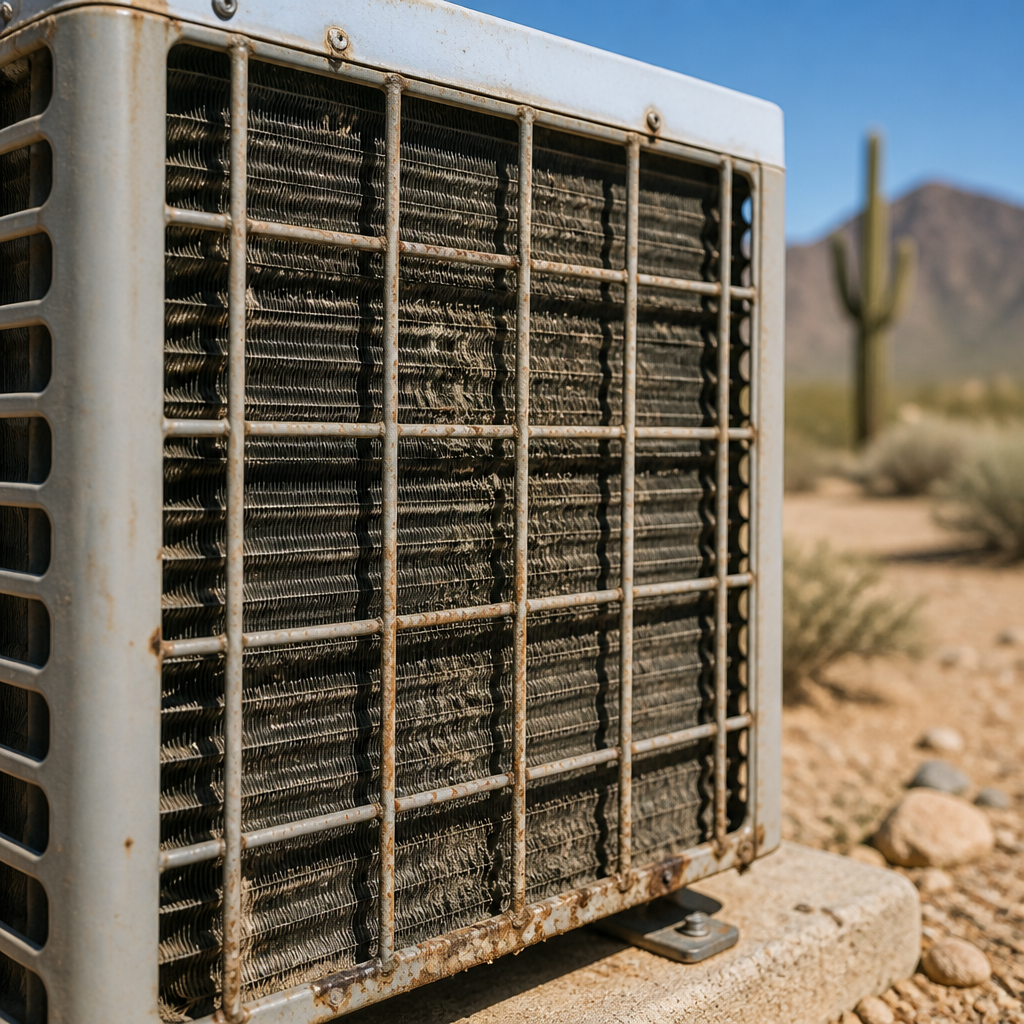
Chandler's environment is particularly hard on condenser coils. Dust, pollen, and debris accumulate on the outdoor coil fins, reducing the system's ability to reject heat. A coil that is only 30% blocked can reduce efficiency by 20% or more. This is one of the most straightforward things a technician can address during a maintenance visit, and the efficiency gain is immediate.
Pro tip: Compare your kilowatt-hour usage from this July to last July directly on your APS or SRP online account, not just the dollar amount. Rate changes can mask usage spikes. If your kWh consumption is up 15% or more with similar thermostat settings, schedule a diagnostic call before the problem compounds further into the season.
Sign 4: Frequent Cycling On and Off
Short cycling is the term HVAC professionals use when an air conditioner turns on, runs for two to five minutes, shuts off, and then repeats that cycle rapidly instead of completing a full cooling run. This is not the system being efficient. It is the system failing to do its job and stressing its components in the process.
There are several causes specific to Arizona systems. An oversized unit installed incorrectly will cool the space too quickly before proper dehumidification occurs, triggering the thermostat prematurely. A refrigerant leak causes the system to lose cooling capacity mid-cycle, triggering a safety shutoff. An overheating compressor, common when outdoor temperatures exceed 110°F, will also shut down on thermal overload protection.
The Long-Term Damage Short Cycling Causes
The compressor is most stressed at startup. Every time a system short cycles, the compressor starts under full load again almost immediately. Over weeks of this behavior, compressor windings overheat, capacitors degrade faster, and refrigerant pressure fluctuates outside normal operating ranges. A compressor replacement on a mid-size residential system runs $1,200 to $2,500 or more. That cost makes a diagnostic call look like a very reasonable investment.
Sign 5: Excess Humidity Indoors
Arizona is known for dry heat, but Chandler and the surrounding east valley experience significant humidity during the monsoon season, which runs from mid-June through September. A properly functioning AC system removes moisture from indoor air as a natural part of the cooling process. When it stops doing that effectively, you notice it immediately: the air feels heavy, windows fog slightly, and the home never quite feels comfortable despite the thermostat reading a low temperature.
A sticky, humid indoor environment during monsoon season points to a failing evaporator coil, improper refrigerant charge, or an oversized system that does not run long enough to pull adequate moisture from the air. Any of these is a diagnosable condition that a qualified technician can identify and address.
Indoor Air Quality Consequences
Excess indoor humidity in Chandler creates a secondary problem beyond comfort: mold and mildew growth in ductwork and on evaporator coil surfaces. This directly affects indoor air quality, which matters especially for households with asthma, allergies, or respiratory conditions. Brewer's Air Conditioning offers indoor air quality solutions that can address these downstream effects once the primary mechanical issue is resolved.
Sign 6: Refrigerant or Water Leaks Around the Unit
Moisture near your indoor air handler is not normal. Some condensation on the refrigerant lines during high-humidity periods is expected, but puddles of water near the indoor unit typically mean the condensate drain line is clogged or the drain pan has overflowed. Left unaddressed, this causes water damage to ceilings, walls, and flooring.
An oily residue around refrigerant line connections on the outdoor unit, on the other hand, is a reliable visual indicator of a refrigerant leak. Refrigerant leaks do not get better on their own. They worsen, and running the system in a depleted state accelerates compressor failure.
Why Arizona Monsoon Season Worsens Drain Clogs
During monsoon season, the evaporator coil pulls significantly more moisture from humid indoor air than it does during dry months. This increased condensate volume flushes more biological growth, dust, and debris into the drain pan and drain line. Systems that run cleanly all spring can develop clogged drains in July simply from the increased moisture volume. A condensate flush during a pre-season tune-up is inexpensive prevention against a $500 to $1,500 water damage repair.
Sign 7: System Age and R-22 Refrigerant Dependency
If your Chandler home's HVAC system was installed before 2010, there is a meaningful chance it uses R-22 refrigerant, also known by the brand name Freon. The U.S. Environmental Protection Agency phased out R-22 production and import in January 2020 under the Clean Air Act. The supply that remains is recycled and reclaimed, which means it is expensive and increasingly scarce.
The data from recent years is clear: R-22 refrigerant that once cost $10 to $15 per pound in 2010 now runs $100 to $200 per pound or more depending on market availability. A system that needs three to four pounds of refrigerant added is now looking at a refrigerant cost alone of $300 to $800, before labor, before any other repairs.
The Age Factor in Arizona's Climate
The nationally cited average AC lifespan of 15 to 20 years assumes moderate climates with normal seasonal cycling. In Chandler and the Phoenix metro, systems run five to seven months at high load each year. This compresses the effective lifespan to 10 to 15 years for many units. A system installed in 2008 that is still limping along on patched repairs is statistically unlikely to survive another full Arizona summer without a significant failure.
"Equipment operating beyond its design lifespan in extreme heat climates should be evaluated annually with replacement cost-benefit analysis in mind, not just repaired reactively." - U.S. Department of Energy, Energy Efficiency and Renewable Energy guidelines for HVAC maintenance
Brewer's Air Conditioning has been serving Chandler and the east valley since 1982. That longevity means their technicians have seen what Arizona heat does to systems across their full lifecycle. When they recommend replacement over repair, it is based on real service history data from this specific climate, not a national average that does not account for 115-degree operating conditions.
Comparing Your Options: Repair, Replace, or Maintain
When your system shows one or more of the warning signs above, you face a decision that has real financial consequences. Here is a direct comparison of the three paths homeowners typically face when dealing with a failing HVAC system in Chandler.
| Option | Best Situation to Use It | Key Risk or Consideration |
|---|---|---|
| Emergency Repair | System is under 10 years old, single component failure (capacitor, contactor, fan motor), no refrigerant leaks, no compressor damage | Reactive repairs during summer peak season in Chandler can carry premium service call costs. Parts availability for older units may delay resolution. |
| Full System Replacement | System is over 12 to 15 years old, uses R-22 refrigerant, has had multiple repairs in the last two seasons, or requires a compressor replacement | Higher upfront cost, but modern Trane and Lennox systems offer SEER2 ratings that reduce monthly energy bills significantly. Brewer's flat-rate pricing removes the guesswork from total cost. |
| Preventive Maintenance Plan | System is in working condition but showing early warning signs (slight efficiency drop, occasional noises), or owner wants to extend system lifespan proactively | Requires consistent scheduling. Skipping one season's tune-up in Arizona negates much of the benefit, especially for coil cleaning and condensate maintenance. |
The 5,000-rule is a practical industry benchmark: multiply the system's age in years by the repair cost in dollars. If the result exceeds $5,000, replacement is typically the financially smarter decision. A 14-year-old system needing a $400 repair scores 5,600 - that alone should trigger a replacement conversation.
Frequently Asked Questions
How much does AC repair in Chandler AZ typically cost?
For common repairs like capacitor replacement, contactor replacement, or a condensate drain flush, costs generally run $150 to $450 depending on the part and labor involved. Refrigerant recharge with leak repair typically ranges from $350 to $800 or more. Compressor replacement is the most expensive single repair at $1,200 to $2,500 or higher. Brewer's Air Conditioning uses upfront flat-rate pricing, so you know the total cost before any work begins, which eliminates the surprise invoices that other companies sometimes deliver.
How do I know if my AC just needs a tune-up or an actual repair?
A tune-up addresses preventive maintenance items: coil cleaning, refrigerant level check, electrical connection inspection, and drain line clearing. An actual repair means something has failed and needs replacement. If your system is cooling adequately but running less efficiently than last year, a tune-up is likely sufficient. If it is showing any of the seven signs described in this article, particularly warm air, short cycling, or unusual noises, you need a diagnostic repair call, not just maintenance.
Is it worth repairing an AC unit that is 15 years old in Arizona?
In most cases, no. A 15-year-old system in Arizona has likely operated through 10 to 12 extreme summer seasons, and its efficiency rating is far below what modern SEER2-rated equipment delivers. Unless the repair is minor and under $300, the financial math almost always favors replacement when you factor in reduced energy bills, no additional repair costs in the near term, and a new manufacturer warranty on a brand like Trane or Lennox.
What causes an AC to fail suddenly during a Chandler summer?
Most sudden failures are not actually sudden. They follow weeks or months of the warning signs described above: short cycling that stresses the compressor, a refrigerant leak that progressively depletes the charge, or a capacitor that has been weakening over multiple seasons. The combination of 110-plus-degree outdoor temperatures and high system demand creates the conditions where a weakened component finally gives out. That is why failures seem to happen at the worst possible time: the system was already at the edge of its capacity.
Can I run my AC if it is making a grinding noise?
No. A grinding noise from either the indoor air handler or the outdoor unit indicates mechanical contact between components that should not be touching, typically worn bearings in a fan motor or a loose blower wheel. Running the system continues that contact, accelerates damage to surrounding components, and can result in a motor or blower replacement that costs three to five times what the original grinding-noise repair would have cost. Shut the system off and call for service.
Does Brewer's Air Conditioning serve Chandler specifically?
Yes. Brewer's Air Conditioning has served Chandler and the broader east valley, including Tempe, Ahwatukee, Mesa, Gilbert, and Phoenix, since 1982. Their technicians are familiar with the specific demands Arizona's climate places on residential and commercial HVAC equipment and carry parts for leading brands like Trane and Lennox to resolve most repairs in a single visit.
Have you noticed any of these warning signs in your own Chandler home this summer? Share your experience or ask a question below - real stories from east valley homeowners help others catch problems before they turn into emergencies.
References
- U.S. Department of Energy - official guidance on home energy use, HVAC efficiency standards, and cooling equipment best practices
- U.S. Environmental Protection Agency - information on refrigerant regulations including the R-22 phaseout under the Clean Air Act
- Energy Saver by DOE - consumer-focused resource on air conditioning maintenance, efficiency ratings, and replacement guidance
- Statista - data on U.S. residential energy consumption, HVAC market statistics, and household cooling costs by region
- Forbes Home - cost estimates and consumer guidance for HVAC repair, replacement decisions, and contractor selection
About the Author
Mark Ybarra
Mark Ybarra is the owner and leader of Brewer's Air Conditioning & Heating, a trusted HVAC company serving Tempe, Phoenix, Scottsdale, Mesa, and surrounding Arizona communities since 1982. After working in multiple roles within the company, Mark officially took ownership in 2018 and continues to uphold Brewer's long-standing commitment to integrity, exceptional service, and customer satisfaction.
Need HVAC Help?
Serving Phoenix, Tempe, Scottsdale, Mesa & surrounding areas since 1982.