Your AC is running. The thermostat says 78. But you are sweating through your shirt and every room in the house feels like a sauna. If this sounds familiar, you are dealing with one of the most frustrating HVAC problems Chandler homeowners face every summer. The issue is not that your system is broken in an obvious way. The issue is that something specific is preventing cool air from reaching you, and without knowing what that something is, you will keep paying high electric bills while staying uncomfortable. Here are the five most common reasons your home stays hot even with the AC running.
Quick Takeaways
| Key Insight | Explanation |
|---|---|
| A clogged filter blocks airflow in minutes | In Chandler's dusty desert climate, air filters can clog in 30 days or less, strangling your system's ability to move cold air through the home. |
| Low refrigerant means the system cannot absorb heat | Refrigerant does not get used up. If it is low, there is a leak somewhere that must be found and repaired, not just refilled. |
| Undersized units run constantly and never catch up | A 2-ton unit in a 2,400 sq ft Chandler home with poor insulation will run all day and never hit your set temperature on a 115-degree afternoon. |
| Duct leaks waste up to 30% of cooled air | The U.S. Department of Energy estimates that leaky ducts can lose 20 to 30 percent of conditioned air before it reaches living spaces. |
| Dirty condenser coils trap heat outside | If the outdoor unit cannot release heat efficiently, the entire refrigeration cycle stalls and your home never cools down. |
| Arizona summers amplify every HVAC weakness | Problems that would be minor in a mild climate become serious comfort failures when outdoor temps exceed 110 degrees Fahrenheit. |
| Most of these issues are detectable before full failure | A licensed HVAC technician can catch refrigerant leaks, airflow issues, and coil contamination during a standard tune-up before they cause a breakdown. |
Reason 1: Dirty or Clogged Air Filter
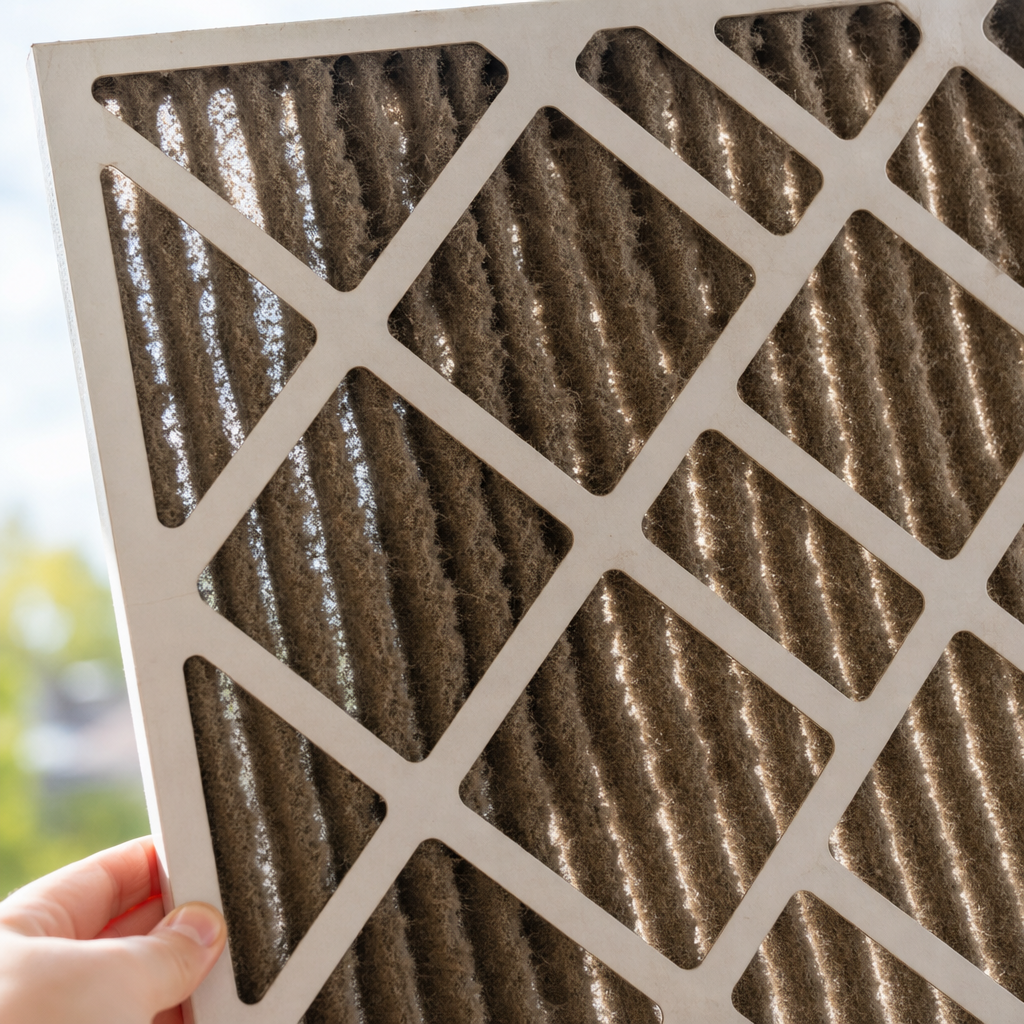
This is the most common cause of an AC running but not cooling in Chandler homes, and it is also the most preventable. A clogged air filter does not just reduce air quality. It physically blocks the airflow your system needs to move cooled air into your living spaces.
In practice, Chandler and Chandler-adjacent areas like Ahwatukee and Gilbert have above-average dust, pollen, and particulate levels compared to much of the country. A standard 1-inch pleated filter can reach maximum restriction in as little as 30 days during heavy-use months. When that happens, your evaporator coil starts running cold without enough warm air passing over it, which can cause the coil to freeze. A frozen coil produces no cooling at all.
What to Check Right Now
Pull your filter out and hold it up to a light source. If you cannot see light through it, it needs to be replaced today. Most Chandler homeowners running their systems heavily should check filters every 3 to 4 weeks from May through September.
A common mistake is assuming a filter only needs changing based on a calendar schedule rather than actual visual inspection. During monsoon season especially, dust loads can spike dramatically in a single week.
Pro tip: If you have pets or live near a construction zone in east Chandler or Queen Creek, use a MERV-8 or higher filter and check it every 2 to 3 weeks during peak summer months. Do not jump to MERV-13 without confirming your system can handle the added static pressure.
Reason 2: Low Refrigerant from a Leak
Refrigerant is the substance that makes cooling physically possible. It absorbs heat from inside your home and releases it outside through the condenser. When there is not enough of it, the system cannot transfer heat efficiently, and your home stays warm no matter how long the unit runs.
Refrigerant does not evaporate or get consumed over time. If your system is low on refrigerant, that means there is a leak somewhere in the refrigerant lines, coils, or fittings. Simply adding more refrigerant without finding and repairing the leak is a waste of money and a violation of EPA Section 608 regulations for systems using older refrigerants like R-22.
Signs You Have a Refrigerant Leak
The most telling signs are warm air blowing from your vents despite a running system, ice buildup on the copper lines near your indoor unit, and a hissing or bubbling sound near the equipment. In some cases, you may also notice higher-than-normal humidity indoors because a low refrigerant charge reduces the system's ability to dehumidify.
The data consistently shows that refrigerant leaks are among the top three causes of no-cool service calls in the Phoenix metro area during June and July. A licensed technician will use electronic leak detection tools or UV dye to locate the exact point of loss before recharging the system.
"The refrigerant charge in your air conditioner is not a consumable. If it is low, you have a leak that must be repaired. Recharging without repairing is like pouring water into a bucket with a hole." - U.S. Department of Energy guidance on residential HVAC systems
Reason 3: Your AC Unit Is Undersized for Your Home
An undersized air conditioner will run continuously during Chandler's hottest days and still never bring the house to your set temperature. This is not a malfunction. It is a math problem. The unit simply does not have enough capacity to remove the heat load your home generates on a 112-degree day.
This situation happens most often after home additions, garage conversions, or in homes where the original HVAC was selected without a proper Manual J load calculation. It also happens after window replacements where old single-pane windows were swapped for larger or more light-admitting glass, changing the solar heat gain significantly.
How to Know If Sizing Is the Problem
If your system runs non-stop during peak afternoon hours but keeps up reasonably well in the morning or evening, sizing could be the culprit. A properly sized system in a well-insulated Chandler home should be able to maintain a 20-degree differential between indoor and outdoor temperatures. So on a 110-degree day, a properly sized and functioning system should hold 90 degrees at minimum with the thermostat set to 78 or lower.
Sizing a replacement unit is not as simple as matching the tonnage of the old one. Brewer's Air Conditioning and Heating performs proper load calculations before any installation to make sure the new system actually fits the home, not just the equipment pad.
Pro tip: If you are replacing a unit that ran well for years but now cannot keep up, do not assume the same size is correct. Your home may have changed through additions, new appliances, or insulation degradation. Always get a proper Manual J load calculation done before purchase.
Reason 4: Duct Leaks and Insulation Failures
Your AC might be producing perfectly conditioned 55-degree air at the air handler, but if that air is leaking out of holes in your ductwork before it reaches your registers, your rooms will never feel it. The U.S. Department of Energy estimates that in a typical home, 20 to 30 percent of conditioned air is lost through duct leaks, gaps, and poorly connected sections.
In Chandler and Mesa homes built in the 1980s and 1990s, ductwork is frequently routed through the attic. Attic temperatures in Arizona regularly exceed 150 degrees Fahrenheit in summer. If the duct insulation has degraded, even air that makes it to the register arrives significantly warmer than it left the air handler.
Common Duct Problems in Arizona Homes
Disconnected flex duct sections are extremely common in older Chandler homes, particularly after pest control treatments or attic insulation retrofits where contractors sometimes accidentally separate duct joints. You can often detect this yourself by holding your hand over supply registers while the system runs. Weak or warm airflow from registers that used to blow strong is a clear indicator.
Professional duct testing using pressurization equipment will show exactly how much air is being lost and where. In many cases, sealing ducts with mastic sealant improves system performance more noticeably than any equipment upgrade, and at a fraction of the cost.
Reason 5: Dirty or Blocked Condenser Coils
The outdoor unit of your AC system, the condenser, works by blowing air through coils to release the heat your system has absorbed from inside your home. If those coils are coated in dirt, cottonwood fluff, grass clippings, or desert debris, that heat transfer is dramatically reduced. The system continues to run, but the refrigerant cannot shed its heat load, so it circulates back inside still too warm to absorb more heat effectively.
Chandler's landscaping environment produces an above-average amount of cottonwood and pollen debris in spring, followed by monsoon dust in late summer. This one-two punch makes condenser coil contamination more aggressive here than in many other U.S. climates.
What Blocked Condenser Coils Look Like in Practice
The most reliable indicator is a system that runs much longer than normal to reach set temperature, combined with the outdoor unit feeling excessively hot to the touch near the top exhaust. You may also notice the compressor cycling off on high-pressure lockout, which is a safety feature that shuts the unit down temporarily to prevent damage.
Never power wash condenser coils yourself. High-pressure water bends the aluminum fins and can cause refrigerant line damage. A technician uses a foaming coil cleaner and low-pressure rinse to clear contamination without causing more problems. Annual condenser coil cleaning is one of the best investments a Chandler homeowner can make before the summer heat peaks.
Comparing the Root Causes: Severity and Fix Type
Not all of these problems carry the same cost or urgency. Here is a direct comparison to help you prioritize.
| Problem | Typical DIY vs. Professional Fix | Relative Urgency in Chandler Summer |
|---|---|---|
| Clogged Air Filter | DIY: Replace filter yourself for $5 to $25 | High. A frozen coil can occur within hours of blockage |
| Refrigerant Leak | Professional only. Requires EPA certification to handle refrigerants | Critical. System will not cool and may damage compressor |
| Undersized Unit | Professional assessment and replacement required | Moderate. System runs but underperforms on peak days |
| Duct Leaks | Minor gaps can be DIY sealed; major leaks need professional duct testing | High. 20 to 30% efficiency loss directly impacts comfort |
| Dirty Condenser Coils | Professional cleaning recommended to avoid fin damage | High. Overheating can trigger compressor lockout in extreme heat |
Frequently Asked Questions
Why is my AC running but not cooling the house in Chandler?
The most common causes in Chandler are a clogged air filter blocking airflow, a refrigerant leak reducing the system's heat absorption capacity, dirty condenser coils on the outdoor unit, or duct leaks losing conditioned air in the hot attic before it reaches your rooms. A licensed HVAC technician can diagnose the exact cause with a full system check, which typically takes less than an hour.
How often should I change my AC filter in Arizona?
In the Phoenix metro area including Chandler, Mesa, and Gilbert, checking your filter every 3 to 4 weeks during summer is strongly recommended. Homes with pets, near desert open land, or close to construction sites may need filter checks every 2 weeks. The visual test is more reliable than any fixed schedule: if you cannot see light through the filter, replace it.
Can a refrigerant leak make my house feel humid as well as hot?
Yes. Refrigerant is responsible for both cooling and dehumidification. When the charge is low, the evaporator coil cannot properly condense moisture out of the air. The result is a home that feels both warmer and stickier than normal, which makes the discomfort significantly worse in Arizona's monsoon months from July through September.
What temperature should my AC be able to maintain on a 115-degree Chandler day?
A properly sized and functioning system should maintain roughly a 20-degree differential between outdoor and indoor temperatures. On a 115-degree day, that means your system should be able to hold around 75 to 78 degrees indoors if your thermostat is set in that range. If you are seeing indoor temps climbing to 85 or higher despite continuous operation, you likely have one or more of the five problems described in this article.
Is it worth repairing an AC that cannot keep up, or should I replace it?
The answer depends on the unit's age, the type of problem, and the cost of repair relative to replacement. A refrigerant leak in a system under 10 years old is usually worth repairing. Repeated compressor failures in a system over 15 years old generally point toward replacement. Brewer's Air Conditioning and Heating uses flat-rate pricing so you know the full repair cost upfront before committing, which makes this comparison much easier to make without feeling pressured.
Can I run my AC with a frozen evaporator coil?
Running the system with a frozen coil risks compressor damage, which is one of the most expensive HVAC repairs there is. If you notice ice on your indoor unit or the copper lines coming out of it, turn the system to fan-only mode to let the coil thaw, then check and replace the air filter. If the coil freezes again after the filter is clean, call a technician immediately, as you likely have a refrigerant or airflow issue that requires professional diagnosis.
If your Chandler home is still feeling hot despite a running AC, share what you have already tried in the comments below. We want to help you figure out what is actually going on.
References
- U.S. Department of Energy official site covering home energy efficiency, HVAC systems, and duct performance guidelines
- U.S. Environmental Protection Agency resources on refrigerant regulations, Section 608 compliance, and indoor air quality
- ASHRAE standards and technical resources for HVAC system design, load calculations, and equipment performance
- ENERGY STAR program guidance on certified HVAC equipment, home comfort, and efficiency ratings
- Consumer Reports testing and ratings for home air conditioning systems and HVAC maintenance advice
About the Author
Mark Ybarra
Mark Ybarra is the owner and leader of Brewer's Air Conditioning & Heating, a trusted HVAC company serving Tempe, Phoenix, Scottsdale, Mesa, and surrounding Arizona communities since 1982. After working in multiple roles within the company, Mark officially took ownership in 2018 and continues to uphold Brewer's long-standing commitment to integrity, exceptional service, and customer satisfaction.
Need HVAC Help?
Serving Phoenix, Tempe, Scottsdale, Mesa & surrounding areas since 1982.