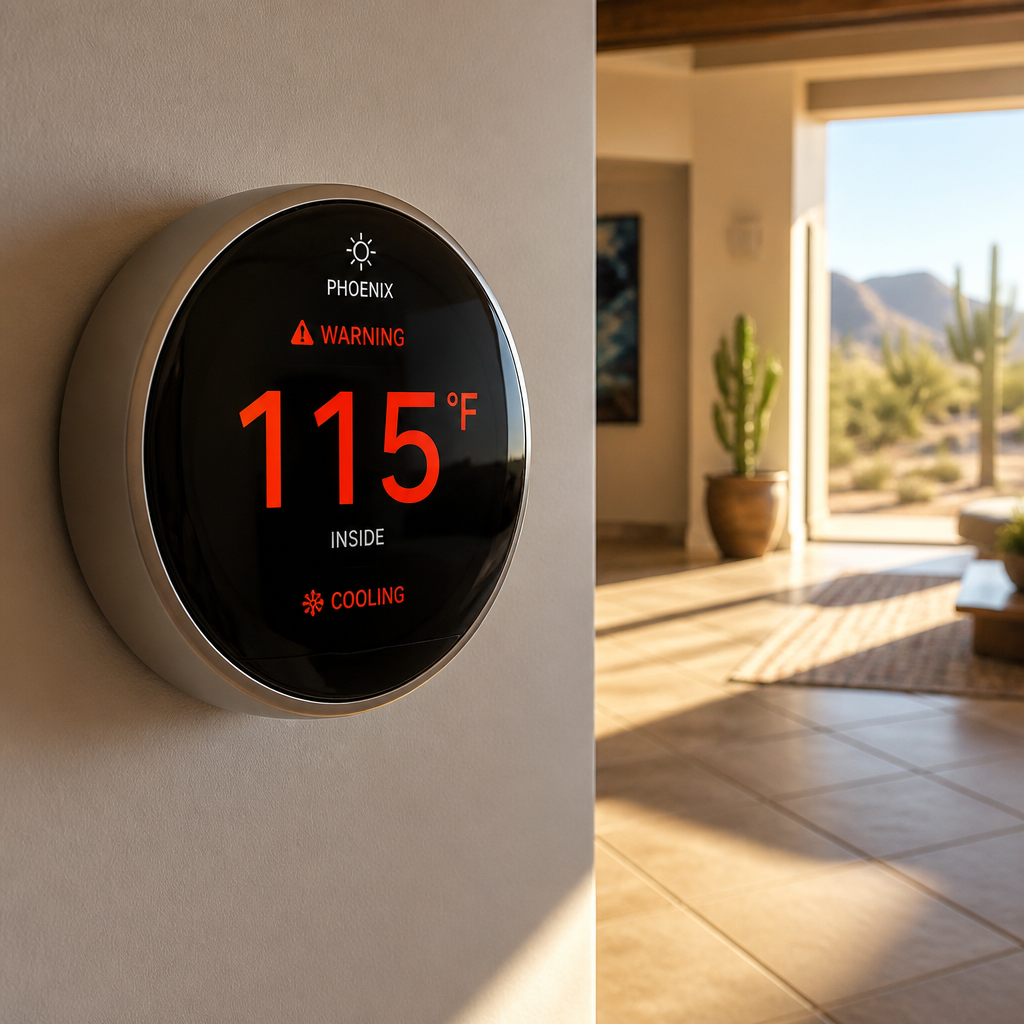
When Phoenix hits 115°F in August and your air conditioner suddenly stops keeping up, you are not dealing with a minor inconvenience. You are dealing with a genuine health risk. AC not cooling in Phoenix during peak summer is the most common emergency call Brewer's Air Conditioning and Heating receives, and the causes are almost always the same handful of problems. This article breaks down exactly why your system fails on the hottest days, what you can diagnose yourself right now, and when you need a licensed HVAC technician on-site before conditions in your home become dangerous.
Quick Takeaways
| Key Insight | Explanation |
|---|---|
| Extreme heat overwhelms undersized systems | A unit sized for 100°F often cannot maintain setpoint at 115°F. August demand regularly exceeds design capacity in older Phoenix homes. |
| Dirty condenser coils are the #1 field finding | Dust, cottonwood debris, and desert grit coat outdoor coils and prevent heat rejection. Performance drops sharply before total failure arrives. |
| Low refrigerant does not fix itself | If your system is low on refrigerant, there is a leak. Adding refrigerant without finding the leak wastes money and repeats the failure within weeks. |
| A tripped breaker is often a symptom, not the root cause | Resetting a breaker that trips repeatedly can damage the compressor. The breaker is protecting the system. Find out why it tripped first. |
| Frozen evaporator coils produce warm air | Ice on the indoor coil blocks airflow completely. The fix is to turn the system off and let it thaw, then diagnose the airflow or refrigerant problem that caused it. |
| Flat-rate pricing removes the guesswork after diagnosis | Brewer's uses upfront flat-rate pricing so you know the repair cost before any work begins. No hourly surprises after a two-hour diagnostic visit. |
| August demand spikes mean longer wait times industry-wide | Every HVAC company in Phoenix is flooded with calls in August. Maintenance agreement customers at Brewer's receive priority scheduling over new service calls. |
Why August Is the Worst Month for AC Systems in Phoenix
Phoenix averages a high of 104°F in August, but heat index conditions, urban heat island effects, and multi-day streaks above 110°F push residential HVAC systems far beyond their rated performance envelope. According to the National Oceanic and Atmospheric Administration, August 2023 was the hottest month ever recorded globally, and Phoenix recorded 31 consecutive days above 110°F that summer. Your AC unit was almost certainly not designed to that standard.
The problem compounds overnight. Most residential AC systems recover efficiency when nighttime temperatures drop below 85°F. In Phoenix during August, overnight lows often stay in the mid-90s. The system never gets a break. It runs continuously, accumulates heat stress, and components that were marginal in June fail outright by mid-August.
The monsoon season adds a second layer of stress. Humidity spikes from 10 percent to 40 percent or higher during storm events, forcing your system to remove moisture in addition to heat. That is a fundamentally different workload than dry summer cooling, and it catches systems that were already running at the edge.
Top Reasons Your AC Stops Cooling on Phoenix's Hottest Days
Condenser Coils Caked with Desert Debris
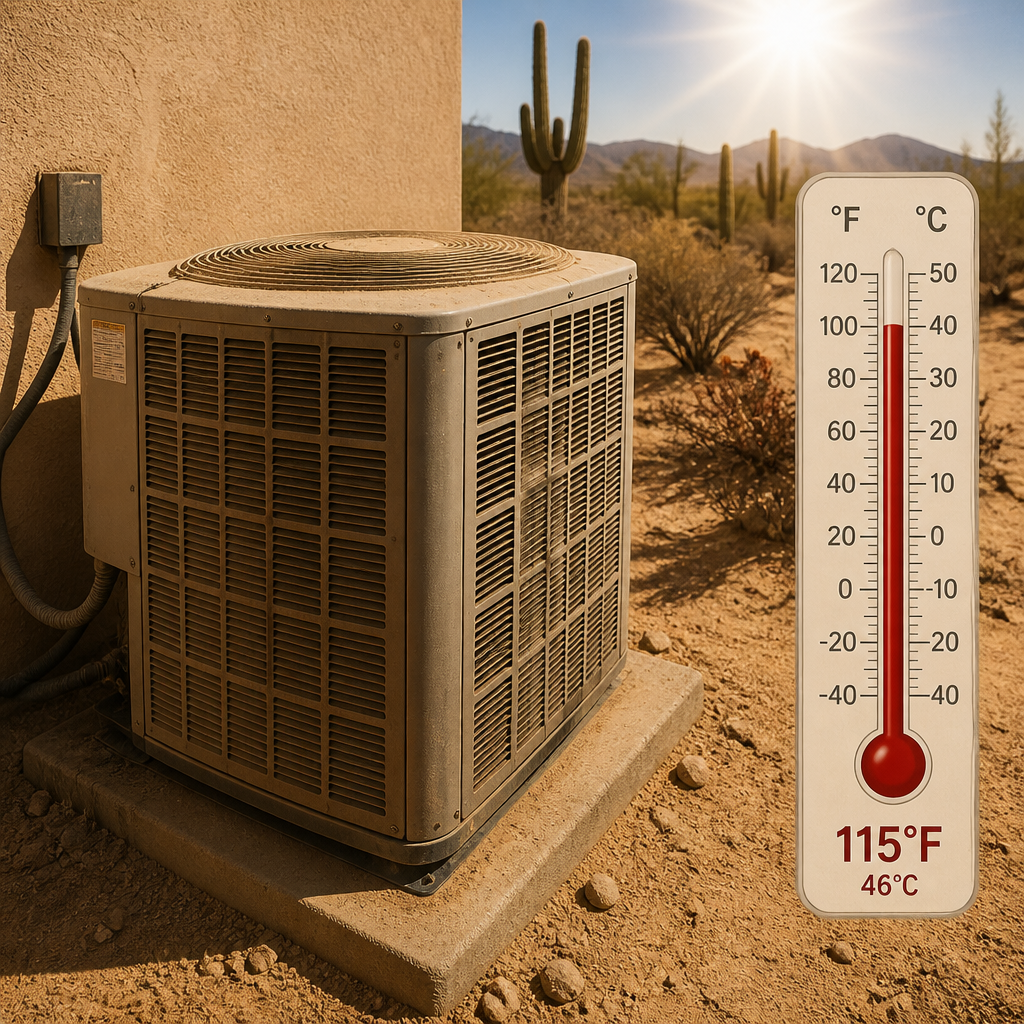
The outdoor unit on your Phoenix home is working in conditions that would accelerate wear anywhere, but the Sonoran Desert environment is particularly harsh. Condenser coils reject heat from your refrigerant into the outside air. When those coils are coated with a layer of dust, cottonwood fluff, or blown sand, heat cannot escape efficiently. The refrigerant stays too hot, head pressure climbs, and the compressor either shuts down on a high-pressure lockout or runs hot until it fails.
In practice, coils on Phoenix units that go a full year without cleaning lose 20 to 30 percent of their heat rejection capacity. On a 115°F day, that loss is the difference between a system that keeps up and one that cannot get below 85°F inside your home.
Refrigerant Leak Reducing System Capacity
A refrigerant leak is not a slow, gradual problem. Below a certain charge level, your system's capacity drops sharply and the evaporator coil may freeze. The common misdiagnosis is calling it a "recharge" issue when it is actually a leak detection and repair issue. Adding refrigerant without sealing the leak is money wasted. EPA regulations under Section 608 also require that leaks above a certain threshold be repaired, not just topped off.
Failing or Failed Capacitor
Capacitors start the compressor and fan motors. High temperatures degrade capacitors faster than almost any other electrical component. A capacitor rated for 10 years at moderate temperatures may last 5 to 6 years in Phoenix. A weak capacitor causes the compressor to struggle on startup, draw excess current, and overheat. On a 115°F day when the compressor is already thermally stressed, a marginal capacitor is often what pushes a system from struggling to stopped.
This is one of the most cost-effective repairs an HVAC technician can perform, typically running $150 to $350 with parts and labor at Brewer's flat-rate pricing. It is also one of the repairs that gets deferred until a failure because there are no obvious warning signs until the unit stops.
Clogged Air Filter and Restricted Airflow
A clogged filter in Phoenix does more damage than in most U.S. climates because the system is running almost continuously from April through October. A filter that lasts 90 days in Minnesota lasts 30 days in Phoenix. When airflow across the evaporator coil drops, the coil freezes, and a frozen coil produces warm air or no air. This is the most preventable failure on this list, and it still accounts for a significant share of emergency calls every August.
Compressor Thermal Overload
The compressor is the most expensive component in your AC system. When ambient temperatures exceed the design limits, compressors overheat and trip an internal thermal cutout. The unit shuts down, often for 30 to 90 minutes, then restarts and shuts down again in a cycle. Homeowners often describe this as the AC "working for a while and then stopping." Running through repeated thermal overload cycles accelerates compressor wear significantly.
What You Can Check Right Now Before Calling for AC Repair
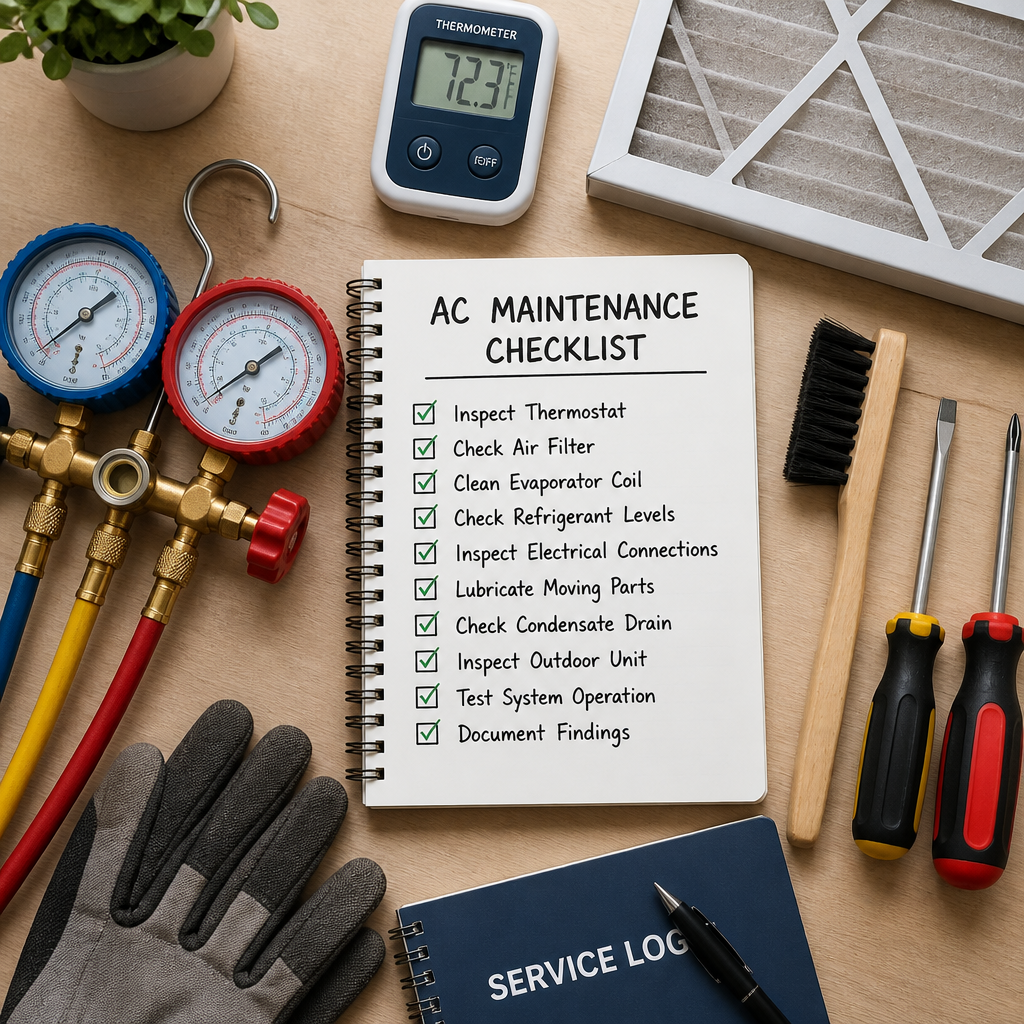
Before you call for AC repair in Phoenix, run through this sequence. Some of these steps will resolve the problem entirely. Others will give a technician critical information when they arrive and reduce diagnostic time.
Check the Air Filter First
Pull the filter and hold it up to a light source. If you cannot see light through it, replace it immediately. Turn the system off for 30 minutes after replacing the filter if you suspect the coil may have frozen. Then restart and give it 20 minutes to evaluate cooling. A surprising number of August emergency calls are resolved at this step.
Check the Thermostat Settings and Batteries
Verify the thermostat is set to COOL, not FAN ONLY. Check that the setpoint is actually below the current room temperature. Replace batteries in battery-operated thermostats. Programmable thermostat failures during a power fluctuation can reset schedules or modes without any obvious indicator.
Check the Breaker Panel
Look for a tripped breaker in the panel. A tripped breaker will be in a middle position, not fully on or fully off. Reset it once. If it trips again immediately or within minutes, stop. Do not keep resetting it. A repeatedly tripping breaker means there is an electrical fault in the system that needs professional diagnosis.
Inspect the Outdoor Unit
Go outside and look at the condenser. Is the fan spinning? Is there ice forming on the refrigerant lines? Is the unit making unusual grinding, screeching, or clicking sounds? A fan that is not spinning with the compressor running is a strong indicator of a failed capacitor or fan motor. Ice on the lines outside confirms a refrigerant or airflow problem. Report what you see when you call for service.
Pro tip: If you see ice anywhere on the system, turn the AC to OFF and the fan to ON. This circulates warm air across the coil to thaw it faster. Running the system in COOL mode with a frozen coil can damage the compressor within hours.
Give the Outdoor Unit Clearance
Check that no landscaping, stored items, or debris is blocking airflow to the condenser unit. There should be at least 18 to 24 inches of clear space on all sides. Overgrown shrubs are a common summer culprit in established Phoenix neighborhoods like Ahwatukee and older parts of Mesa.
Comparison of Common AC Failure Scenarios
| Failure Type | Symptoms You Will Notice | DIY Fix Possible? |
|---|---|---|
| Clogged air filter | Weak airflow, warm air, possible ice on indoor coil, system runs constantly | Yes. Replace filter, thaw coil, restart system. |
| Failed capacitor | Compressor hums but does not start, outdoor fan not spinning, unit shuts off quickly after starting | No. Capacitors store lethal electrical charge. Requires a licensed technician. |
| Low refrigerant from leak | Ice on refrigerant lines, warm air, system runs but cannot reach setpoint, hissing sound near unit | No. Requires EPA-certified technician to locate leak, repair, and recharge. |
| Dirty condenser coils | System runs constantly, cannot keep up on hot days, outdoor unit feels excessively hot | Partial. You can rinse fins with a garden hose on low pressure. Deep cleaning requires a technician. |
| Thermostat failure or misconfiguration | System does not respond to thermostat changes, wrong mode active, erratic cycling | Yes for settings and batteries. No for a faulty thermostat board. |
When to Call a Professional for AC Repair in Phoenix
Call a professional immediately if you have worked through the checklist above and the system still is not cooling. Do not wait to "see if it fixes itself" in August in Phoenix. Interior temperatures above 95°F are dangerous for elderly residents, children, and pets within hours, not days. The CDC reports that heat-related illness is the leading cause of weather-related death in the United States, and Arizona consistently leads the nation in heat fatalities.
Call immediately if you notice any of the following: the breaker keeps tripping, you hear grinding or screeching from the outdoor unit, you smell burning, or the system is running continuously but the indoor temperature is rising instead of falling.
"Heat stroke can occur when body temperature reaches 104°F. In an uncooled Phoenix home during a heat event, indoor temperatures can exceed outdoor ambient levels within hours of AC failure." - Maricopa County Department of Public Health, Heat Emergency Guidelines
Pro tip: When you call Brewer's for an emergency AC repair in Phoenix, tell the dispatcher the indoor temperature, when the system last worked normally, and what you observed when you checked the unit outside. This information helps dispatch the right parts on the service truck and can cut your repair time significantly.
How Brewer's Approaches Emergency AC Repair
Brewer's Air Conditioning and Heating has been servicing Phoenix-area homes and commercial properties since 1982. That is more than four decades of August emergency calls, and the pattern is consistent: the failures are predictable, the repairs are executable, and the difference between a resolved call and a repeat call is usually whether the technician fixed the root cause or patched a symptom.
The flat-rate pricing model matters here. When a technician finds a failed capacitor and a dirty coil on the same visit, there is no incentive to fix only one and return for a second billable hour. The diagnosis is complete and the repair estimate is presented before any work begins. That is how Brewer's has differentiated from competitors who use hourly billing structures that reward slower work.
Brewer's services Trane and Lennox systems as primary brands, which are commonly installed throughout the east valley in Tempe, Chandler, Mesa, Gilbert, and Ahwatukee. Technicians carry common capacitors, contactors, and other high-failure components for these brands as standard truck stock, which reduces the wait for a return visit with parts.
Priority Service for Maintenance Agreement Customers
During August, every reputable HVAC company in Phoenix has more calls than available technicians. Brewer's maintenance agreement customers receive priority scheduling over new service requests. If you are calling Brewer's for the first time during a peak heat event, be prepared for a possible wait. If you are a maintenance customer, you move to the front of the queue.
Preventive Steps to Avoid Next Summer's Breakdown
The right time to prevent an August failure is February or March, not July. A spring tune-up performed before cooling season begins catches the components that are marginal and will fail under peak load. A technician who inspects a capacitor in March and finds it reading at 70 percent of rated capacity can replace it for $200 before it strands you at 115°F in August. That same capacitor replacement as an emergency call with priority dispatch costs more and comes with a wait.
What a Pre-Season Tune-Up Should Include
A credible AC tune-up for a Phoenix home should include: condenser coil cleaning, evaporator coil inspection, capacitor testing with a multimeter, refrigerant pressure check, contactor inspection, blower motor amperage check, filter replacement, and thermostat calibration. If a company offers a tune-up that does not include capacitor testing and refrigerant pressure verification, it is not a complete inspection for desert climate conditions.
Filter Replacement Schedule for Phoenix
Replace 1-inch pleated filters every 30 days during the cooling season, April through October. Replace 4-inch media filters every 60 to 90 days. Do not trust the "replace every 90 days" label on the filter package. That rating assumes an average climate with average runtime. Phoenix is neither.
Keep the condenser unit clear of vegetation and hose down the fins lightly every four to six weeks during summer. This is not a substitute for professional coil cleaning, but it extends the time between deep cleans and maintains efficiency between service visits.
Frequently Asked Questions
Why does my AC work fine at night but stop cooling during the afternoon?
This is a classic sign that your system is undersized for peak load, has dirty condenser coils, or has a marginal capacitor. Afternoon hours from 2 PM to 6 PM are when outdoor temperatures peak, and your AC is working hardest against the worst conditions. Systems that are borderline functional will keep up at night when temperatures drop 10 to 15 degrees, but fail to maintain setpoint during the peak heat window. Have a technician evaluate the system during peak hours if possible, or at minimum during business hours when the unit has been running for several hours.
How long can I wait before calling for AC repair in Phoenix in August?
Do not wait more than a few hours if indoor temperatures are rising above 85°F and you have elderly residents, children under five, or anyone with a heart or respiratory condition in the home. For a healthy adult, a failing AC in August is seriously uncomfortable but manageable for a day if you have fans, hydration, and can access a cooled space like a library, mall, or neighbor's home. For vulnerable populations, interior temperatures above 90°F become a medical risk within hours. Call Brewer's right away and be honest with the dispatcher about who is in the home.
Is it worth repairing an older AC unit or should I replace it?
The standard rule in HVAC is to multiply the repair cost by the age of the unit. If the result exceeds the cost of replacement, replace it. A unit over 12 to 15 years old in Phoenix has often operated twice the equivalent hours of the same unit in a milder climate. If you are facing a compressor replacement on a 14-year-old unit, that is a strong replacement signal. If you are facing a capacitor or contactor on a 10-year-old Trane or Lennox, repair it. Brewer's technicians will give you a straight answer on this rather than defaulting to the higher-revenue option.
Why did my AC freeze up in 115-degree heat?
A frozen evaporator coil is counterintuitive in Phoenix summer heat, but it happens when airflow across the indoor coil drops too low or refrigerant charge is insufficient. The coil surface temperature drops below freezing even when the outdoor air is extremely hot, and condensation freezes on the coil. The ice then blocks airflow entirely, turning your supply vents warm. The most common cause is a severely clogged air filter. The second most common cause is low refrigerant from a leak. Turn the system off, replace the filter, let the coil thaw completely (at least two hours), then restart. If it freezes again, call for service because you have a refrigerant leak.
What is the typical cost of emergency AC repair in Phoenix?
Cost varies widely based on what failed. A capacitor replacement typically runs $150 to $350 all-in. A contactor replacement is similar. Refrigerant leak detection and repair with recharge can run $400 to $800 or more depending on the leak location and refrigerant type. Compressor replacement on an older R-22 system often makes replacement the more economical choice. Brewer's provides the exact cost in writing before any work begins, so you are never looking at a surprise invoice after the fact.
Does Brewer's offer same-day AC repair service in the Phoenix area?
Brewer's serves Phoenix, Tempe, Scottsdale, Mesa, Chandler, Gilbert, and Ahwatukee and works to schedule same-day service for cooling emergencies. Availability during August peak demand depends on call volume, and maintenance agreement customers receive priority. Call as early in the day as possible. Morning calls have the highest likelihood of same-day scheduling versus calls placed in mid-afternoon when the dispatch board is typically at capacity.
Have you dealt with an AC failure during a Phoenix heat wave? Share what the problem turned out to be or what temporary measures helped while you waited for service.
References
- National Oceanic and Atmospheric Administration (NOAA) climate and temperature records for the United States
- U.S. Centers for Disease Control and Prevention guidance on heat-related illness prevention and risk factors
- U.S. Department of Energy resources on residential air conditioning efficiency and proper system sizing
- U.S. Environmental Protection Agency Section 608 refrigerant handling regulations for HVAC technicians
- ASHRAE standards for HVAC system design, performance, and indoor air quality in residential and commercial buildings
About the Author
Mark Ybarra
Mark Ybarra is the owner and leader of Brewer's Air Conditioning & Heating, a trusted HVAC company serving Tempe, Phoenix, Scottsdale, Mesa, and surrounding Arizona communities since 1982. After working in multiple roles within the company, Mark officially took ownership in 2018 and continues to uphold Brewer's long-standing commitment to integrity, exceptional service, and customer satisfaction.
Need HVAC Help?
Serving Phoenix, Tempe, Scottsdale, Mesa & surrounding areas since 1982.