August in Phoenix does not forgive neglected air conditioners. By the time Labor Day rolls around, the average Arizona home AC unit has been running at near-maximum capacity for four straight months, often 10 to 14 hours a day. AC maintenance Phoenix August is not optional upkeep, it is the difference between a system that coasts into fall and one that fails during a 112-degree afternoon. At Brewer's Air Conditioning and Heating, we have serviced HVAC systems across the Phoenix metro since 1982, and the pattern is consistent: the homeowners who complete end-of-summer maintenance spend far less on emergency repairs than those who wait until something breaks.
Quick Takeaways
| Key Insight | Explanation |
|---|---|
| August is peak stress month for Arizona AC units | Compressors and capacitors fail most often in July and August after sustained heat exposure. Catching wear now prevents a full breakdown during the last hot weeks of the season. |
| Dirty coils can cut efficiency by up to 30 percent | Condenser coils clogged with dust, cottonwood, and monsoon debris force the compressor to work harder. Cleaning them at end-of-summer extends compressor life noticeably. |
| Air filters in Arizona need changing every 30 to 45 days in summer | Dust storms and monsoon activity accelerate filter loading. A clogged filter reduces airflow, raises indoor humidity, and strains the blower motor. |
| Low refrigerant is a system problem, not just a recharge issue | Refrigerant does not get used up. If levels are low, there is a leak. Simply topping it off without finding the source is money wasted and a system health risk. |
| Capacitors fail silently before the compressor goes | A weak capacitor is one of the most common causes of no-cool calls in Phoenix. A licensed tech can test capacitor microfarad ratings during a tune-up before the unit stops starting. |
| Drain line clogs are an August problem, not a spring problem | Monsoon humidity puts the condensate drain under serious pressure. A blocked drain causes water damage and mold growth inside the air handler rapidly in Arizona heat. |
| Flat-rate preventive maintenance costs far less than emergency calls | Brewer's charges a straightforward flat rate for tune-ups. Emergency weekend calls in Phoenix during August routinely cost three to five times more than scheduled preventive service. |
Why August Is the Critical Window for Arizona AC Care
Most HVAC advice is written for climates where summer ends in early August and homeowners are already thinking about furnace checkups. Arizona is different. August in the Phoenix metro, including Tempe, Ahwatukee, Chandler, Mesa, and Gilbert, is still deep summer. Ambient temperatures regularly reach 108 to 115 degrees, and monsoon storms add humidity and dust that accelerate system wear rapidly.
The data consistently shows that compressor failures peak between July 15 and August 31 across the Phoenix metro. By August, your system has accumulated thousands of operational hours since April. Capacitors are weakened, coil fins are bent and dirty, drain lines are slow, and filters are often overloaded. This is the exact moment when a quick inspection catches problems before they become 2 AM emergency calls.
In practice, homeowners who complete an end-of-summer maintenance check in August protect two things simultaneously: the comfort of the final hot weeks and the lifespan of the equipment heading into the fall. A system that limps through August without intervention often fails just when you think you are safe, usually in mid-September when temperatures are still in the upper 90s.
Outdoor Unit Inspection: What to Check Around the Condenser
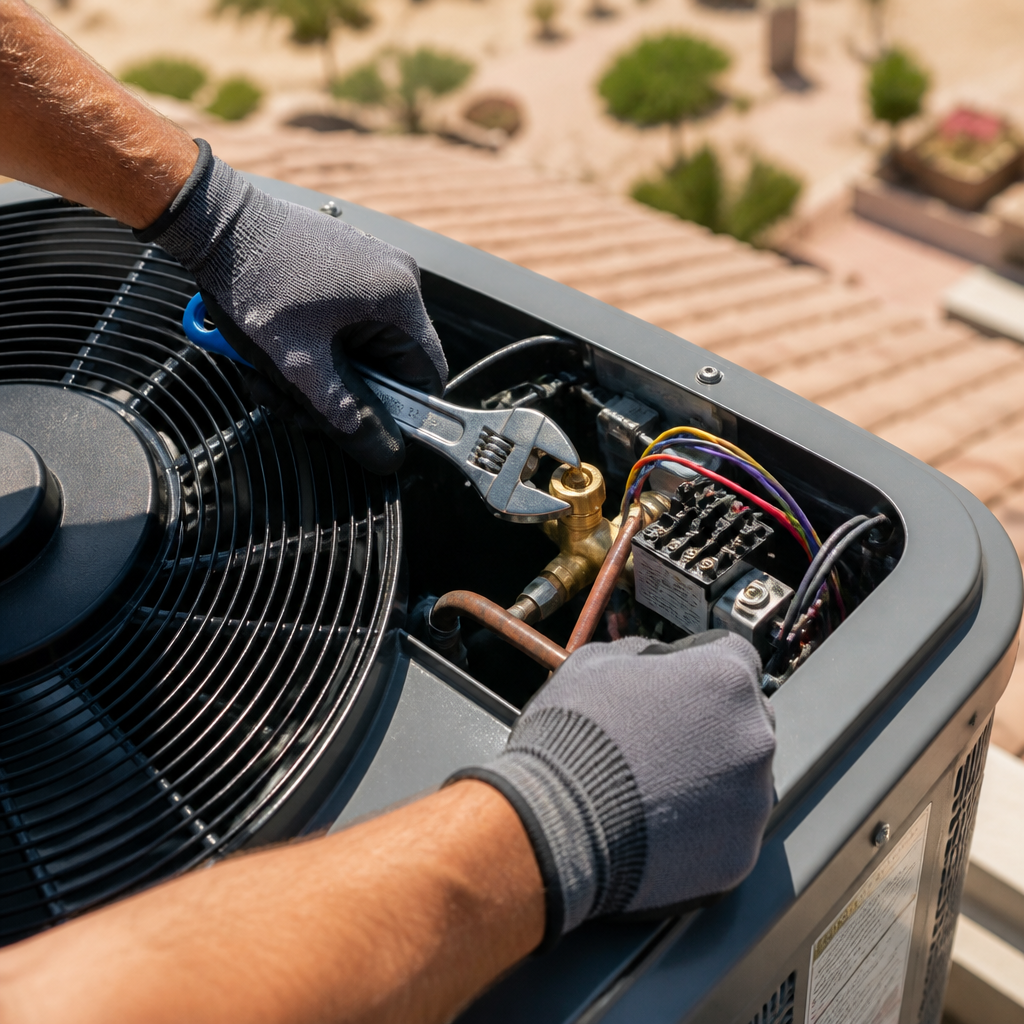
The outdoor condenser unit absorbs the heat pulled from inside your home and rejects it into the outside air. When that process is obstructed, efficiency drops and component stress rises fast. A proper end-of-summer outdoor inspection covers several specific items that are easy to overlook.
Condenser Coil Condition
Monsoon storms push fine desert dust, pollen, cottonwood seeds, and debris directly into condenser coil fins. Even a thin layer of buildup acts as insulation, preventing the coil from shedding heat. Cleaning condenser coils professionally, using a low-pressure coil cleaner and rinse, is one of the highest-return maintenance tasks in Arizona HVAC. Do not use a pressure washer. Fin damage from excessive water pressure is a common and expensive mistake.
Clearance and Shade Around the Unit
The condenser needs at least 18 to 24 inches of clear space on all sides. Desert landscaping, particularly mesquite and oleander, grows aggressively during monsoon season. Check that no branches, shrubs, or debris piles are restricting airflow around the unit. Artificial shade structures built directly over condenser units can actually trap heat, which is the opposite of what most homeowners intend.
Fan Blade and Motor Check
Listen for rattling, grinding, or wobble when the condenser fan runs. Bent fan blades are surprisingly common after monsoon wind events. A rattling blade puts stress on the motor bearing, and a failing motor bearing is a several-hundred-dollar repair that becomes far more expensive if the motor seizes entirely during peak use.
Pro tip: Turn the unit off at the breaker before visually inspecting the fan blades. Never reach into the condenser while power is live, even if the unit appears to be off at the thermostat.
Air Filter and Indoor Components: The Parts Most Homeowners Ignore
The indoor air handler, located in a closet, attic, or utility room in most Arizona homes, does the work of circulating conditioned air through your duct system. By August, this equipment has been running hard for months, and several components need direct attention.
Air Filter Replacement Schedule in Arizona
Standard HVAC guidance recommends replacing filters every 60 to 90 days. That advice is written for moderate climates. In Phoenix, Tempe, Mesa, and Chandler, dust storms and monsoon activity mean your filter is often fully loaded within 30 to 45 days. A clogged filter does not just reduce air quality; it creates negative pressure in the air handler that strains the blower motor and can cause the evaporator coil to ice over, even in August heat.
Pull your filter in August and hold it up to a light source. If you cannot see light through it, it is overdue. For homes with pets, high dust exposure, or occupants with allergies, MERV-8 to MERV-11 rated filters offer meaningful filtration improvement without restricting airflow the way high-MERV filters can in systems not designed for them.
Evaporator Coil and Blower Motor
The evaporator coil sits inside the air handler and absorbs heat from your indoor air. When airflow is restricted by a dirty filter for extended periods, the coil surface accumulates a film of dust and sometimes mold, particularly after monsoon humidity spikes. A licensed technician at Brewer's can inspect and clean this coil during a preventive maintenance visit. This is not a DIY task because improper cleaning damages the delicate aluminum fins and can introduce moisture that worsens mold growth.
The blower motor should run quietly and smoothly. Squealing sounds indicate a bearing that is beginning to fail. Humming without full airflow indicates the motor capacitor is weak. Both are caught easily during an end-of-summer air conditioner maintenance checklist Arizona visit and repaired inexpensively compared to a mid-season motor failure.
Refrigerant and Electrical Checks: Leave These to a Licensed Tech
Refrigerant handling requires EPA Section 608 certification. This is not a gray area. Beyond the legal requirement, refrigerant diagnosis requires calibrated gauges and a working knowledge of system pressures that vary by refrigerant type, outdoor temperature, and unit age. Attempting this without proper tools gives you inaccurate data and potentially damages the compressor.
What Low Refrigerant Actually Means
Refrigerant circulates in a closed loop. If the system is low, there is a leak somewhere in that loop. Common leak points in aging Arizona systems include the Schrader valve cores, solder joints at the evaporator coil connections, and the service ports. A technician should use a refrigerant leak detector or UV dye test to locate the source before adding any refrigerant. Adding refrigerant to a leaking system without repair is a temporary fix that harms the compressor over time.
Electrical Component Testing
The capacitor is the single most commonly replaced component in Phoenix-area AC systems. It stores and releases electrical energy to start the compressor and fan motor. Heat degrades capacitor performance measurably, and a capacitor operating below its rated microfarad range draws excessive amperage from the compressor, shortening its life. Technicians test capacitors with a capacitance meter. Replacing a failing capacitor costs roughly 75 to 200 dollars. Replacing the compressor it destroys costs 1,500 to 2,800 dollars or more.
"The capacitor is the cheapest insurance policy in residential HVAC. Testing it every summer in Arizona is not optional, it is the cost of keeping a compressor alive." - Brewer's Air Conditioning and Heating service team, drawing on over 40 years of field experience in the Phoenix metro.
Pro tip: Ask your technician to document the capacitor microfarad reading during every maintenance visit. Tracking the reading over multiple years shows you the rate of degradation and lets you plan a replacement before failure, rather than reacting to one.
Thermostat and Airflow Calibration for Late-Season Efficiency
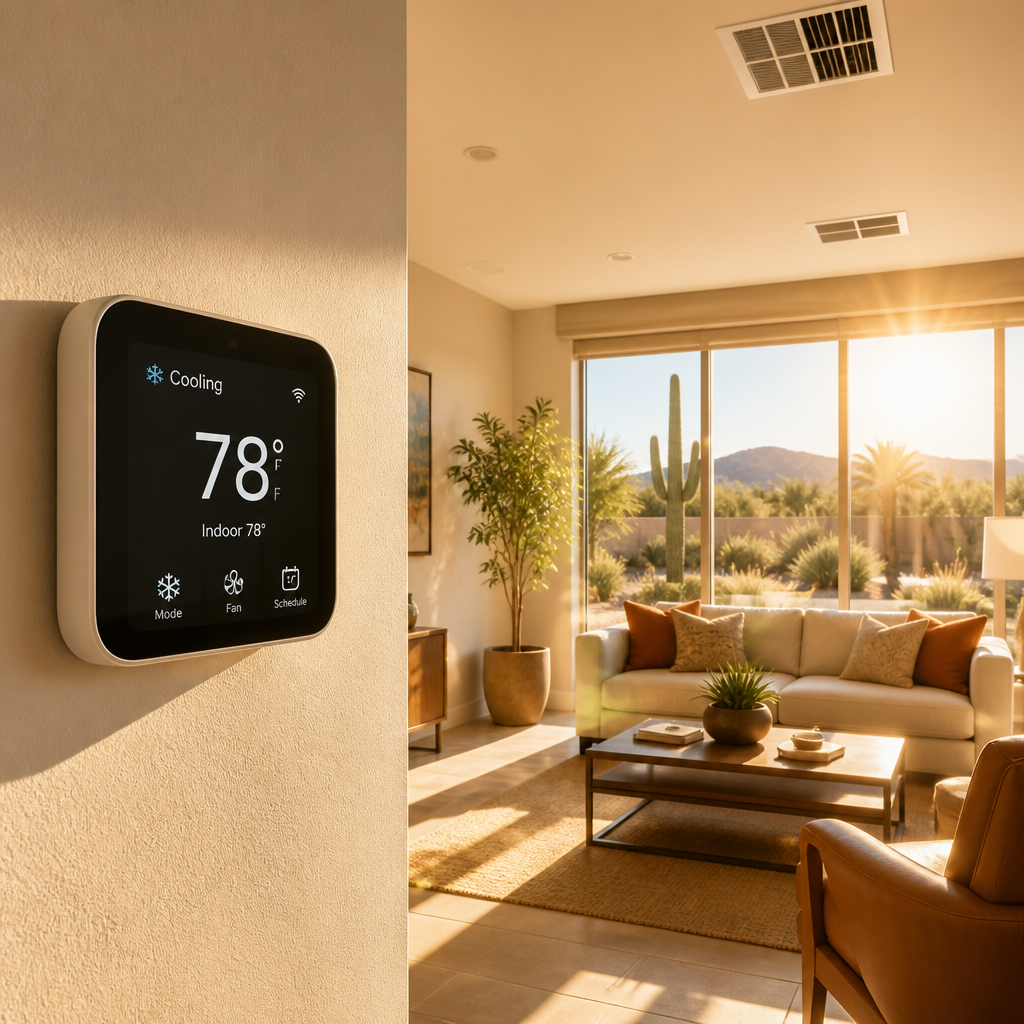
A thermostat that reads two degrees warmer than actual room temperature makes your system run longer cycles for no gain. Calibration drift is real, especially in older mechanical or first-generation digital thermostats. Smart thermostats like Ecobee or Nest are generally more accurate, but their temperature sensors can also be affected by direct sunlight or placement near heat sources.
Check your thermostat calibration by placing a calibrated indoor thermometer near the unit for 15 minutes and comparing readings. A two-degree or greater discrepancy justifies recalibration or replacement. In Arizona, where the system runs constantly, even a one-degree calibration error translates to measurably higher utility costs over a full summer season.
Duct Airflow and Register Balance
Walk through every room in the house in August with the system running and hold your hand over each supply register. Rooms with significantly weaker airflow than others indicate either a duct leak, a blocked register, or an imbalanced damper. Duct leakage in Arizona attics is particularly costly because attic temperatures reach 145 to 160 degrees in August. Cooled air leaking into a 150-degree attic space before it reaches the living area is pure efficiency loss.
Duct sealing with mastic compound, not duct tape which degrades rapidly in desert heat, is one of the best investments a Phoenix homeowner can make for long-term energy savings. According to the U.S. Department of Energy, duct leakage accounts for 20 to 30 percent of energy loss in typical homes with forced air systems.
DIY vs. Professional Maintenance: A Honest Comparison
Not every maintenance task requires a licensed technician. Some items on this checklist are genuinely appropriate for a capable homeowner. Others require tools, certifications, and experience that make DIY attempts either ineffective or dangerous. Here is a clear breakdown.
| Maintenance Task | DIY Appropriate | Licensed Tech Required |
|---|---|---|
| Air filter replacement | Yes, every 30 to 45 days in Arizona summer | No |
| Clearing debris around outdoor condenser | Yes, keep 18 to 24 inches clear on all sides | No |
| Thermostat calibration check | Yes, compare with a separate thermometer | No for check, yes for repair |
| Condenser coil cleaning | Light rinsing only, no chemicals without training | Yes for full chemical cleaning |
| Condensate drain flush | Yes, diluted bleach solution monthly in monsoon season | Yes if line is fully blocked |
| Capacitor testing and replacement | No, risk of electrocution from stored charge | Yes, always |
| Refrigerant level check | No, EPA 608 certification required | Yes, always |
| Evaporator coil cleaning | No, requires partial disassembly of air handler | Yes, always |
| Electrical connection tightening | No, risk of arc flash and shock | Yes, always |
A common mistake is homeowners watching a tutorial, buying a set of AC manifold gauges, and attempting refrigerant checks themselves. Inaccurate gauge readings from improper technique lead to either overcharging or undercharging, both of which damage the compressor more than the original low refrigerant condition would have. When in doubt, the answer is a professional visit from a company like Brewer's, where you know the pricing upfront before any work begins.
Indoor Air Quality in August: Dust, Mold, and Monsoon Moisture
August monsoon season in Arizona creates a unique indoor air quality challenge that homeowners in northern states simply do not face. Relative humidity spikes from 10 to 15 percent up to 40 to 55 percent during storm events. That moisture enters homes through doors, windows, and HVAC systems and creates conditions where mold growth can begin on evaporator coils and in ductwork within 24 to 48 hours.
Condensate Drain Line Maintenance
The condensate drain removes moisture pulled from the air by the evaporator coil. In monsoon months, this drain handles far more water than in spring or fall. A slow or clogged drain backs up into the air handler drain pan, and a full pan triggers a float switch that shuts the system down entirely. Many homeowners discover this problem on a Saturday afternoon when they find the house warming up and the system unresponsive.
Flush the condensate drain monthly during June through September by pouring a cup of diluted bleach or white vinegar down the access port to prevent algae and biofilm buildup. This takes two minutes and prevents one of the most common service calls in the Phoenix east valley market.
Air Purification and Filtration Options
Standard 1-inch pleated filters capture particles but do nothing for volatile organic compounds, mold spores that pass through the media, or bacteria. For homeowners with allergy or asthma concerns, whole-home air purification systems integrated into the air handler are a meaningful upgrade. UV germicidal lights installed at the evaporator coil kill mold and bacteria on the coil surface continuously. These systems are particularly relevant during August when coil surfaces face peak moisture exposure.
Brewer's offers indoor air quality solutions as part of comprehensive HVAC service, including UV systems and media air cleaners that outperform standard filters in allergy environments. This is not an upsell for the sake of it. In Arizona monsoon season, coil-level microbial control is a legitimate system health and occupant health concern.
Scheduling Your HVAC Tune-Up in Chandler, Mesa, and the East Valley
If you are in Chandler, Mesa, Gilbert, Tempe, Ahwatukee, or Phoenix and you have not had a professional maintenance visit since spring, August is the right time to schedule one. Not October. Not when something breaks. August, while the system is still under load and any problems are fully visible to a trained technician under real operating conditions.
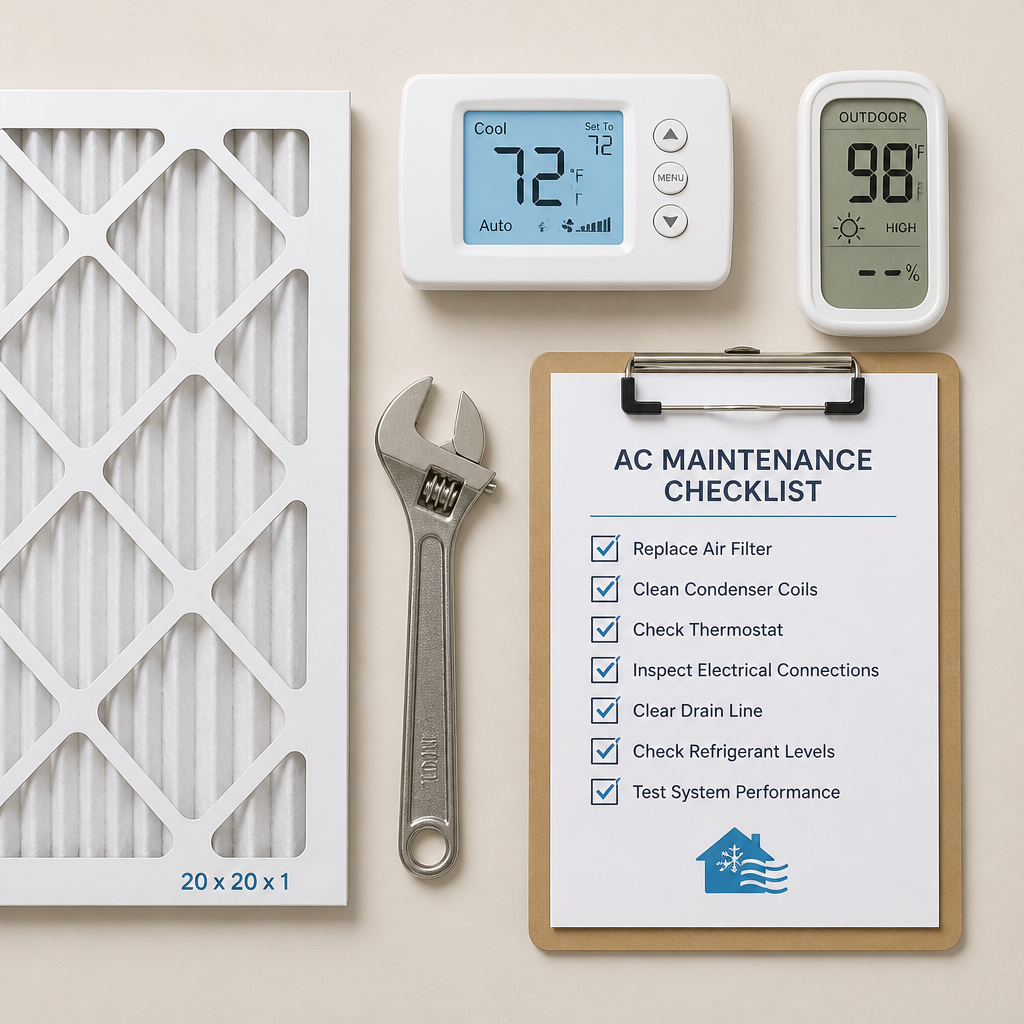
A preventive HVAC service Mesa AZ visit from Brewer's includes a full inspection of refrigerant levels, electrical components including capacitor and contactor, coil condition, blower motor operation, thermostat calibration, condensate drain, filter condition, and overall system performance metrics. The pricing is flat-rate and disclosed upfront, which means you know the cost before the technician starts work, not after.
A common objection is that the system seems to be working fine, so why spend money now. The honest answer is that Arizona AC systems fail most often after sustained stress, not during it. The compressor that ran hard all summer without a refrigerant check, with a weak capacitor, and through clogged coils is statistically much more likely to fail in the next 60 days than one that received attention in August. The preventive visit is not about fixing what is broken. It is about finding what is about to break while the repair is still manageable.
Brewer's has served the Phoenix metro since 1982, working with leading brands including Trane and Lennox. The east valley service area, covering Chandler, Mesa, Gilbert, Tempe, and Ahwatukee, is a core part of our operation. Scheduling is straightforward at brewersac.com or by phone, and technicians arrive on time with parts to handle the most common repairs in a single visit.
Frequently Asked Questions
How often should I schedule AC maintenance in Phoenix?
At minimum, once per year in spring before peak season. For systems older than 8 years or for homeowners with high indoor air quality needs, twice per year is the better standard: once in March or April and once in late summer, ideally in August. Arizona's climate is harder on HVAC equipment than nearly any other region in the country, and annual service intervals reflect climate averages that do not apply here.
What does an HVAC tune-up in Chandler or Mesa actually include?
A reputable tune-up, like the ones Brewer's performs across Chandler, Mesa, Gilbert, and Tempe, includes inspection and testing of the compressor, capacitor, contactor, refrigerant levels and pressures, coil condition (both evaporator and condenser), condensate drain, thermostat calibration, filter condition, and overall airflow. You should receive a written record of what was found and what was done. If a technician cannot tell you specifically what they checked, that is a red flag.
Is it worth fixing an older AC unit in August, or should I replace it?
The answer depends on the repair cost relative to replacement cost, not on the age alone. A widely used guideline is the 5,000 rule: multiply the unit's age in years by the repair cost. If that number exceeds 5,000, replacement is worth evaluating seriously. For example, a 12-year-old unit needing a 500-dollar repair scores 6,000, which points toward considering replacement. But a 10-year-old unit needing a 200-dollar capacitor replacement scores 2,000, which clearly justifies repair. A Brewer's technician can walk you through this calculation honestly during a service visit.
Can monsoon storms damage my AC system?
Yes, in several direct ways. High winds push fine debris into condenser coil fins, reducing efficiency. Lightning-related power surges can damage compressor motors and control boards. A quality whole-home surge protector installed at the electrical panel protects HVAC equipment from surge damage and is a worthwhile investment in Arizona. After any major dust storm, inspect your outdoor unit for debris accumulation and clear anything blocking the condenser coil intake areas.
Why does my AC run constantly in August but the house never feels cool enough?
Continuous running without reaching setpoint temperature in August points to one or more of these causes: low refrigerant due to a leak, dirty evaporator or condenser coils, a failing compressor operating below capacity, significant duct leakage into a hot attic, or a system that was undersized for the home's heat load to begin with. Each of these requires a different diagnostic approach. A technician using calibrated gauges and a temperature differential measurement across the evaporator coil can identify the actual cause rather than guessing.
What is the condensate drain and why does it matter in monsoon season?
The condensate drain removes liquid water that forms on the evaporator coil as it removes humidity from indoor air. During monsoon season, indoor humidity spikes cause the coil to collect significantly more water than during dry periods. If the drain line is slow or clogged with algae, water backs up into the drain pan and eventually shuts the system down via a float switch, or worse, overflows and causes water damage to ceilings and walls around the air handler. Monthly flushing with diluted bleach during June through September is a two-minute task that prevents a genuinely costly problem.
Have you completed any of these steps already this summer, or are you working through the checklist for the first time? Let us know in the comments what your experience has been with late-season AC maintenance in Arizona.
References
- U.S. Department of Energy official resource on home energy efficiency, HVAC systems, and duct performance standards
- U.S. Environmental Protection Agency guidance on indoor air quality, refrigerant regulations, and EPA Section 608 certification requirements
- ASHRAE technical standards and guidelines for HVAC system maintenance, efficiency ratings, and residential ventilation
- ENERGY STAR program data on HVAC equipment efficiency ratings, qualified products, and home energy savings benchmarks
- Forbes reporting on home maintenance costs, HVAC repair versus replacement financial analysis, and homeowner service spending trends
About the Author
Mark Ybarra
Mark Ybarra is the owner and leader of Brewer's Air Conditioning & Heating, a trusted HVAC company serving Tempe, Phoenix, Scottsdale, Mesa, and surrounding Arizona communities since 1982. After working in multiple roles within the company, Mark officially took ownership in 2018 and continues to uphold Brewer's long-standing commitment to integrity, exceptional service, and customer satisfaction.
Need HVAC Help?
Serving Phoenix, Tempe, Scottsdale, Mesa & surrounding areas since 1982.