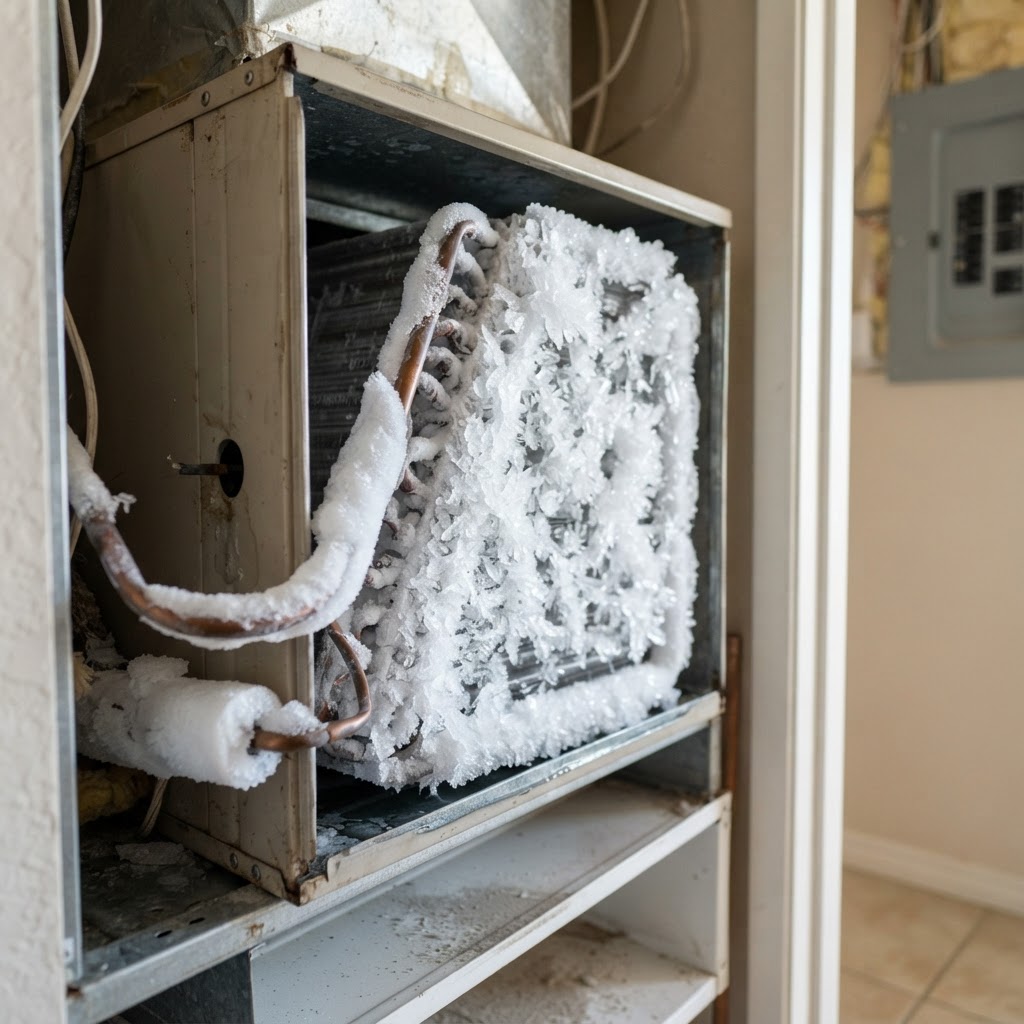
Your air conditioner is running flat-out in 115-degree Phoenix heat, and suddenly you notice ice forming on the unit. It sounds impossible in Arizona's brutal summer, but AC freezing up in Phoenix is one of the most common service calls Brewer's Air Conditioning and Heating responds to every June through August. The cruel irony is that a frozen AC coil causes your system to blow warm air right when you need cold air most. Understanding exactly why this happens, and what to do about it, can mean the difference between a quick fix and a full compressor replacement.
Quick Takeaways
| Key Insight | Explanation |
|---|---|
| A dirty air filter is the number one cause | Restricted airflow drops coil temperature below 32°F even when outdoor temps are above 110°F |
| Low refrigerant causes freezing, not just warm air | Refrigerant leaks reduce pressure in the evaporator coil, causing it to supercool and ice over |
| Turn the system to fan-only mode first | Running the fan without cooling melts the ice safely without damaging the compressor |
| A frozen AC can destroy your compressor | Running a frozen system forces liquid refrigerant into the compressor, causing catastrophic failure that costs $1,500 or more to replace |
| Thaw time is typically 1 to 24 hours | Depending on ice thickness, you may wait up to a full day before the system can be safely restarted |
| Refrigerant recharge is not a DIY job in Arizona | EPA Section 608 certification is required to handle refrigerants, and improper handling can result in fines |
| Preventive maintenance every spring cuts freeze risk sharply | Annual coil cleaning and refrigerant checks prevent most freeze events before summer peak demand begins |
Why AC Units Freeze in Phoenix Heat
Most homeowners assume that an AC unit can only freeze in cold weather. The physics say otherwise. Freezing happens inside the evaporator coil, which operates at a much lower temperature than the air around it. When something interrupts the heat exchange process, the coil drops below 32°F and moisture in the air condenses and freezes solid right on the coil surface.
In Phoenix and the east valley communities of Tempe, Mesa, Chandler, and Gilbert, this problem is actually more common in summer because systems run continuously for 16 to 20 hours a day. That sustained runtime under abnormal operating conditions accelerates every underlying problem. A marginal refrigerant level that might go unnoticed in a mild climate becomes a freeze event after four straight hours of Phoenix afternoon heat.
The evaporator coil needs two things to stay above freezing: adequate airflow moving heat across the coil surface, and sufficient refrigerant pressure. Remove either one and you have ice on your coil within a few hours.
Top Causes of a Frozen AC Coil in Arizona
Clogged or Dirty Air Filter
This is the cause Brewer's technicians find most often on frozen AC calls in the Phoenix metro. A filter clogged with Arizona dust, pet dander, and debris blocks warm air from reaching the evaporator coil. Without that warm air supply, the coil temperature plummets. The fix takes less than five minutes and costs under five dollars, but the resulting freeze can sideline your system for 24 hours.
In practice, Phoenix homes need filter changes every 30 to 45 days during summer, not every 90 days as most packaging suggests. Arizona dust loads are significantly higher than national averages, and high-MERV filters trap more debris but also restrict airflow faster.
Pro tip: Check your filter before calling for service. If it looks gray and packed with debris, replace it, switch your thermostat to fan-only mode, and let the system thaw for several hours before restarting in cooling mode. This single step resolves a meaningful percentage of freeze calls without requiring a truck roll.
Low Refrigerant from a Leak
When your system is low on refrigerant, the pressure inside the evaporator coil drops. Lower pressure means lower boiling point, which means the refrigerant absorbs heat at a much colder temperature than designed. The coil drops below freezing and ice forms quickly.
Refrigerant does not evaporate on its own. If your system is low, there is a leak somewhere in the refrigerant circuit. Simply recharging the system without locating and repairing the leak is a temporary patch that will result in another freeze event within weeks or months. A thorough leak detection and repair is the only correct fix.
Blocked or Closed Supply Vents
Closing vents in unused rooms feels like a logical way to save energy. It is not. Modern forced-air HVAC systems are designed for specific static pressure ranges. Closing vents raises system pressure, reduces airflow across the evaporator coil, and can trigger a freeze. Brewer's technicians commonly find frozen coils in homes where homeowners have closed vents in multiple rooms to try to redirect airflow.
Dirty Evaporator Coil
Even with a clean filter, evaporator coils accumulate a thin film of dust and biological matter over time. That film acts as insulation, blocking heat transfer and causing the coil surface to run colder than designed. Annual coil cleaning, part of a standard Brewer's maintenance visit, prevents this buildup from reaching the point of causing a freeze.
Faulty Blower Motor or Fan
If the blower motor is failing or running below its rated speed, airflow across the evaporator coil drops even with a clean filter and open vents. This is a mechanical failure that requires a technician to diagnose. Signs include a motor that sounds labored, sluggish startup, or airflow that feels weaker than usual from your supply registers.
Signs Your AC Is Freezing Up Right Now
Catching a freeze early can save your compressor. The problem is that most of the visible ice forms on the indoor air handler, inside the cabinet or on the refrigerant lines, where you cannot see it without opening the unit. What you can observe from the outside tells you what you need to know.
The clearest indicator is warm air blowing from your supply vents while the system is running. This happens because the ice layer over the evaporator coil prevents heat exchange entirely. Your system is running but accomplishing nothing. You may also notice ice on the copper refrigerant line running from your indoor air handler to the outdoor condenser, which is visible without opening any cabinets. Water pooling around the base of your indoor unit is another tell, usually caused by ice melting and overwhelming the drain pan.
Some homeowners also notice a musty or unusual smell when the ice begins to melt, as the standing water in the drain pan can grow mold within 24 to 48 hours in Arizona's summer heat.
"The evaporator coil operates at around 40°F under normal conditions. Any restriction in airflow or drop in refrigerant pressure can push that temperature below 32°F within minutes under Phoenix summer load conditions." - U.S. Department of Energy, Office of Energy Efficiency and Renewable Energy
Immediate Steps to Take When Your AC Freezes
The worst thing you can do with a frozen AC is keep running it in cooling mode. Doing so risks sending liquid refrigerant into the compressor, a condition called liquid slugging that can destroy the compressor within minutes. A compressor replacement on a residential system in Phoenix typically runs between $1,200 and $2,500 depending on the unit size and refrigerant type.
Here is the correct sequence of actions:
Step 1: Switch your thermostat from cooling mode to fan-only mode. Do not turn the system off entirely. Running the fan circulates warm air across the frozen coil and speeds the thawing process significantly compared to letting the system sit idle.
Step 2: Check your air filter. If it is dirty, replace it immediately. This removes the most common cause before the technician arrives and may resolve the issue entirely after the system thaws.
Step 3: Place towels around the base of your indoor air handler to catch meltwater. A full freeze can release several gallons of water as the ice melts, which can damage flooring, drywall, and cabinetry in the mechanical closet or utility room.
Step 4: Wait for the ice to fully melt before restarting in cooling mode. This takes anywhere from one to 24 hours depending on how much ice accumulated. Attempting to restart too early will re-freeze the coil quickly and may not give you enough time to identify the underlying cause.
Step 5: If the system freezes again after restarting with a clean filter, call Brewer's Air Conditioning and Heating. Repeat freezing almost always indicates a refrigerant leak or mechanical issue that requires professional diagnosis.
Pro tip: Place a bucket under the condensate drain line outside your home during the thaw. If water drips slowly rather than freely, your condensate drain may also be clogged, which is a separate problem that can cause its own water damage and should be cleared at the same time.
When to Call a Professional HVAC Technician
Some freeze situations are self-correctable. Others require a licensed HVAC technician immediately. Call a professional when any of the following apply.
The system refreezes within a few hours of restarting with a clean filter. This pattern points to low refrigerant, which you cannot diagnose or fix without gauges and EPA certification. You notice oil stains on or around the refrigerant lines near the air handler or outdoor condenser. Oil stains often indicate a refrigerant leak at a fitting or in the coil itself.
The blower fan sounds different than normal, louder, slower, or makes a rattling or grinding noise. These are signs of a failing motor that will not resolve on its own. You see visible ice on the outdoor condenser unit rather than just on the indoor refrigerant lines. Ice on the outdoor unit in summer points to a more severe system malfunction.
Brewer's Air Conditioning and Heating has served central Arizona since 1982 and uses flat-rate pricing, so you know the cost of the repair before any work begins. That transparency matters when you are dealing with a system failure in triple-digit heat and need to make quick decisions about repair versus replacement.
DIY vs. Professional Repair: What Actually Works
Not every freeze situation requires a service call, but homeowners consistently overestimate what they can safely handle and underestimate the damage risk of getting it wrong. The table below lays out what is appropriate to handle yourself and what requires a licensed technician in Arizona.
| Problem | DIY Appropriate | Requires Licensed Technician |
|---|---|---|
| Clogged air filter causing freeze | Yes. Replace filter, switch to fan-only, allow thaw, restart. | Only if system refreezes after filter change. |
| Closed or blocked supply vents | Yes. Open all vents, remove furniture or debris blocking registers. | If airflow still feels weak after opening vents, blower may be failing. |
| Low refrigerant or leak | No. EPA Section 608 certification required. DIY refrigerant handling is illegal and dangerous. | Yes. Leak detection, repair, and recharge require certified technician and proper equipment. |
| Dirty evaporator coil | Light surface cleaning possible with coil cleaner spray if accessible, but risky without training. | Yes. Full coil cleaning during annual maintenance is more thorough and avoids coil damage. |
| Failing blower motor | No. Motor replacement involves electrical work and refrigerant-adjacent components. | Yes. Motor diagnosis and replacement require proper tools and system knowledge. |
Preventing AC Ice Buildup in Phoenix Summers
Prevention in Arizona's climate comes down to three consistent habits. Miss any one of them and you increase your risk of a summer freeze event significantly.
Schedule Annual Spring Maintenance Before June
A pre-season tune-up in April or May accomplishes several things that directly prevent freezing. Technicians check refrigerant pressure and look for slow leaks before they become a problem. They clean the evaporator and condenser coils. They test the blower motor and measure actual airflow output. A system that passes a proper spring inspection has a dramatically lower chance of freezing during peak summer load. Brewer's spring maintenance visits cover all of these checks in a single appointment.
Change Filters Every 30 Days During Summer
In Phoenix, the standard 90-day filter replacement schedule is simply wrong for summer operation. Dust storms, high pollen counts, and the system running nearly continuously throughout July and August load filters fast. Set a calendar reminder for the first of every month from May through September and replace the filter on that date regardless of whether it looks dirty. The cost of a filter is negligible compared to a freeze event.
Keep All Supply and Return Vents Clear
Walk through your home and verify that no furniture, rugs, or storage is blocking supply or return vents. Pay particular attention to return air vents, which are often in hallways or utility areas where items accumulate. A blocked return air vent has the same effect on your system as a clogged filter: restricted airflow that invites a freeze.
Homeowners in Ahwatukee, Chandler, and Gilbert who take these three steps consistently rarely experience repeat freeze events. Those who skip spring maintenance and stretch filter changes to 90 days or longer are the ones calling for emergency service in the middle of a July heat wave.
Frequently Asked Questions
Can my AC really freeze in Phoenix when it's 110 degrees outside?
Yes, absolutely. Freezing happens inside the evaporator coil, not in response to outdoor temperature. When airflow is restricted or refrigerant pressure drops, the coil surface falls below 32°F regardless of outdoor conditions. In fact, Phoenix's extreme summer heat makes freezing more likely because systems run longer and harder, which accelerates any underlying problem.
How long does it take for a frozen AC coil to thaw?
Thaw time depends on how much ice accumulated before you caught the problem. Light ice buildup may thaw in one to three hours with the fan running on fan-only mode. A severe freeze with ice packed around the entire coil can take 12 to 24 hours to fully clear. Do not restart the system in cooling mode until all visible ice is gone and you can feel strong airflow from your supply vents.
Is it safe to chip the ice off my AC coil to speed up the thaw?
No. Chipping ice from an evaporator coil risks puncturing or bending the aluminum fins and copper tubing, which can create a refrigerant leak or permanently damage the coil. The only safe way to accelerate thawing is to run the fan on fan-only mode. Do not use heat guns, hair dryers, or ice picks on or near the coil.
How much does it cost to fix a frozen AC in Phoenix?
If the cause is a clogged filter, your cost is just the price of a new filter, typically under ten dollars. If the issue is a refrigerant leak, expect to pay for leak detection, the repair itself, and a refrigerant recharge. Total costs for a refrigerant leak repair in the Phoenix area typically range from $300 to $700 or more depending on leak location and refrigerant type. A failing blower motor replacement generally runs $400 to $800. Brewer's uses flat-rate pricing so you get the exact cost upfront before any work begins.
My AC keeps freezing even after I replaced the filter. What now?
Repeat freezing after a filter change almost always indicates a refrigerant leak or a failing blower motor. These require professional diagnosis with manifold gauges and electrical testing equipment. Do not continue running the system in cooling mode through repeated freeze-thaw cycles, as each cycle stresses the compressor. Call a licensed technician to identify the root cause before running the system again.
Does a frozen AC coil mean I need a new system?
Not automatically. Most freeze events are caused by problems that are repairable without replacing the entire system. A refrigerant leak in the coil itself can sometimes require coil replacement, which is expensive but still less costly than a full system replacement. The exception is when repeated freeze events have damaged the compressor. Once a compressor fails, replacement or full system upgrade becomes the more cost-effective path, particularly on systems older than 10 to 12 years.
How often should I have my AC serviced in Arizona to prevent freezing?
Once per year is the minimum, timed in April or early May before peak summer demand. Arizona's climate puts significantly more strain on HVAC systems than most of the country, with systems running for more annual hours than virtually anywhere else in the United States. Some commercial properties and homes with older systems benefit from a second inspection mid-season in July. Annual maintenance by a qualified technician, like those at Brewer's Air Conditioning and Heating, directly prevents the coil contamination and refrigerant issues that cause most freeze events.
Have you dealt with a frozen AC in your Phoenix or east valley home this summer? Share what caused the problem and how it was resolved in the comments below.
References
- U.S. Department of Energy official site covering HVAC efficiency, refrigerant regulations, and home cooling guidance
- U.S. Environmental Protection Agency site with information on EPA Section 608 refrigerant handling certification requirements
- ASHRAE official site with technical standards for HVAC system design, airflow requirements, and refrigerant safety protocols
- ENERGY STAR program site with guidance on proper AC maintenance schedules and efficiency standards for residential cooling systems
- Forbes coverage of home HVAC repair costs, maintenance spending trends, and homeowner advice on air conditioning systems
About the Author
Mark Ybarra
Mark Ybarra is the owner and leader of Brewer's Air Conditioning & Heating, a trusted HVAC company serving Tempe, Phoenix, Scottsdale, Mesa, and surrounding Arizona communities since 1982. After working in multiple roles within the company, Mark officially took ownership in 2018 and continues to uphold Brewer's long-standing commitment to integrity, exceptional service, and customer satisfaction.
Need HVAC Help?
Serving Phoenix, Tempe, Scottsdale, Mesa & surrounding areas since 1982.